
BJJ Belt Promotions: 5 Criteria Coaches Can Track
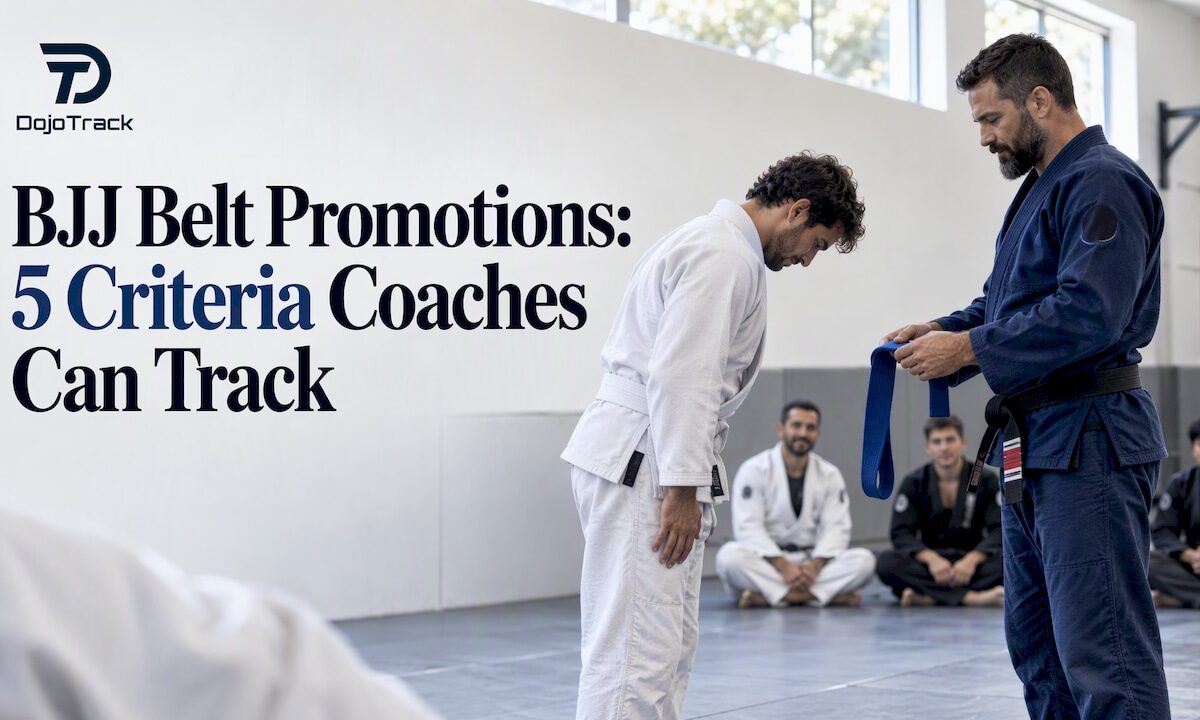
Most coaches promote based on technical skill you can apply against a resisting partner, steady mat time, and their own judgment of how those fit together. No universal test or mandatory calendar exists. Belt promotion criteria differ from gym to gym, and the instructor’s discretion carries the most weight. Your job is to make that judgment easy to reach.
TL;DR:
- Prioritize repeatable success against resisting partners of similar size and experience; track escapes, recurring mistakes, completed submissions, and how you adjust strategy mid round.
- Treat attendance as supporting evidence, not a deadline; prior grappling experience, training intensity, age, injuries, and each coach’s standards can change promotion timing.
- Competition can strengthen a borderline case by showing composure under pressure, but many academies do not require it, and daily rolling can demonstrate readiness.
- Ask your coach which skills remain before your next belt, then bring attendance records, recent sparring clips, and one unresolved problem to discuss.
Table of Contents
- What are the core belt promotion criteria instructors use?
- What should you expect at each belt level?
- How do coaches turn judgment into measurable indicators?
- How long does it take to get promoted?
- Does competition affect belt promotion?
- What do stripes mean?
- How do coaches track progress?
- What are typical curriculum requirements per belt?
- What do standardized testing formats look like?
- What mindset and attitude do coaches expect?
- How much do fitness and conditioning matter?
- What challenges come up during promotion testing, and how do you handle them?
- How do promotion criteria vary between martial arts?
- What does patience have to do with belts?
- How can studios run fair, evidence-based promotions?
- FAQ
- Sources
What are the core belt promotion criteria instructors use?
Think of promotion as a weighted conversation between several kinds of evidence. No single input wins every time, but some carry more than others. Experienced instructors argue that well-rounded technical proficiency performed under the stress of sparring is the top indicator coaches look for, and that merit, not time served, should guide the decision.
Here is how the main inputs break down:
- Technical knowledge: The range of techniques you know and how well you understand positions. A broad toolkit matters because it lets you perform reliably in more than one scenario, not just in your favorite position.
- Performance under pressure: Whether your skills survive live rolling against partners who resist. This is often the deciding factor, because drilling a move with a cooperative partner proves very little.
- Consistency and mat time: Regular attendance builds the repetition that makes technique automatic. Mat time supports a promotion case, but it never replaces skill.
- Attitude and team contribution: How you treat training partners, whether you help newer students, and how you carry yourself in class.
- Instructor judgment: The coach’s overall read, which reconciles all of the above.
That last point deserves a plain explanation. Judgment is subjective by nature, but it is not random. A good coach has watched you roll for months or years, remembers which problems you solved and which you keep repeating, and knows how you compare with others at your level. The sections below turn that judgment into factors you can observe and track.
Pro Tip: Ask your coach once, directly, “What would you like to see from me before the next belt?” A specific answer beats months of guessing.
What should you expect at each belt level?
Every academy sets its own bar, so treat these as common benchmarks rather than rules. They describe what instructors usually want to see before moving a student up.
- White belt: Survival and awareness. You can escape bad positions like mount and side control, understand basic positional hierarchy, and stay calm when someone is on top of you. Winning is not the goal here. Staying composed and learning why positions work is.
- Blue belt: Dependability. You retain and recover guard, pass at least a few ways, and own several submissions. Coaches also want to see you chain techniques, so that when one attack fails, you flow into the next instead of stalling.
- Purple belt: Breadth and consistency. Your game covers more areas and holds up against more types of opponents. Many instructors expect early teaching ability at this stage, such as explaining a technique clearly to a newer student.
- Brown belt: Refinement. Timing, patience and control define this rank. You set the pace of a round instead of reacting to it, and your fundamentals show up cleanly even against strong opponents.
- Black belt: Depth and leadership. Your technical understanding is deep, your performance is consistent, and you can guide others. Black belt is less a finish line than an indication that the coach trusts you to represent the school’s jiu-jitsu.
Notice what these benchmarks have in common. Each one describes what you can do on the mat, not how long you have been around. When you plan your next stretch of training, pick the one or two gaps in your current belt’s description and work on them deliberately. If you struggle to pass a resisting guard, spend rolling rounds starting from the guard pass. If you stall when a submission attempt fails, drill follow-up options until they flow.
Instructors also keep an eye on how you handle the transition between belts. A new blue belt who still survives mostly through scrambling may get more time than one who shows early structure and a plan. That is not punishment. It is the coach protecting you from being outmatched at a rank where partners expect more.
How do coaches turn judgment into measurable indicators?
Instructors rarely use a checklist, but they do notice patterns. When you understand which patterns count, you can build them on purpose. The most commonly cited indicators are:
- Repeatable success against resisting partners. You land several different techniques on people of similar size and experience, not just on newer students.
- Fewer repeated mistakes. The error that used to cost you rounds shows up less often. Coaches notice when a student actually fixes problems.
- Reliable escapes and conversions. You get out of bad positions and turn them into neutral or dominant ones. Being able to recover from trouble is an observable skill that coaches value highly.
- Visible growth in rolling strategy. You start rounds with a plan, adjust mid-round, and finish with intent instead of reacting to what happens.
- Documented attendance and drilling. Logs of your training back up what the coach already sees. They show commitment, but they work as supporting evidence, not proof of skill.
Competition results can corroborate these signs, though they should not be the only proof. A medal shows you performed under stress. It does not show you can teach, help a team, or maintain the technical standards the coach cares about.
The standard coaches reach for: Well-rounded technical proficiency and an ability to perform that under the stress of sparring is the number one indicator coaches look for, according to the Saulo Ribeiro and John Danaher discussion on promotion philosophy.
If you want to self-assess honestly, review your recent rolling. Count how often you escaped, how often you were stuck in the same position, and which techniques you actually finished. That quick audit tells you more about readiness than a calendar does.
How long does it take to get promoted?
Timelines vary widely, and many seasoned coaches reject a rigid calendar altogether. Students with similar training schedules can end up at different ranks, because the gap in skill, experience and intensity is real.
Several factors legitimately change the picture:
- Prior grappling experience: A former wrestler or judoka may show blue belt skill very early, especially in positional control and takedowns. A coach may promote faster if performance supports it.
- Concentrated instruction: Frequent private lessons and high-volume training can speed development, as long as the skill shows up in live rolling.
- Age and physical condition: Students of different ages do not roll the same way. Fair coaches adjust expectations about athleticism while still looking for sound technique and smart problem-solving.
- Training intensity: Showing up twice a week and drilling with purpose can outperform showing up five times and coasting through rounds.
- Injuries and breaks: Time off for injury or life reasons slows progress, and thoughtful coaches factor it in.
The strongest argument against time-only policies comes from experienced instructors themselves. A schedule based on dates or attendance is, in their words, the worst way to gauge development, because jiu-jitsu is more complex than a calendar can capture. A student who hits a date without the skills gets promoted into a level they cannot handle. A student who has the skills but misses the date gets held back and may quit.
So use time as a loose reference, never a target. If you are comparing yourself with a friend at another academy, you are comparing two different coaches’ standards, and that tells you very little.
Does competition affect belt promotion?
Competition is strong supporting evidence, but few academies require it. A tournament shows that your skills hold when an opponent is trying their hardest, the clock is running, and nerves are high. Coaches value that composure, and a solid competition record can tip a borderline decision.
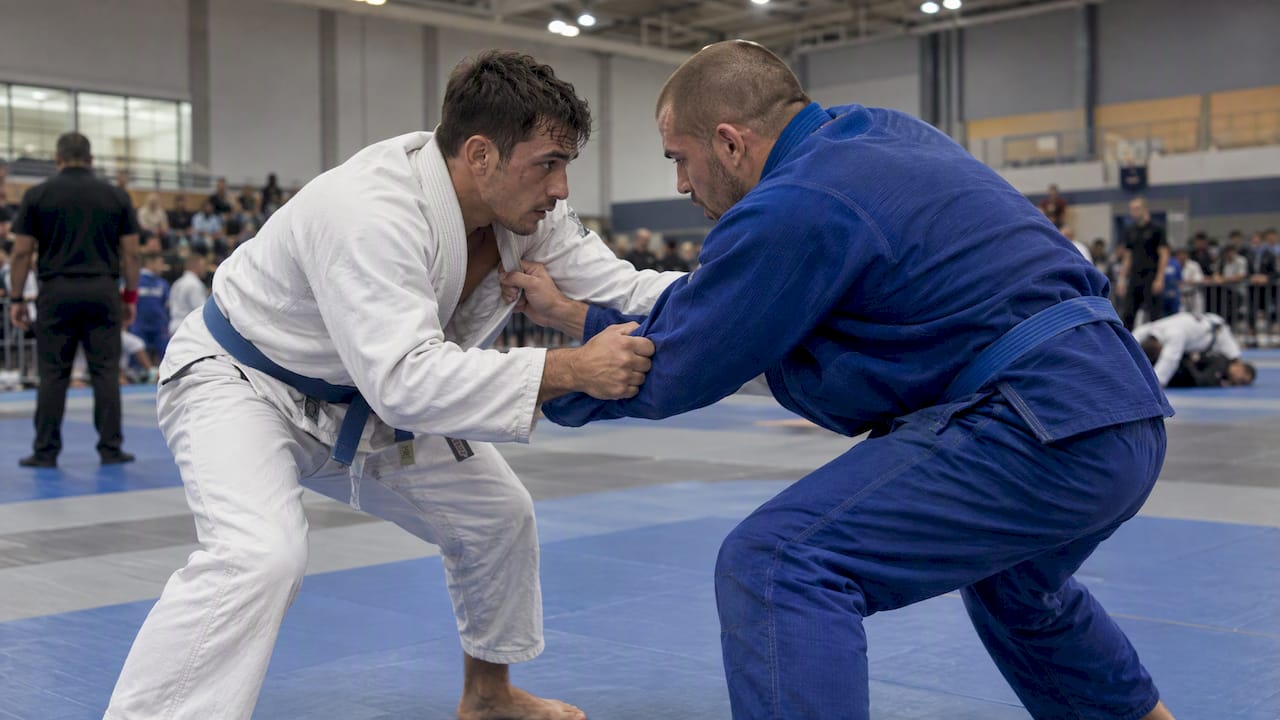
Still, it is not universally required. Plenty of excellent practitioners never compete, and their coaches judge readiness through daily rolling instead. What matters is that your performance under pressure is visible somewhere, whether on the mat at open mats or on a tournament bracket.
A few cases sit at the edges of this rule:
- Intensive coaching can speed things up. One widely discussed example involved a reported 3,000 hours of intensive private instruction before a fast black belt promotion, which Mikey Musumeci defended amid debate about its legitimacy. Concentrated hours and strong results can validate readiness, but they do not remove instructor scrutiny.
- Skepticism follows non-performance motives. When a promotion looks tied to marketing, money or friendship, the community notices, and the rank loses credibility.
- Results work best as a story. If you want to use competition to support your case, bring context: who you faced, how you won or lost, and what you learned. A bare medal count says less than a clear account of how you solved problems.
If you do compete, treat it as feedback. A loss that exposes a hole in your guard retention is more useful to your coach than a win against a weak bracket.
What do stripes mean?
Stripes are small, incremental markers on the belt that signal progress inside a rank without changing the rank itself. Think of them as checkpoints rather than rewards.
What stripes typically recognize:
- Technical milestones: You have shown a new level of control, such as finally passing a tough guard or hitting a submission in live rolling.
- Consistency: Steady attendance over a stretch of months.
- Contribution: Helping with warm-ups, assisting newer students or supporting the academy.
- Motivation: Many coaches use stripes to keep students engaged during the long middle of a belt.
Stripes vary between schools. Some give them on a fixed schedule, some only when a coach feels the student has earned one, and some skip them completely. Informal promotions can also happen quietly, with a coach telling you privately that you are ready before a ceremony.
Coaches often use stripe progress as part of a promotion narrative. A student with stripes who has shown consistent skill in live rolling and positive team behavior has built a clear story: steady growth with no obvious gaps. The belt then becomes a natural next step rather than a surprise.
How do coaches track progress?
Most instructors rely on a mix of memory and light documentation. Common methods include:
- Coach notes: Short records of what a student is working on, strengths, and recurring mistakes.
- Video review: Clips of rolling used to point out patterns the coach saw live.
- Occasional formal testing: A technique review or a set of live rounds before a promotion.
- Ongoing observation: Daily rolling, which remains the main source of judgment.
You can help the process by keeping your own records. Useful items to log include attendance, drilling sessions, sparring clips, competition results, and the specific problems you have been working on. Centralized tracking, whether a spreadsheet or studio software, turns a vague “I think I’m ready” into a concrete conversation backed by evidence.
Pro Tip: Prepare a one-page promotion summary: attendance totals, three techniques you’ve improved, two recent clips, and one problem you’re still fixing. Hand it over before asking, not during class.
What are typical curriculum requirements per belt?
Curriculum requirements are the structured side of promotion: a list of techniques and concepts a school expects you to know at each rank. They differ by academy, so ask your coach for your school’s list rather than assuming.
In general, curricula build in layers:
- White belt: Core escapes, basic submissions from dominant positions, guard fundamentals and safe movement.
- Blue belt: Expanded guard passing, a broader submission set, sweeps and the first connections between positions.
- Purple belt: Deeper systems, such as a full guard game or top game, plus transitions and counters.
- Brown and black belt: Advanced details, refined timing and the ability to explain principles, not just moves.
A written curriculum has one clear advantage: it removes mystery. You know what to study, and your coach has a shared reference for feedback. The weakness is that knowing a technique on paper is different from using it on a resisting partner. That is why the best academies pair curriculum review with live rolling instead of treating the list as a checkbox.
If your school has no written curriculum, you can still build one with your coach. Write down the techniques covered over a month, mark the ones you can do in live rounds, and highlight the rest as study priorities.
What do standardized testing formats look like?
Some academies and federations use formal assessment, though many promote without any test at all. Where tests exist, they usually combine a few familiar parts:
- Technique demonstration: You perform a set of required moves with a partner, showing correct detail and flow.
- Live sparring rounds: Several rounds against different partners, sometimes with starting positions set by the coach.
- Written or verbal review: Occasionally a short quiz on concepts, terminology or rules.
- Coach evaluation: A final conversation or scoring sheet that ties it together.
Assessment criteria tend to focus on accuracy, composure, adaptability and effort. Coaches notice whether you stay technical when tired, whether you recover from mistakes, and whether you respect your partners.
Testing has real benefits. It sets a clear moment, gives students a goal and creates a shared standard inside the academy. Its limit is that a single day can misrepresent months of training, so thoughtful coaches weigh test performance alongside everything else they have seen. There is no single national standard in jiu-jitsu, so a test at one school may look very different from a test at another.
What mindset and attitude do coaches expect?
Attitude often explains why two students with similar skill get different outcomes. Coaches want people they can trust with a higher rank, because a belt represents the school.
Qualities that tend to help a promotion case:
- Coachability: You listen, apply feedback and do not argue about every correction.
- Humility: You tap early, learn from losses and credit your partners.
- Respect and safety: You control your sparring intensity, protect partners and avoid injuring people to win a round.
- Generosity: You help newer students, welcome visitors and pitch in around the gym.
- Patience: You do not pester your coach about belts or compare yourself constantly with others.
Experienced instructors say it plainly: if you are preoccupied with the speed of your promotions, you lose yourself. A better question than “when is my next belt?” is “do I feel like a blue, purple or brown belt?” Your skills should feel real to you before anyone ties a new belt around your waist.
A good attitude will not replace skill, but a poor one can delay a promotion even when the skill is there.
How much do fitness and conditioning matter?
Physical fitness supports promotion indirectly. No academy hands out belts for a fast mile or a big deadlift, but conditioning shapes how well your technique holds up late in a round and how safely you can train.
Here is how it shows up in a coach’s evaluation:
- Technique under fatigue: A student who stays sound when tired demonstrates real skill, not just early-round energy.
- Consistency: Good conditioning means fewer missed weeks from injury or burnout, which builds the mat time that supports promotion.
- Pace control: Higher belts are expected to manage energy, rest in good positions and use efficient movement instead of constant explosion.
- Durability: Strength, mobility and recovery habits reduce injury risk and keep you training.
Fitness expectations should be fair. A coach should judge an older student by the quality of their technique and decision-making, not by how they match a younger student’s cardio. Smart training habits, such as warming up, sleeping well and building strength outside class, help at any age, and they show your coach you take the long view.
What challenges come up during promotion testing, and how do you handle them?
Even well-prepared students struggle when a promotion is on the line. The common problems are predictable, and so are the fixes.
- Nerves: Anxiety makes you rush and forget basics. Practice under mild pressure beforehand, such as rolling with a coach watching, and focus on your breathing and first movements.
- Fatigue in back-to-back rounds: Prepare by training extra rounds with short rest, and pace your effort instead of sprinting early.
- Unfamiliar partners: Different body types expose weaknesses. Roll with a wide mix of people in the weeks beforehand.
- Forgetting techniques: Review your curriculum, but anchor memory in positions and principles, not isolated moves.
- Comparing yourself with others: Someone else’s test is not your test. Concentrate on your own preparation.
- Overthinking the outcome: Treat the test as a normal training day with an audience. Your coach already knows your level.
Most importantly, ask for feedback afterward whether or not you pass. A coach’s notes on what to improve are worth more than the belt itself, and they give you a clear plan for the next stretch.
How do promotion criteria vary between martial arts?
Brazilian jiu-jitsu is unusually flexible about promotions compared with many other arts. Taekwondo and karate, for example, commonly use formal grading events with set curricula, forms and board-breaking or sparring components, and belts are awarded more frequently through a ladder of colors. Judo often combines technical knowledge with competition points or demonstrated results, depending on the federation.
BJJ tends to run on instructor discretion. Belts come less often, time spans are longer, and the promotion usually happens inside the academy without an external examiner. That structure gives coaches freedom to judge real sparring ability, but it also means standards differ more from school to school.
Here are the key contrasts:
- Frequency: Arts with many belt levels promote more often, while BJJ promotions are spaced widely.
- Format: Many striking arts use scheduled testing days, while BJJ more often relies on ongoing evaluation.
- Emphasis: Forms and technique accuracy matter heavily in some arts. In BJJ, live rolling carries the most weight.
- Governance: Some arts have strict federation rules. BJJ academies often set their own standards within their lineage.
If you cross-train, expect to learn each art’s own language of progress, and avoid judging one system by the rules of another.
What does patience have to do with belts?
My view is simple: the belt should be the quiet result of getting better, not the target. Students who chase speed tend to rush past fundamentals and end up wearing a rank their game cannot support. Students who focus on improving, helping teammates and solving problems on the mat usually get promoted at a pace that matches their skill.
Align your training with what your coach values, document progress without making it a campaign, and remember that a belt is worth only what you can do while wearing it. The calendar proves nothing. The mat does.
— DojoTrack
How can studios run fair, evidence-based promotions?
If you run a school, the hardest part of promotion is rarely deciding who is good. It is keeping a clear record so decisions feel fair to everyone. That is why we built DojoTrack to give studios the tracking they need:
- Attendance tracking so you can see mat time at a glance.
- Belt and curriculum progress so students and coaches share a clear picture of what comes next.
- Automated belt promotions that keep records tidy and reduce paperwork.
- A student mobile app where members can follow their belt curriculum progress.
You can start with our free core platform, and you can compare paid options on our pricing page. If you are ready to try it with your own students, create your studio account and see how much easier promotion conversations become.
FAQ
What are the requirements to get a black belt?
There is no single universal requirement. Most coaches look for deep technical understanding, consistent performance under pressure, long-term commitment and the ability to guide others. Standards differ between academies and lineages, so ask your own instructor what they expect.
What are the belt levels in Gracie jiu-jitsu?
Adult practitioners typically progress through white, blue, purple, brown and black belts. Individual academies may add stripes within each rank, and requirements for each level vary by school and lineage.
Do competition results decide belt promotions?
Usually not on their own. Competition is strong supporting evidence of skill and composure, but most coaches weigh it alongside daily rolling, technique, attitude and consistency. Many students are promoted without ever competing.
How long does each belt take?
It depends on the student and the academy. Prior grappling experience, training intensity, age and instructor standards all change the timeline, and many experienced coaches avoid fixed calendars for exactly that reason.