
Attendance-Based Promotions: How to Set Fair Belt Rules

An attendance-based promotion means a student must reach a set number of classes, or a set share of offered classes, before they become eligible for the next belt or stripe. Most schools use attendance as a gate, not as the whole decision. Mat time gets a student to the door, and the instructor’s judgment of skill, effort and character decides whether they walk through it. This guide shows you how to set those rules, write them down, track them without spreadsheets and use attendance forecasts without confusing a prediction with a student’s real progress.
TL;DR
- Attendance works best as a minimum requirement for eligibility. Instructor assessment of skill and character still decides the promotion.
- Pair a class count with time in rank, and publish both for every belt so students know the target.
- Count against classes offered (a percentage) or a fixed number. Pick one and apply it the same way to everyone.
- Write down how you handle excused absences, make-ups and exceptions before the first student asks.
- Forecasts of attendance help you plan classes and staffing. They never replace the actual record of what a student has done.
Table of Contents
- What attendance-based promotion really means
- How schools set class counts and time in rank
- Handling excused absences, make-ups and exceptions
- How to track attendance against promotion requirements
- Attendance forecasting: what it is and what it is good for
- Don’t confuse a forecast with a student’s progress
- Using attendance to keep students, not only to promote them
- Perspective: why we built promotion tracking around attendance
- Putting it together: a sample policy you can adapt
- Run attendance-based promotions without the spreadsheet
- FAQ
- Sources
What attendance-based promotion really means
The phrase covers a spectrum. At one end, a school promotes strictly by the numbers: show up enough times in a window and the stripe or belt arrives on the due date. At the other end, the instructor promotes when they feel a student is ready, and attendance is only one thing they notice. Students in online BJJ discussions describe both models, and plenty of academies sit somewhere in between.
The hybrid is the most defensible for a business. A published example comes from a US dojo’s attendance policy: white through purple belts must attend at least 50% of offered classes per month before testing. The same policy says membership and attendance do not guarantee promotion. That one policy contains the full pattern: a measurable threshold, a testing step and a clear statement that the threshold is necessary but not sufficient.
Gracie Barra Fullerton takes the same view in its belt system guide. It says promotions are not solely based on attendance, but you cannot earn them without showing up, and it suggests students attend at least twice a week. Notice what that does for you as an owner. It tells students that frequency matters, gives them a realistic rhythm and leaves room for you to judge improvement.
Why owners like attendance gates
- They are objective. A number is easier to defend than a feeling when a parent asks why their child was not promoted.
- They reward consistency. Students who train steadily tend to learn more, and a gate makes that expectation visible.
- They give you retention signals. When a student’s attendance drops below the pace needed for the next belt, you see it early and can reach out.
- They make planning simpler. If you know how many students are approaching eligibility, you can plan testing days and stock belts ahead of time.
Where attendance alone falls short
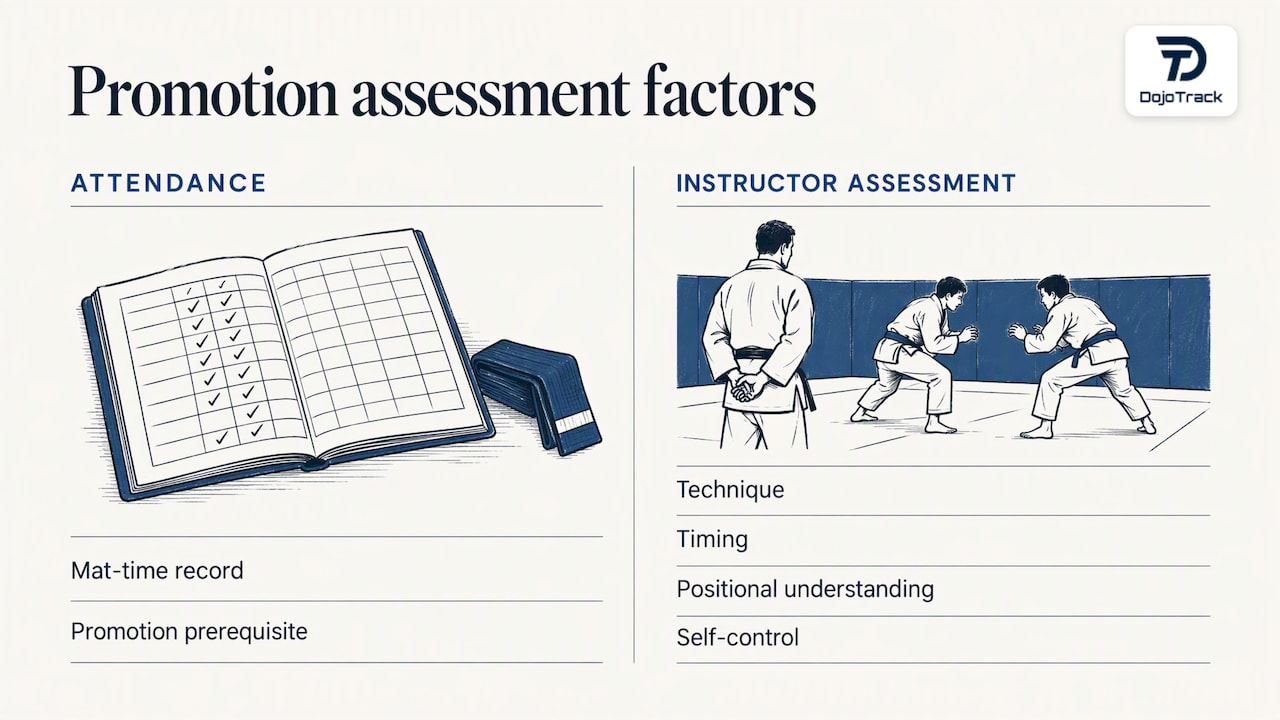
A student can attend 100 classes and spend most of them checking the clock. Another can attend slightly less and train with focus and care for partners. Optimus BJJ describes attendance as a record of mat time that supports promotion decisions, and says promotion also depends on technique, timing, positional understanding, self-control, effort, coachability and how a student treats training partners. That is why the best schools treat the number as a prerequisite and keep a human assessment on top.
How schools set class counts and time in rank
There are two levers: how long a student has held their current rank, and how many classes they have taken in that time. Using both prevents two opposite problems. Time alone lets a casual student drift upward. Class count alone lets a student binge-train for a few weeks and skip ahead without absorbing the material.
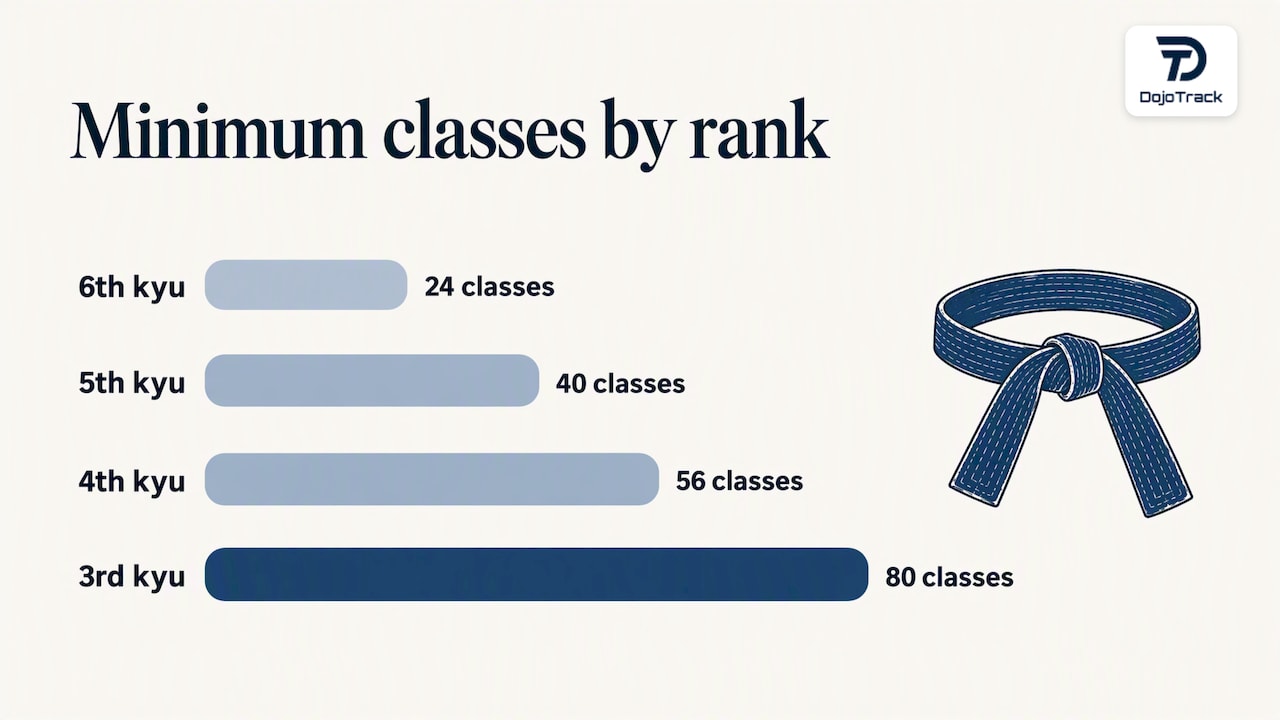
The United States Judo Association publishes a clear example in its promotion system, with rank-specific requirements that combine time in grade and classes:
| Rank | Minimum time in grade | Minimum classes |
|---|---|---|
| 6th kyu | 3 months | 24 |
| 5th kyu | 5 months | 40 |
| 4th kyu | 7 months | 56 |
| 3rd kyu | 10 months | 80 |
Two patterns are worth borrowing. First, the requirements rise at each rank, so higher belts take more time and more training. Second, the class counts are consistent with a steady weekly pace. Divide classes by months and you get roughly two classes per week at the early ranks, which is a reasonable expectation for a recreational student.
The same page says the system is meant to ensure rank reflects technical expertise, character development and overall contribution, and that candidates must meet minimum eligibility requirements, pass an exam and receive a recommendation from an instructor or Certified Rank Examiner. Attendance is the first gate in a sequence of gates.
A practical way to build your own table
- Start from your curriculum. How long does it realistically take a dedicated student to learn the material for each belt?
- Convert to classes. Multiply the months by the number of classes per week you expect, then trim a little for holidays and illness.
- Set the minimum below the ideal. The requirement is a floor. A student training at your recommended pace should clear it comfortably.
- Differentiate by program. Kids, teens and adults often train on different schedules and need different counts. Families with several children benefit from a clear explanation of each program.
- Review every year. If most students hit the count but are not ready, raise it or strengthen the skill assessment. If good students stall, lower it.
Fixed count or percentage of offered classes?
There are two common ways to express the requirement.
| Method | Example | Best for | Watch out for |
|---|---|---|---|
| Fixed class count | 40 classes before the next belt | Schools with a stable schedule | Students with fewer class options may need more time |
| Percentage of offered classes | 50% of offered classes per month | Schools whose schedule changes, or that run many programs | Needs accurate records of what you offered each month |
The percentage approach is fair when your schedule varies, for example in a month with a holiday closure. The fixed count is easier for students to understand and track themselves. Whichever you choose, say it plainly in your handbook and on your website.
Handling excused absences, make-ups and exceptions
The rule only feels fair if people know what happens when life gets in the way. The US dojo policy mentioned above allows limited discretionary waivers and additional training to make up attendance deficits. That is a useful template, because it keeps the standard intact while giving you a way to be human.
Decide these points in advance:
- What counts as a class? Regular sessions only, or also seminars, open mats and private lessons?
- Do make-up classes count? If a student attends a different time slot, does it count toward the total?
- Who can grant an exception, and how often? Name the person, cap the number and log each decision.
- What about injuries and illness? Many schools let a student keep their count in place during a documented injury and restart the clock when they return. Decide whether you want that and write it down.
- What is the appeal path? A short process for a parent or adult student to ask for a review prevents resentment.
Keep the final promotion decision separate from the raw attendance log. That separation matters because the log is a fact, and the decision is a judgment that includes exceptions.
How to track attendance against promotion requirements
You can do this with a binder and a pencil, and many schools did for decades. The trouble starts at about 50 students. Counting classes by hand at the end of every month, adjusting for holidays and remembering who had a make-up is slow and error-prone.
The general practice recommended in an official US education register guide translates well to a dojo. It calls for a system that records attendance every instructional day with the student’s present or absent status and, where policy requires, an excused or unexcused reason. At set checkpoints you calculate the applicable percentage or count, compare it with the rule, document exceptions, make-up plans and appeals, and record the final decision separately from the attendance log. A school is a different setting from a dojo, but the logic is the same: capture the raw data daily, check it at fixed points, document the exceptions.
A simple monthly routine
- Record every class. Use a sign-in kiosk, a tablet at the front desk or instructor check-in, so each student is logged at the door.
- Check at set points. Run an eligibility report on the same day each month, or before each testing cycle.
- Flag students who are close. A student 3 classes short with a month left needs a nudge, not a surprise.
- Flag students who are behind pace. These are your early retention conversations.
- Review exceptions. Log any waiver, make-up or injury hold with a reason.
- Record the promotion separately. Eligibility is a report. Promotion is a decision, and it should be recorded when you make it.
This is the work dojo software is built for. DojoTrack records attendance, tracks belt curriculum progress and supports automated belt promotions, so the eligibility report is already there when you sit down to plan a testing day. Our article on attendance tracking and dojo revenue covers how the same records feed your business numbers, and our post on digital belt promotion tracking shows what that workflow looks like day to day.
If you are still weighing what kind of tool fits a studio, a roundup of project management tools for fitness studios shows how general studio tools approach scheduling and task tracking. A martial arts school adds belt requirements, family accounts and testing cycles on top of that, which is where purpose-built software earns its place.
Attendance forecasting: what it is and what it is good for
The other question owners ask is about attendance forecasting: predicting how many students will show up to a class next week or next month. Forecasts are different from promotion tracking. One looks forward at the group, the other looks back at an individual.
The pattern is familiar to most owners. Industry guidance for martial arts schools describes seasonal swings, with spring enrollment often growing, summer attendance dropping and winter breaks slowing class engagement. You can see your own version of this in your records after a year or two.
A simple forecast needs no data science:
- Pull the last 12 months of class attendance by class and by month.
- Find the average for each class slot in each season.
- Adjust for known events: school breaks, tournaments, a new beginner program, holiday closures.
- Compare the forecast to what happens and refine it each quarter.
What can you plan with a forecast?
- Class schedule. Move or merge a Tuesday class that consistently draws four students. Add a session where the room is regularly full.
- Staffing. Schedule assistant instructors for classes you expect to be large, particularly kids’ classes.
- Testing days. Predict how many students will be eligible by a given date and book the space and judges accordingly.
- Inventory. Order belts, stripes and uniforms in the quantities your eligibility count suggests.
- Cash flow. Attendance patterns are a leading sign of who will renew, which is useful when you plan your revenue.
Academic work points the same direction. A study on predictive analytics for martial arts membership retention discusses how patterns in member data can reveal the likelihood of disengagement. It gives the example that members who attend consistently but fail to make timely payments may be at greater risk of leaving. In other words, attendance is one signal among several, and combining it with billing data gives a more reliable picture.
Don’t confuse a forecast with a student’s progress
This is where well-meaning owners get into trouble. A forecast says something about the group, or about a probability. It says nothing about what a particular student has done on the mat.
Keep these rules in place:
- Promotion uses actual attendance. Never promote or hold back a student based on how many classes the system predicts they will attend.
- A risk score is a prompt to talk, not a verdict. If a student is flagged as likely to drop out, call them. Do not change their belt timeline.
- Keep the data in separate columns. Actual classes attended, classes required, projected classes and instructor assessment should be distinct fields. When they blur, disputes follow.
- Re-check predictions against reality. If the forecast says a student will be eligible in March and they are not, the forecast was wrong, not the student.
- Tell students what you track. Transparency about the attendance record builds trust. Students should be able to see their own count.
A student-facing view helps here. When members can open an app and see their belt requirements and class progress, fewer people ask the front desk whether they are eligible yet, and students see how consistency adds up. DojoTrack’s student mobile app lets members track belt curriculum progress, view class schedules and receive push notifications.
Using attendance to keep students, not only to promote them
An attendance gate has a second job. Because it creates a visible pace, it exposes the students who are slipping before they quit. The routine is simple:
- Run the behind-pace report weekly.
- Send a friendly message to anyone who has missed two weeks. A text often gets a faster reply than an email.
- Offer a make-up class or a short conversation with their instructor.
- Note the result so the next staff member knows what was said.
The tone matters. You are not policing absence. You are telling the student that you noticed and that their progress matters to you. DojoTrack’s AI-driven retention system identifies students at risk of dropping out so you can reach them before the habit breaks. For more on the automation side, see how AI and automation are changing the game for studio owners.
Perspective: why we built promotion tracking around attendance
We started DojoTrack because we ran schools ourselves and lost hours every month to belt tracking by hand. Counting classes from a binder, hunting for the last promotion date and answering the same “am I ready?” question at the front desk is time you could spend on the mat.
Our view is that attendance should be the fair, visible floor of your promotion system, not the ceiling. The software should count classes from the last promotion date, show you who is eligible and who is close, and leave the final decision where it belongs: with the instructor who has watched the student train.
That is how we designed belt tracking, attendance, family accounts and retention alerts to work together in one platform, rather than in four disconnected tools. When the records are accurate and automatic, you can be generous and consistent at the same time. Students get a clear target, parents get a clear answer and you get your evenings back.
DojoTrack
Putting it together: a sample policy you can adapt
Here is a framework to adjust to your style and program. The numbers are placeholders, not recommendations, so build yours from your own curriculum.
- Eligibility gate. A minimum number of classes since the last promotion, plus a minimum time in rank.
- Counting rule. Regular classes and approved make-ups count. Seminars count if the instructor approves them.
- Assessment. The instructor confirms technique, effort, conduct and treatment of training partners.
- Exceptions. Injury, illness or family emergencies can be handled with a documented hold or a make-up plan, approved by the head instructor.
- Appeals. A student or parent can ask for a review within a set period.
- Records. Attendance is logged at the door. Promotions are recorded separately with the date and the approving instructor.
- Communication. Students can see their own count at any time, and you tell them clearly when they become eligible.
Print it, post it and put it in your welcome packet. A rule that nobody has read is a rule you will end up arguing about.
Run attendance-based promotions without the spreadsheet
DojoTrack has a free plan at $0 per month, so you can start recording attendance and tracking belts without a commitment. Paid plans run from $95 per month for Launch to $245 per month for Master, and unlock more advanced automation, analytics, billing, SMS and student app features. Compare them on the DojoTrack pricing page, or open the platform and set up your first belt requirements.
FAQ
Should belt promotions be based only on attendance?
No. Attendance is best used as a minimum requirement for eligibility. A published US dojo policy states that membership and attendance do not guarantee promotion, and the USJA ties rank to technical expertise and character as well as time and classes. Instructor assessment should have the last word.
How many classes should a student attend before the next belt?
It depends on your curriculum and how often students train. As a reference point, the USJA’s published kyu requirements run from 24 classes over 3 months at 6th kyu to 80 classes over 10 months at 3rd kyu. Build your own numbers from the pace of a committed student, then set the minimum slightly below it.
What should we do when a student misses classes because of injury or illness?
Decide your rule in advance and write it down. One US dojo policy allows limited discretionary waivers and extra training to make up a deficit. Many schools handle it with a documented hold or a make-up plan approved by the head instructor. In either case, log the exception so the decision is consistent.
Can attendance forecasting help with promotions?
It helps you plan, not decide. A forecast can estimate how many students will become eligible for a testing day, so you can book space, judges and belts. It should never replace a student’s actual attendance record or an instructor’s assessment.
Sources
- Attendance Policy, US dojo
- Promotion System, United States Judo Association
- Optimus BJJ Belt Rank & Attendance Card System
- Understanding the Belt System, Gracie Barra Fullerton
- Elementary-Secondary School Register 2020-2021
- Predictive Decision Analytics for Membership Retention