

TL;DR:
- AI analytics in Taekwondo schools identify at-risk students by tracking attendance, belt progress, app use, and payments. Implementing simple, rule-based alerts allows instructors to intervene early and effectively, boosting retention by over 20%. Personalized feedback and genuine communication foster student motivation, loyalty, and long-term commitment.
AI analytics in Taekwondo student retention is defined as the use of data-driven systems to identify at-risk students, trigger timely instructor outreach, and personalize training feedback to keep students engaged long-term. The role of AI analytics in Taekwondo student retention has moved from theory to practice in 2026, with research confirming that AI-integrated training environments improve retention by more than 20% over control groups. For school administrators and instructors managing dozens or hundreds of students, that number represents real revenue and real relationships. Dojotrack is built specifically to deliver these outcomes for martial arts schools across the United States, combining attendance tracking, predictive alerts, and personalized communication in one platform.
How AI analytics drive Taekwondo student retention
AI analytics in Taekwondo programs work by monitoring multiple data streams simultaneously and flagging students who show early signs of disengagement. The industry term for this process is predictive retention analytics, and it operates well before a student submits a cancellation notice.
The signals AI systems track include:
- Attendance frequency. A student who attends three times per week and drops to once per week is showing a measurable warning sign. Attendance data is the single most reliable early indicator of dropout risk.
- Belt progression pace. Students who stall at a rank for longer than expected often lose motivation. AI tracks advancement trajectories and flags students whose progress has slowed significantly.
- App engagement. Reduced logins, fewer curriculum views, and declining push notification opens all signal fading interest before it becomes a cancellation.
- Payment irregularities. Late payments or failed billing attempts frequently precede a student leaving. AI systems correlate payment behavior with attendance to sharpen risk predictions.
Martial arts AI systems generate weekly at-risk lists that give instructors a prioritized view of who needs attention right now. That timing matters. An instructor who reaches out after a student has already decided to quit is too late. A system that surfaces the warning two weeks earlier creates a real opportunity to intervene.
Predictive analytics tools in educational settings have shown retention improvements exceeding 20% when schools act on early alerts. The same principle applies directly to Taekwondo academies, where the dropout curve is steepest in the first six months of training.
How AI feedback affects student motivation and persistence
AI-powered feedback changes how students experience their own progress. AI feedback positively affects student motivation and self-efficacy, producing measurable improvements in technical movement scores and physical fitness. That is not a minor benefit. Self-efficacy, a student’s belief in their own ability to improve, is one of the strongest predictors of long-term training persistence.
When a student receives real-time corrections on their Ap Chagi kick technique or personalized recommendations for conditioning drills, they feel seen. Generic class instruction treats every student the same. AI-driven feedback treats each student as an individual with a specific training history and specific gaps to close. That distinction matters enormously for retention.
The psychological benefits compound over time:
- Students who receive personalized feedback report higher confidence in their technique.
- Higher confidence leads to more consistent attendance.
- Consistent attendance accelerates belt progression, which reinforces motivation further.
Pro Tip: Use AI-generated progress reports as conversation starters during belt promotion meetings. A student who sees objective data on their improvement is far more likely to commit to the next rank than one who hears only general encouragement.
Taekwondo student engagement depends on students feeling that their effort is being recognized and measured accurately. AI makes that recognition systematic rather than dependent on an instructor’s memory or available time.
Practical steps for implementing AI analytics in your school
Getting AI analytics working in your school does not require a data science background. The most effective implementations follow a clear, repeatable process.
-
Set up attendance tracking first. Every other AI function depends on clean attendance data. If your check-in process is inconsistent, your at-risk alerts will be unreliable. Use a sign-in kiosk or mobile app check-in to capture accurate data automatically.
-
Define your alert thresholds. Rule-based lifecycle automation, such as sending an SMS when a student has not checked in for 14 days, is more reliable and easier to audit than complex machine learning models. Start with simple, predictable rules and adjust them based on results.
-
Connect alerts to instructor action. An alert that sits in a dashboard and goes unread does nothing. Assign each at-risk alert to a specific instructor who is responsible for following up within 48 hours. The automation handles the timing. The instructor handles the relationship.
-
Personalize your outreach messages. Milestone-related communication is significantly more effective than generic check-ins. A message that references a student’s upcoming belt test or a specific technique they have been working on reads as genuine care, not a form letter.
-
Review and tune your triggers monthly. If your 14-day alert is generating too many false positives for students who simply travel frequently, adjust the threshold. AI tools work best when you treat them as living systems that improve with feedback.
Pro Tip: Avoid the trap of over-automating. If a student receives three automated messages in a week with no human follow-up, the outreach feels hollow. Use automation to identify the moment, then let your instructor own the conversation.
A common pitfall is treating AI as a replacement for instructor relationships. AI restores scale by alerting instructors to the right student at the right time. The personal connection that follows is still the instructor’s job. Schools that forget this distinction see their retention numbers plateau because automation without human warmth does not build loyalty.
The role of AI in BJJ student retention follows the same principles as Taekwondo, which means the best practices transfer directly across martial arts disciplines.
How do you measure the business impact of AI-driven retention?
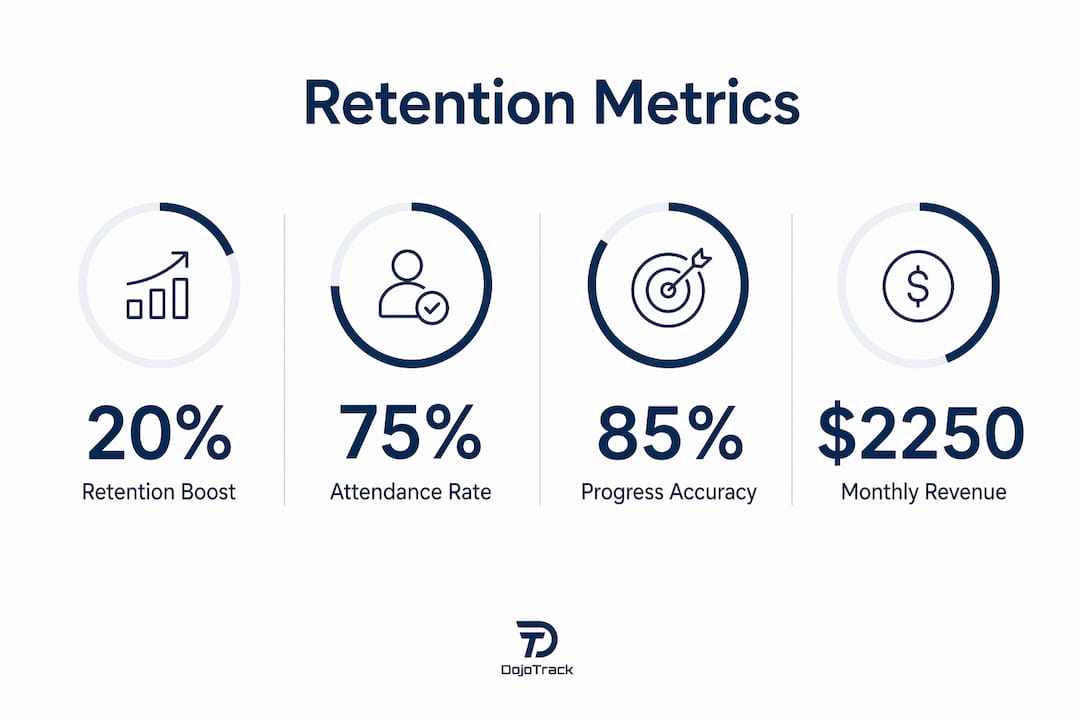
Retention improvements show up in three measurable places: attendance continuity, membership renewal rates, and monthly recurring revenue. Schools that implement AI analytics track these metrics on a weekly basis rather than reviewing them quarterly after the damage is done.
“Retention automation is a timing aid. The outreach message and the human follow-up are what actually determine whether a student stays. Automation gets you to the moment. Your instructor closes it.”
The table below shows the key performance indicators that AI analytics systems track and what each one tells you about your school’s health.
| Metric | What it measures | Why it matters |
|---|---|---|
| Weekly attendance rate | Class visits per enrolled student | Drops signal disengagement before cancellation |
| Belt advancement pace | Time between rank promotions | Stalls predict motivation loss |
| App engagement score | Logins, curriculum views, notifications opened | Low engagement precedes physical absence |
| Payment on-time rate | Billing success per billing cycle | Irregularities correlate with dropout intent |
| 90-day renewal likelihood | Predicted membership continuation | Drives proactive outreach before renewal window |
Student progress tracking systems replace subjective instructor impressions with objective data. Promotion decisions backed by data reduce the frustration students feel when advancement feels arbitrary, which directly improves long-term engagement.
The financial case is straightforward. A school with 150 students and an average monthly tuition of $150 loses $2,250 in monthly recurring revenue for every 10 students who quit. A 20% improvement in retention on a school that was losing 20 students per year means retaining four additional students annually. Over a 12-month period, that is a meaningful revenue difference. The lifetime value calculator from Dojotrack makes this math concrete for your specific school size and tuition structure.
Key Takeaways
AI analytics improve Taekwondo student retention by identifying at-risk students early, personalizing feedback to build motivation, and giving instructors the right information at the right time to intervene effectively.
| Point | Details |
|---|---|
| Early risk detection | AI monitors attendance, belt pace, app use, and payments to flag at-risk students weeks before dropout. |
| Personalized feedback builds loyalty | AI-driven movement corrections and training recommendations increase student self-efficacy and persistence. |
| Rule-based automation is most reliable | Simple, auditable triggers outperform complex ML for everyday retention workflows in martial arts schools. |
| Human follow-up closes the loop | Automation identifies the moment; the instructor’s personal outreach is what actually retains the student. |
| Retention has a direct revenue impact | Keeping more students enrolled stabilizes monthly recurring revenue and reduces the cost of constant new enrollment. |
The part most schools get wrong about AI and retention
Running Dojotrack, we have seen a consistent pattern: schools that adopt AI analytics expect the software to do the retention work for them. They set up the alerts, watch the dashboard, and wait for students to stop quitting. It does not work that way.
The schools that see the biggest gains treat AI as a leadership tool. They use the weekly at-risk list the same way a good head instructor uses a whiteboard during a staff meeting: it focuses the conversation on who needs attention and why. The instructor still makes the call, sends the personal text, or pulls the student aside after class. AI just makes sure that conversation happens before it is too late.
What I have found is that the psychological dimension is consistently underestimated. When a student receives a message that references their specific training history, it changes how they feel about the school. They feel known. That feeling is what builds the kind of loyalty that survives a busy month, a tough belt test, or a scheduling conflict. Generic automation cannot create that feeling. But AI-assisted, instructor-delivered communication absolutely can.
The schools winning at retention in 2026 are not the ones with the most sophisticated algorithms. They are the ones where instructors use data to have better conversations with students. That is the real role of AI in this business.
— Dojotrack
How Dojotrack helps Taekwondo schools retain more students
Dojotrack’s AI-powered platform is built for exactly the challenges described in this article. The platform tracks attendance, belt progression, app engagement, and billing in real time, then surfaces at-risk students automatically so your instructors can act before a student disappears. Automated SMS outreach tied to student milestones keeps communication personal and timely without adding hours to your administrative workload. Whether you run a single Taekwondo academy or multiple locations, Dojotrack gives you the data and the tools to build a school where students stay, advance, and refer others. Schools in the United States can access Dojotrack’s core features at no upfront cost and scale up as their retention programs grow.
FAQ
What does AI analytics actually do for student retention?
AI analytics monitor attendance, belt progression, app engagement, and payment behavior to identify students at risk of dropping out. The system generates alerts that allow instructors to intervene before a student cancels.
How much can AI improve Taekwondo retention rates?
AI-integrated training environments show retention improvements exceeding 20% compared to schools without AI tools. Results depend on how consistently instructors act on the alerts the system generates.
Does AI replace the instructor’s role in retention?
AI does not replace instructors. It identifies which students need attention and when, so instructors can focus their personal outreach where it will have the most impact.
What is the difference between rule-based automation and machine learning in retention tools?
Rule-based automation triggers actions based on fixed conditions, such as sending an SMS after 14 days without a check-in. Machine learning adapts over time using patterns in data. Most martial arts schools benefit more from rule-based systems because they are predictable and easy to audit.
How does personalized communication improve student loyalty?
Milestone-related outreach that references a student’s specific training history is perceived as genuine care rather than generic marketing. That perception directly increases the likelihood a student renews their membership.