

TL;DR:
- Event registration in martial arts involves submitting verified personal details, rank credentials, and fees before a deadline to confirm eligibility. Schools should use early deadlines and clear communication to prevent errors, while automation tools like Dojotrack streamline the process. Proper registration ensures fairness, safety, and a smoother experience for competitors and organizers.
Event registration in martial arts is the formal process by which competitors officially enroll in a tournament or seminar by submitting verified personal information, rank credentials, and paid fees before a set deadline. This process is not just paperwork. It is a verification system that confirms every competitor meets eligibility standards before they step on the mat. For school owners and instructors, understanding what is event registration martial arts means knowing how to guide students through requirements set by federations like the IBJJF and World Hwa Rang Do Association, avoid costly mistakes, and run events that reflect well on your school.
What is event registration in martial arts?
Event registration in martial arts is the administrative procedure that secures a competitor’s spot in a tournament or seminar. It requires proof of age, rank, and affiliation along with paid fees submitted before the event deadline. That combination of verified identity, rank confirmation, and payment is what separates a confirmed competitor from someone who simply showed up hoping to compete.
The process exists for two reasons: fairness and safety. Federations use registration data to build accurate brackets, match competitors by age, weight, and belt level, and confirm that every participant meets the event’s eligibility rules. Without a clean registration process, you get mismatched divisions, on-site disputes, and frustrated athletes.
Registration also serves as a commitment mechanism. Paid entry fees confirm competitor commitment and give organizers the data they need to allocate staff, mats, and scheduling resources. Non-payment typically results in registration cancellation even when all documents have been submitted. That detail surprises many first-time competitors and their coaches.
What are the key components of martial arts competition registration?
Every martial arts event signup requires a core set of information and documents. The specifics vary by federation, but the standard requirements are consistent across most major organizations.
Participant information required:
- Full legal name matching a government-issued photo ID
- Date of birth for age division placement
- Current belt or rank level with supporting documentation
- Academy or school affiliation
- Weight class selection
- Division type (gi, no-gi, kata, sparring, etc.)
Documentation typically required:
- Government-issued photo ID (passport, driver’s license, or state ID)
- Rank certificate or instructor verification letter
- Signed liability waiver or digital consent form
- Proof of active federation membership where applicable
For example, IBJJF registration requires an online account, an annual membership fee of approximately $40, academy approval, and a valid government photo ID that matches the registration exactly. The membership must be active on the day of the event, not just at the time of signup. That distinction catches many competitors off guard.
Fee structures add another layer. Early bird rates at IBJJF events run $90–$100, while late fees climb to $120–$150. That is a 20%–50% increase for missing the early deadline. For a school sending ten students to a tournament, that difference adds up fast.

Pro Tip: Build a registration checklist for each student that includes their ID type, rank certificate location, and payment confirmation. Hand it out at least three weeks before any event. Students who arrive prepared have fewer on-site problems.
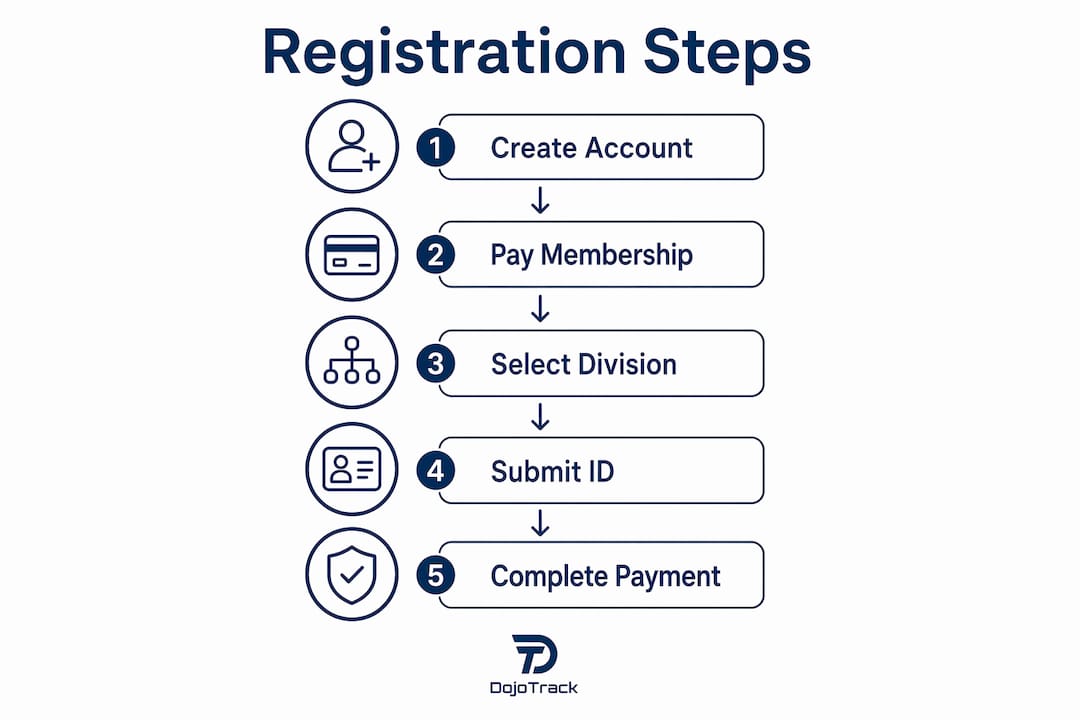
This data also feeds directly into bracket construction. Organizers use division selections to group competitors, set match schedules, and assign mat space. Incomplete or inaccurate submissions delay that process and can push a student into the wrong bracket entirely.
How does timing affect martial arts event registration?
Timing is the single most controllable factor in a successful registration outcome. Registration windows typically open and close 2–4 weeks before the event, and missing those cutoffs has real consequences.
The World Hwa Rang Do Association enforces strict registration deadlines for its championship events. Missing those deadlines results in exclusion from competition or late fee penalties. There is no grace period at most major federations. That policy exists because bracket finalization depends on having a complete and accurate competitor list well before event day.
Here is a practical timeline for managing registration deadlines at your school:
- Six weeks out: Announce the event to students. Share the federation’s registration page, fee schedule, and division options. Give students time to gather documents.
- Four weeks out: Confirm which students plan to compete. Collect copies of their IDs and rank certificates. Verify that federation memberships are active.
- Two to three weeks out: Submit all registrations before the early bird deadline. Confirm payment for each student and save confirmation receipts.
- One week out: Review each student’s registration confirmation. Check that names, divisions, and weight classes are correct. Flag any discrepancies immediately.
- Event day: Arrive with printed or digital copies of all confirmations, IDs, and rank documents. Weigh-ins happen on event day, and gear requirements must be met per event rules.
Pro Tip: Set your internal school deadline one full week before the federation’s early bird cutoff. That buffer gives you time to fix errors without paying late fees.
The bracket accuracy point deserves emphasis. Organizers cannot finalize match schedules until registration closes. Schools that submit late force last-minute bracket changes, which frustrates every other competitor and coach at the event. Submitting early is a professional courtesy as much as a financial decision.
What common pitfalls do instructors face during event registration?
Registration errors are more common than most instructors expect, and the consequences range from late fees to on-site disqualification. Incorrect or incomplete registration details can lead to disqualification at the event, which causes real distress for competitors and coaches alike.
The most frequent problems instructors encounter:
- Name mismatches: The name on the registration does not match the government-issued ID. Even a middle name or nickname discrepancy can trigger a verification failure.
- Expired or inactive memberships: A student’s federation membership lapses between registration and event day. The registration is valid at submission but fails on event day.
- Wrong division selection: A student registers in the wrong weight class or age bracket. Correcting this after the deadline often requires paying a change fee or reregistering entirely.
- Missing waivers: Digital or paper liability waivers are not submitted with the registration. Many events will not allow a competitor to check in without a signed waiver on file.
- Late payment: Documents are submitted on time but payment is not processed. Non-payment results in registration cancellation regardless of how complete the rest of the submission is.
Instructors who provide detailed registration guidance help first-time competitors avoid these problems and have a better overall experience. That guidance is especially important for students competing for the first time, who often do not know what documents they need or how strict the verification process is.
Pro Tip: Run a mock registration walkthrough with new competitors before their first event. Walk them through the federation’s website, show them where to upload documents, and confirm their ID matches their profile exactly. Fifteen minutes of preparation prevents hours of on-site frustration.
Lack of transparency about equipment rules is another common gap. Many events have specific gear requirements, such as approved gi brands, mouthguard rules, or headgear standards. Students who show up with non-compliant gear face disqualification even with a clean registration. Post the full equipment list alongside registration instructions every time.
How can schools use technology to manage event registration efficiently?
Online registration systems integrated with school management software reduce administrative errors and give instructors a clear view of each student’s registration status. Schools using these tools report smoother event logistics and better communication with athletes. That improvement is not accidental. It comes from replacing manual tracking with automated verification and payment confirmation.
The difference between managing registrations manually versus using purpose-built software is significant:
| Task | Manual process | Software-assisted process |
|---|---|---|
| Tracking submission status | Spreadsheets, email threads | Real-time dashboard per student |
| Payment confirmation | Manual bank checks | Automated payment receipts |
| Document collection | Paper files or email attachments | Digital uploads with version control |
| Deadline reminders | Instructor sends individual messages | Automated SMS or push notifications |
| Division accuracy | Instructor reviews manually | System flags mismatches before submission |
Dojotrack is built specifically for martial arts schools and includes event registration management as part of its unified platform. Instructors can track which students have submitted documents, confirmed payment, and completed waivers, all from one place. That visibility removes the guesswork from pre-event preparation.
“Registration is more than signing up. It is a verification system ensuring competitors meet standards before event day, ensuring fairness and safety.”
Integrating registration tracking with attendance and rank records adds another layer of accuracy. When a student’s belt level is already verified in your school’s system, you can confirm their division eligibility without chasing down paper certificates. That connection between daily school operations and event preparation is where technology delivers its clearest value.
Key takeaways
Effective martial arts event registration requires verified documentation, accurate division selection, early fee payment, and a clear communication system between instructors and students.
| Point | Details |
|---|---|
| Registration is a verification system | Federations use submitted data to confirm eligibility, build brackets, and ensure fair competition. |
| Early deadlines save money | IBJJF late fees run 20%–50% higher than early bird rates, so submitting early is a direct cost saving. |
| Name and ID accuracy is critical | A mismatch between registration details and a government ID can result in on-site disqualification. |
| Technology reduces errors | Software that tracks submissions, payments, and waivers in one place prevents the most common registration mistakes. |
| Instructor communication drives outcomes | Students who receive clear, detailed guidance before an event have fewer problems and better experiences on competition day. |
The part of registration most schools get wrong
Running martial arts schools for years teaches you something that no federation rulebook states directly: registration problems are almost never about the rules. They are about communication gaps between instructors and students.
Most disqualifications and late fees happen because a student did not know what was required, not because they were careless. They assumed their instructor would handle it. The instructor assumed the student had read the event page. Nobody confirmed the details in writing. That gap is where registrations fall apart.
The fix is not complicated. Build a standard pre-event communication protocol and use it every time. Send a checklist. Hold a five-minute briefing. Confirm each student’s submission personally. That level of diligence feels like extra work until the first time it prevents a student from being turned away at the door.
Technology helps, but it does not replace the instructor’s role. A platform like Dojotrack can automate reminders and track payment status, but the instructor still needs to verify that the right documents are uploaded and that the student’s name matches their ID exactly. The combination of clear process and the right tools is what actually works.
Schools that treat registration as an afterthought pay for it in late fees, disqualified students, and lost confidence from competitors who feel unprepared. Schools that treat it as part of their coaching responsibility build a reputation for running organized, professional programs. That reputation brings students back and attracts new ones.
— Dojotrack
How Dojotrack supports event registration for martial arts schools
Dojotrack gives martial arts school owners in the United States a single platform to manage the full registration workflow, from tracking student documents and payment status to sending automated reminders before event deadlines. The platform’s school management software connects attendance records, rank verification, and event enrollment so instructors spend less time chasing paperwork and more time preparing students to compete. Use the Lifetime Value Calculator to see exactly how better event management and student retention translate into revenue for your school. If you are ready to move your school’s operations onto a purpose-built platform, Dojotrack makes the transition straightforward.
FAQ
What is event registration in martial arts?
Event registration in martial arts is the formal process of enrolling a competitor in a tournament or seminar by submitting verified personal information, rank credentials, and paid fees before the event deadline. It confirms eligibility and secures the competitor’s division placement.
What documents are needed for martial arts competition registration?
Most events require a government-issued photo ID, a rank certificate or instructor verification, a signed liability waiver, and proof of active federation membership where applicable. The name on all documents must match exactly.
How early should you register for a martial arts event?
Submitting registration 3–4 weeks before the event captures early bird pricing and gives organizers time to build accurate brackets. IBJJF early bird fees run $90–$100, while late fees climb to $120–$150.
What happens if registration details are incorrect?
Incorrect details, such as a name that does not match a government ID, can result in on-site disqualification. Verifying all information against official documents before submission prevents this outcome.
How can instructors help students with the martial arts event signup process?
Instructors should provide a written checklist of required documents, confirm payment completion, and run a brief walkthrough of the federation’s registration portal with first-time competitors. Clear guidance before the event prevents the majority of common registration errors.