

TL;DR:
- Automated billing enables martial arts studios to process recurring payments, generate invoices, and follow up on failed charges without manual effort. Starting with automated systems before reaching 30 members ensures scalable growth, reduces errors, and improves cash flow. Connecting billing to student management systems and setting clear rules are essential for efficient, error-free automation, allowing owners to focus on teaching and retention.
Automated billing setup is the system that lets martial arts studios process recurring membership payments, generate invoices, and follow up on failed charges without any manual intervention. For new studios, getting this infrastructure in place from day one is not optional. It is the difference between a financially stable operation and one where cash flow problems quietly compound while you are focused on teaching. Whether you run a Taekwondo academy, a Brazilian Jiu-Jitsu school, or an MMA gym, the importance of billing automation becomes clear the moment your membership count climbs past a handful of students.
Why new studios need automated billing setup from day one
Automated billing setup, known in financial operations as recurring billing automation, solves a problem that gets worse the longer you ignore it. Manual invoicing complexity grows rapidly as your membership base expands and billing scenarios multiply across class packs, family plans, and add-on services. What takes 20 minutes to manage for 15 students takes 3 hours for 80 students, and the error rate climbs with every manual entry.
New studios face a specific vulnerability here. You are building habits and systems at the same time you are building a student base. If you build manual billing habits early, you will eventually have to break them under pressure, which is the worst possible time to change a financial process. Starting with automation means your billing system scales with your growth rather than fighting against it.
The billing challenges most new studios encounter fall into predictable categories:
- Missed payments that go unnoticed for weeks because no one is tracking them systematically
- Incorrect invoice amounts caused by manual data entry errors across membership tiers
- Inconsistent follow-up on declined cards, which leaves revenue uncollected
- Time lost to administrative tasks that pull instructors away from the mat
Automated billing saves studios up to 70% of manual billing and collection effort, with studio owners reporting a drop from 5 to 10 hours of weekly admin work down to 2 to 3 hours. That recovered time goes directly back into instruction, student relationships, and studio growth.
Pro Tip: Set up your billing automation before you open your doors, not after you hit 50 students. Retrofitting a billing system onto an existing manual process is significantly harder than building it correctly from the start.
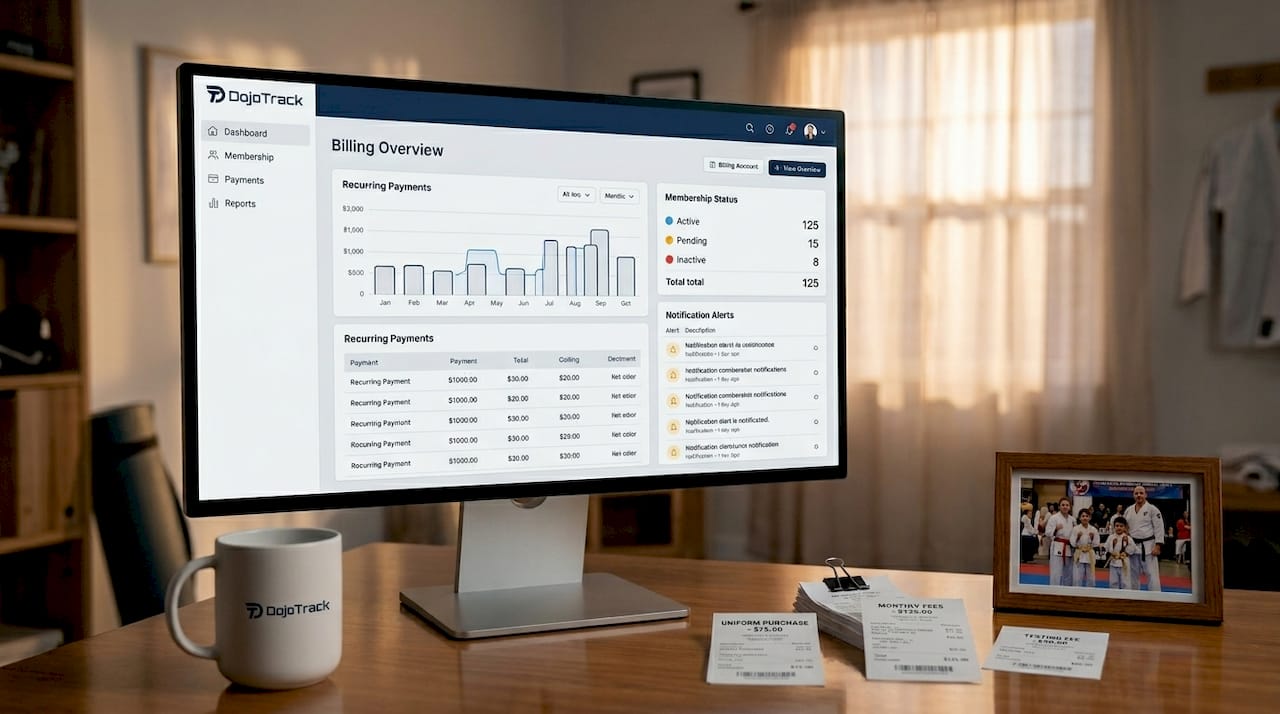
What operational benefits does automated billing deliver?
The operational benefits of automated billing extend well beyond saving time. They affect cash flow, audit readiness, and your ability to grow without hiring proportionally more administrative staff.
-
Faster billing cycles. Invoicing within 24 hours of session delivery accelerates payment receipt by 10 to 15 days on average compared to delayed invoicing. For a studio collecting monthly membership fees, that speed difference compounds into meaningful cash flow improvement over a full year.
-
Reduced Days Sales Outstanding. Automated billing can reduce DSO by up to 20% through faster invoice delivery and systematic follow-up workflows. DSO measures how long it takes to collect payment after a charge is due. Cutting it by 20% means your money arrives weeks earlier, which matters when you are paying rent, instructor salaries, and equipment costs.
-
Centralized revenue visibility. Invoice automation improves accuracy and creates timestamped logs that support audit readiness. Every transaction, adjustment, and payment attempt is recorded automatically. This matters when you need to reconcile accounts, dispute a chargeback, or simply understand where your revenue stands at any given moment.
-
Scalability without proportional headcount. Studios growing from 1,000 to 5,000 customers can maintain approximately the same billing team size with automation in place. That is not a minor efficiency gain. It is a structural advantage that directly improves your profit margin as you grow.
The combination of these four benefits means that billing automation for studios is not just an administrative convenience. It is a financial strategy that pays for itself quickly and keeps paying dividends as your student base grows.
Manual vs. automated billing: how do they compare?
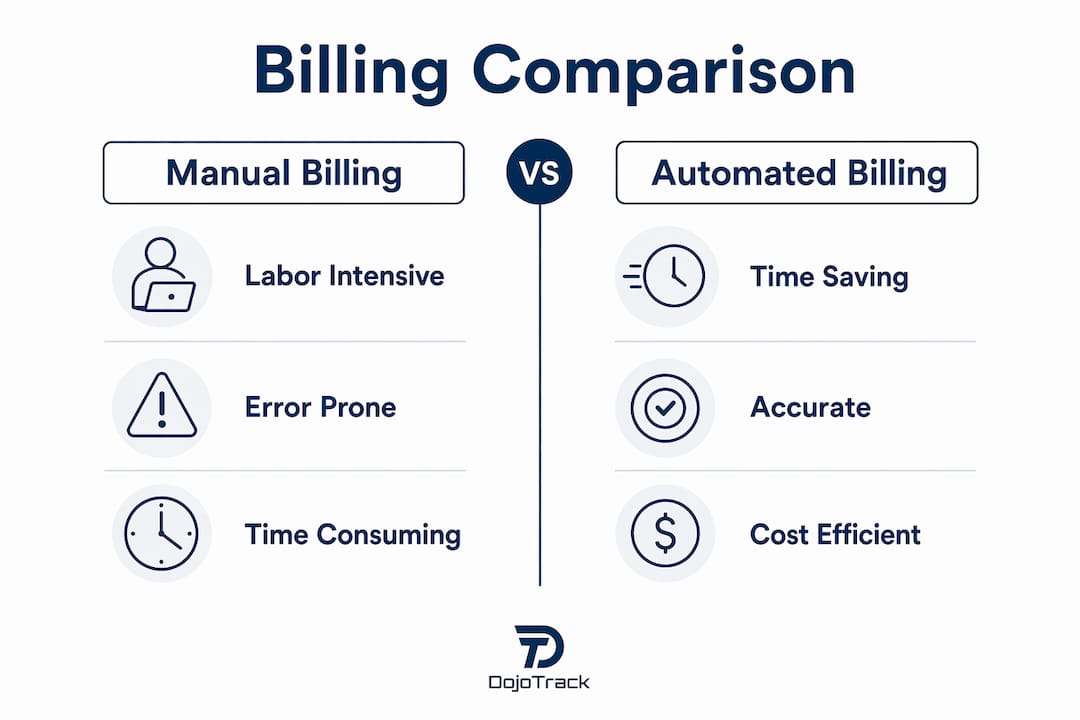
Understanding the difference between manual and automated billing helps you see exactly where the costs and risks are concentrated. The table below maps the key operational differences.
| Factor | Manual billing | Automated billing |
|---|---|---|
| Invoice generation | Staff creates each invoice individually | System generates invoices on a set schedule |
| Error rate | High due to manual data entry | Low due to rule-based processing |
| Failed payment follow-up | Depends on staff availability and memory | Automated retry and dunning sequences |
| Scalability | Requires more staff as volume grows | Handles volume increases with minimal added effort |
| Audit trail | Inconsistent, often paper-based | Timestamped digital logs for every transaction |
| Staff focus | Repetitive execution tasks | Exception handling and policy decisions |
Manual billing is labor-intensive by design. Every invoice requires a human decision, a human action, and a human follow-up. Automation shifts staff workload from repetitive execution to managing exceptions and policy decisions. That shift is what makes growth sustainable.
The financial cost of manual billing is also underestimated by most new studio owners. Beyond staff hours, manual billing produces errors that result in underbilling, overbilling disputes, and uncollected revenue from missed follow-ups. A single month of inconsistent collections at a 60-student studio can represent thousands of dollars in delayed or lost revenue.
Most studios should transition to automated billing before they reach 30 active members. At that point, the administrative burden of manual billing starts to create real operational drag, and the risk of errors becomes significant enough to affect your financial reporting.
How to implement automated billing in your studio
Setting up automated billing does not require a technical background. It requires a clear process and the right platform. Here is how to approach it without creating a brittle system that breaks under real-world conditions.
-
Start with clean data. Data cleanup and integration readiness are the foundation of any successful billing automation rollout. Before you configure anything, make sure your student records, membership types, and payment information are accurate and consistently formatted.
-
Define your billing rules first. Map out every membership tier, class pack, family discount, and add-on fee you offer. Each one needs a corresponding billing rule in your system. Trying to configure billing rules while students are already enrolled leads to errors and confusion.
-
Automate high-volume, simple transactions first. Configuring billing automation incrementally, starting with simple, high-volume cases, avoids building a system that requires constant manual exceptions. Monthly membership fees are the right place to start. Trial periods, event registrations, and custom packages come later.
-
Set up failed payment retry workflows. Automated recurring billing systems handle failed payment retries and member self-service for payment updates, which removes the most time-consuming part of manual billing follow-up. A card decline should trigger an automatic retry and a member notification, not a staff phone call.
-
Connect billing to your enrollment and scheduling data. Linking enrollment, scheduling, and billing data eliminates manual data re-entry errors. When a student enrolls in a new class tier, their billing should update automatically. Manual re-entry between disconnected systems is one of the most common sources of billing errors in new studios.
-
Give members a self-service portal. When students can update their own payment methods, expired card failures drop significantly. This single feature reduces a large portion of the manual follow-up work that consumes staff time every month.
Pro Tip: Use a platform that connects your recurring membership payments directly to your student management system. Disconnected billing tools create the same data re-entry problems you are trying to eliminate.
Key takeaways
Automated billing setup is the single most impactful operational decision a new martial arts studio can make, directly affecting cash flow, accuracy, and long-term scalability.
| Point | Details |
|---|---|
| Start before you scale | Set up billing automation before reaching 30 members to avoid retrofitting under pressure. |
| DSO reduction is measurable | Automated billing can cut Days Sales Outstanding by up to 20%, accelerating cash flow. |
| Manual billing has hidden costs | Errors, missed follow-ups, and staff time create financial drag that compounds as membership grows. |
| Clean data is the foundation | Accurate student and membership records are required before any billing automation can work correctly. |
| Scalability is structural | Automation lets studios grow from dozens to thousands of members without proportional admin increases. |
The case for not waiting another month
At DojoTrack, we have worked with martial arts school owners across the United States who delayed billing automation because it felt like a problem for later. The pattern is consistent. Studios that start with manual billing spend the first year building workarounds, and the second year trying to fix the damage those workarounds caused.
The uncomfortable truth is that manual billing does not just cost you time. It costs you revenue you never knew you were missing. Declined cards that no one followed up on, membership tiers that were never updated after a rate change, family discounts applied inconsistently because no one had a clear record. These are not edge cases. They are what manual billing looks like at 60 students.
What we have found actually works is treating billing automation as infrastructure, not software. You would not open a studio without a payment terminal. You should not open one without a billing system that handles recurring charges, retries, and reporting automatically. The studios that get this right early spend their energy on teaching and retention. The ones that get it wrong spend their energy on spreadsheets.
The time you invest in setting up billing automation in your first month pays back every single month after that. That is not a theory. It is what the data and the experience of running martial arts schools consistently shows.
— DojoTrack
How DojoTrack handles billing for new studios
DojoTrack is built specifically for martial arts studios, and billing automation is one of its core functions. The platform runs Stripe-powered recurring billing that handles membership charges, failed payment retries, and automated dunning sequences without any manual input. Student enrollment, attendance, and billing data are connected in one system, which eliminates the re-entry errors that plague studios using disconnected tools.
New studios get a setup process designed to get billing running quickly, with support for family discounts, multiple membership tiers, and member self-service payment updates. If you want to see exactly how the billing and management features work together, DojoTrack’s features page walks through every capability. You can also explore the full platform at DojoTrack to see how it fits your studio’s specific needs.
FAQ
What is automated billing setup for a martial arts studio?
Automated billing setup is the configuration of a system that processes recurring membership payments, generates invoices, and follows up on failed charges without manual staff intervention. It connects student enrollment data to payment processing so billing updates automatically when memberships change.
When should a new studio switch to automated billing?
New studios should implement automated billing before reaching 30 active members. At that point, manual billing creates enough administrative burden and error risk to meaningfully affect cash flow and reporting accuracy.
How much time does billing automation actually save?
Studio owners report cutting manual billing and collection work by up to 70%, reducing weekly admin time from 5 to 10 hours down to 2 to 3 hours. That time goes back into instruction and student engagement.
What happens when a student’s payment fails?
Automated billing systems apply retry logic on a set schedule and send member notifications prompting them to update their payment method. This replaces manual staff follow-up and recovers a significant portion of declined charges without any human involvement.
Does automated billing work for studios with multiple membership types?
Yes. Automated billing handles multiple tiers, class packs, family discounts, and add-ons through rule-based configuration. The key is defining each billing rule clearly during setup so the system processes every membership type correctly from the start.