

TL;DR:
- Mobile apps help karate studios improve student retention by maintaining connection outside classes. They automate administrative tasks, reducing staff workload and increasing operational efficiency. AI coaching features provide real-time form feedback, accelerating student progress and belt promotions.
A mobile app for your karate studio is defined as a dedicated digital platform that connects students to your dojo between classes, automates administrative tasks, and tracks belt progression in real time. Understanding why karate studios need mobile apps comes down to one core fact: students who lose connection between sessions are the students most likely to quit. Dojotrack’s student mobile app addresses this directly by giving members visibility into their belt curriculum, class schedules, and push notifications from a single interface. The studios that adopt purpose-built mobile technology today are the ones building retention systems that compound over time.
How mobile apps improve student engagement and retention
Student retention is the single biggest revenue driver in a karate studio. A student who stays for three years is worth exponentially more than one who quits after three months. The problem is that most dropout happens silently, between classes, when students lose momentum and stop showing up.
Visible belt progression timelines and grading notifications on a mobile app directly increase student motivation and retention. When a student can open their phone and see exactly how many classes stand between them and their next kyu rank, the goal feels real and close. That visibility turns abstract progress into a daily reminder to come back.
Automated alerts are equally powerful. Automated re-engagement messages activate after 14 days of inactivity or a payment lapse to pull at-risk students back before they fully disengage. Fourteen days is the critical window. After that, the habit breaks and re-enrollment becomes a sales conversation rather than a simple nudge.
Apps also fill the gap between classes in ways that a front desk phone call never could. Push notifications about upcoming belt tests, event registrations, and curriculum videos keep your dojo present in a student’s mind on Tuesday night, not just during Saturday class. Maintaining student-studio connection outside class hours is the primary mechanism that prevents cancellations caused by broken attendance habits.
Here are the engagement features that move the needle most:
- Belt progression tracker: Shows current kyu rank, requirements completed, and estimated grading eligibility date
- Absence alerts: Automated messages triggered by missed classes or payment gaps
- Push notifications: Reminders for upcoming events, belt tests, and class schedule changes
- Curriculum access: Video breakdowns of kata and techniques students can review at home
- Attendance milestones: Badges or acknowledgments for streaks that reinforce the habit of showing up
Pro Tip: Set your absence alert to fire at day 10, not day 14. Catching students before the two-week mark gives you a better chance of re-engagement before the habit fully breaks.
Streamlining administrative tasks with a karate studio app
Every minute your staff spends answering a phone call about class times or processing a manual membership renewal is a minute not spent on the mat. Administrative friction is a hidden cost that most studio owners underestimate until they calculate it.

The most common mistake studio owners make when building or choosing an app is focusing on branding and visual design instead of behavior change and self-service functionality. A beautifully branded app that still requires a phone call to reschedule a class has failed its primary job. The app’s value is measured in reduced staff contact points, not in how good the logo looks.
A well-built studio app handles these administrative tasks automatically:
- Self-service booking: Students book, cancel, or reschedule classes without calling the front desk
- One-tap membership renewals: Automated membership renewals reduce front-desk calls and eliminate the awkward renewal conversation
- Recurring billing: Stripe-powered or equivalent payment processing runs in the background without manual intervention
- Profile updates: Students update their own contact information, emergency contacts, and waiver signatures
- Attendance check-in: Digital sign-in through the app or a kiosk replaces paper sign-in sheets entirely
The cumulative effect of these features is significant. When students handle their own logistics, your staff shifts from reactive customer service to proactive community building. That is a better use of their time and a better experience for your members.
Branded apps work best when they are fully synchronized with your studio management software. Booking, payments, memberships, and push notifications must all pull from the same data source. Disconnected systems create double-booking errors, missed payment notifications, and frustrated students.
Pro Tip: Before choosing any app platform, test the booking and payment flow yourself as a student would. If it takes more than three taps to book a class, the friction is too high and students will default to calling you instead.
What AI coaching features can a karate app offer?
The most forward-looking mobile app features for karate go beyond scheduling and billing. AI-integrated pose detection now brings objective technical feedback directly to a student’s phone.
Mobile apps with AI-based pose detection can analyze karate fundamentals like stance depth and hip rotation, providing real-time objective feedback that supports instructor coaching. A student practicing Zenkutsu Dachi at home can record a short video, receive instant analysis of their knee alignment and weight distribution, and arrive at the next class with corrections already in progress. That is a qualitative shift in how students train between sessions.
The table below outlines how AI coaching features compare to traditional instruction across key dimensions:
| Feature | AI-powered app feedback | Traditional instructor coaching |
|---|---|---|
| Availability | 24/7, on demand | Scheduled class times only |
| Objectivity | Consistent, data-driven analysis | Subject to instructor attention and class size |
| Depth of feedback | Stance geometry, hip rotation, posture angles | Holistic technique, timing, and intent |
| Personalization | Based on recorded movement data | Based on instructor observation |
| Best use case | Between-class practice and self-correction | Live technique refinement and sparring |
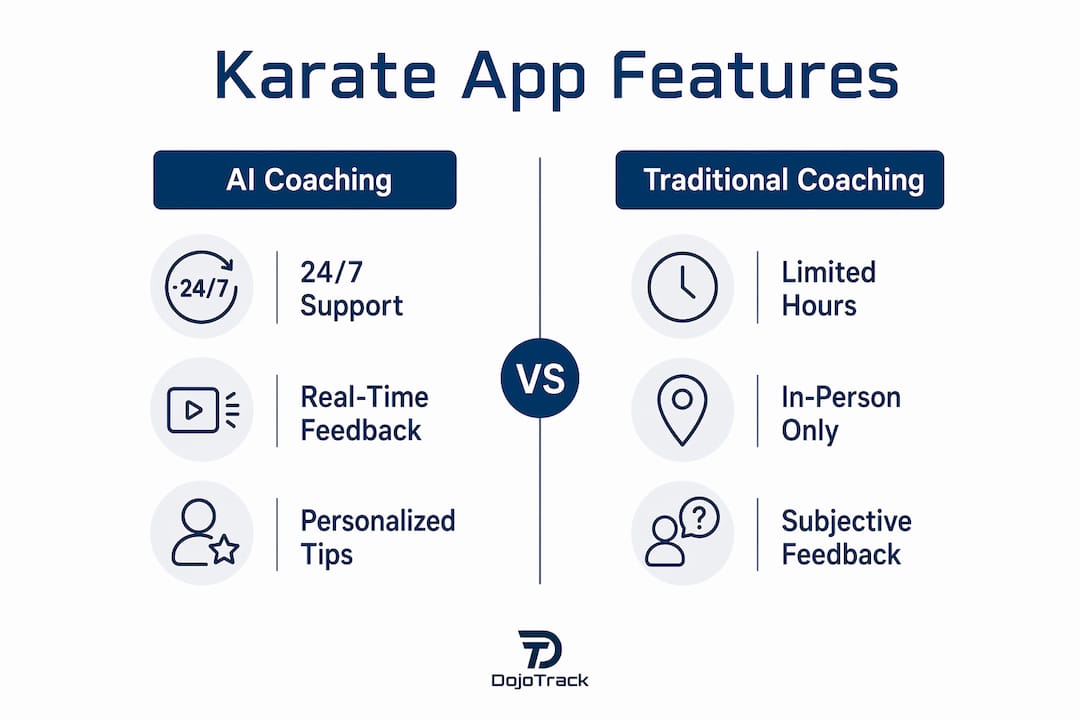
AI and mobile technology supplement, not replace, traditional instructor coaching by providing consistent real-time feedback on form and posture. The instructor’s role remains irreplaceable for timing, sparring, and the nuanced judgment that comes from years on the mat. The app fills the hours between classes when no instructor is present.
For studio owners, this is a genuine differentiator. Students who train with AI feedback between classes progress faster. Faster progress means earlier belt promotions. Earlier promotions mean higher satisfaction and lower dropout. The role of AI analytics in karate school growth is no longer theoretical. It is a practical retention tool.
How to choose the right app strategy for your karate studio
Not every studio needs a fully custom branded app on day one. The right mobile strategy depends on your current student count, your existing software stack, and what problem you are actually trying to solve.
Start by identifying your biggest pain point. If students are dropping out silently, your priority is retention features: belt tracking, absence alerts, and push notifications. If your front desk is overwhelmed, your priority is self-service booking and automated billing. If your instructors want to support home practice, AI coaching tools become relevant.
When evaluating any app platform, focus on these criteria:
- Integration depth: Does the app sync with your existing management software for bookings, payments, and attendance in real time?
- Retention tools: Does it include belt progression tracking, grading eligibility alerts, and automated absence notifications?
- Self-service capability: Can students book, pay, and update their profiles without staff involvement?
- Push notification control: Can you send targeted messages to specific groups, like students approaching a belt test?
- Scalability: Does the platform handle multiple locations and family accounts without breaking the billing logic?
A generic fitness booking app can handle scheduling. What it cannot do is track kyu ranks, automate belt promotion workflows, or send a grading eligibility alert tied to a specific martial arts curriculum. That distinction matters when you are running a karate studio, not a yoga class. Purpose-built martial arts CRM tools integrate mobile app features with the operational logic your studio actually runs on.
Key Takeaways
Mobile apps are the most direct tool karate studio owners have for reducing dropout, cutting administrative work, and supporting student progress between classes.
| Point | Details |
|---|---|
| Retention starts between classes | Apps maintain student connection outside the dojo, preventing the habit breaks that cause dropout. |
| Belt visibility drives motivation | Students with visible kyu progression timelines show higher commitment and longer retention. |
| Self-service cuts admin load | Automated booking, billing, and renewals reduce front-desk calls and free up instructor time. |
| AI coaching fills training gaps | Pose detection tools provide real-time form feedback between sessions, accelerating student progress. |
| Integration is non-negotiable | Apps must sync with studio management software to avoid booking errors and missed payment alerts. |
The feature that most studios overlook
Running martial arts schools for years teaches you something that no software demo ever shows you: the moment a student stops feeling progress, they start looking for the exit. It does not happen dramatically. It happens quietly, over two or three weeks of missed classes, until one day they just stop coming.
The studios that retain students longest are not always the ones with the best instructors. They are the ones that make progress visible and the habit of showing up feel rewarding. A mobile app that shows a student they are four classes away from their next belt test does more retention work than a follow-up phone call ever will.
What I have seen consistently is that studio owners who treat their app as a branding exercise get very little return. The ones who treat it as a behavior change tool, focused on reducing friction and making progress tangible, see real drops in their monthly churn. The difference is not the app’s design. It is the decision to prioritize function over appearance.
The future of karate studio apps is not just scheduling and payments. It is AI-driven personalization: apps that know a student’s attendance pattern, flag risk before the owner notices it, and send the right message at the right moment. That technology exists now. The studios that build those habits into their operations today will have a structural advantage over the ones that adopt it two years from now.
— Dojotrack
How Dojotrack supports karate studios with mobile app tools
Dojotrack is built specifically for martial arts schools, and its student mobile app is designed around the retention and administrative features covered in this article. Students track their belt curriculum progress, view class schedules, receive push notifications, and purchase products directly through the app. On the operations side, Dojotrack automates billing, attendance, and membership management through a single platform that eliminates the disconnected systems that create errors and extra work.
If you want to understand the financial impact of improving student retention at your studio, the lifetime value calculator for martial arts schools gives you a concrete number to work with. To see the full platform, visit Dojotrack’s AI-powered software and explore how the mobile app and management tools work together.
FAQ
Why do karate studios need mobile apps?
Mobile apps keep students connected to the dojo between classes, which is the primary period when dropout occurs. Features like belt progression tracking and automated absence alerts directly reduce cancellation rates.
What features matter most in a karate training app?
The highest-impact features are belt progression visibility, automated re-engagement alerts, self-service booking, and recurring billing. These reduce both dropout and administrative workload simultaneously.
Can a mobile app replace a karate instructor?
No. AI coaching tools in mobile apps supplement instructor feedback by analyzing posture and stance between sessions. Live instruction remains irreplaceable for timing, sparring, and technique refinement.
How does a karate app reduce administrative work?
Apps automate membership renewals, class bookings, attendance tracking, and payment processing. Students handle their own profile updates and scheduling, which cuts front-desk calls and manual data entry.
What should I look for when choosing an app for my dojo?
Prioritize integration with your existing management software, belt tracking functionality, self-service booking, and push notification controls. Visual branding is secondary to operational performance.