

TL;DR:
- Integrated payments streamline karate school billing by automating charges and reducing manual work. They improve revenue recovery, security, and member experience while providing real-time data insights. Dojotrack offers purpose-built features, including family billing and dunning automation, to optimize martial arts business operations.
Karate schools need integrated payments because they cut admin time, stop revenue leakage, and stabilize cash flow in ways that manual billing simply cannot match. When your billing system talks directly to your membership records, attendance logs, and reporting tools, you stop chasing expired cards and start running a tighter operation. Platforms like Dojotrack pair Stripe-powered recurring billing with PCI-DSS-compliant tokenization so your student data stays protected and your revenue keeps moving.
The short version:
- Faster cash flow: Automated recurring billing charges tuition on schedule, no manual invoicing required.
- Fewer failed payments: Retry logic and dunning sequences recover declined charges before they become write-offs.
- Less reconciliation time: Integrated payments let transaction data flow directly into your business systems, eliminating manual entry.
- Stronger security: Tokenization and encryption keep card data out of your staff’s hands and inside a compliant environment.
- Better member experience: Families pay once, stay on file, and never get an awkward call from the front desk.
Ready to see it in action? Evaluate your current billing setup against the checklist below, or book a Dojotrack demo to see how it maps to your school.
Table of Contents
- Why integrated payments are a direct business upgrade for dojos
- How retry logic and dunning automation stop revenue from walking out the door
- How PCI compliance and tokenization protect your school
- What integrated payments actually look like inside your dojo
- Which payment methods should your school actually offer?
- How to evaluate payment partners and understand what you are paying
- Step-by-step checklist to switch without disrupting your school
- KPIs to track after you switch and how to calculate your ROI
- Why Dojotrack is built for this specific problem
- Key Takeaways
- The billing problem nobody talks about at belt tests
- Dojotrack gives you a clear path to automated billing
- Useful sources
- FAQ
Why integrated payments are a direct business upgrade for dojos
The business case for integrated payment systems in martial-arts schools comes down to four concrete gains: predictable revenue, lower overhead, a better member experience, and data you can actually use.

Automated recurring billing charges monthly tuition on the same date every cycle. That alone removes the single biggest source of cash-flow uncertainty for most schools. When a payment fails, the system retries automatically rather than waiting for a staff member to notice a gap in the spreadsheet. The result is more consistent deposits and fewer awkward conversations with families you see on the mat three times a week.
On the admin side, integrated payments eliminate manual entry by pushing transaction data directly into your membership records, accounting tools, and reporting dashboards. One source of truth means month-end reconciliation takes minutes instead of hours.
- Predictable cash flow: Tuition hits your account on schedule, every cycle.
- Lower admin burden: No manual matching of payments to student accounts.
- Member experience: One card on file covers monthly dues, belt-test fees, and camp registrations.
- Retention and upsell: Real-time transaction data lets you spot trends, run targeted promotions, and price programs more accurately.
Pro Tip: Most schools recover their initial platform cost from payments they would have otherwise lost. Audit your last 90 days of failed payments before you sign with any provider — that number is your baseline ROI.
How retry logic and dunning automation stop revenue from walking out the door
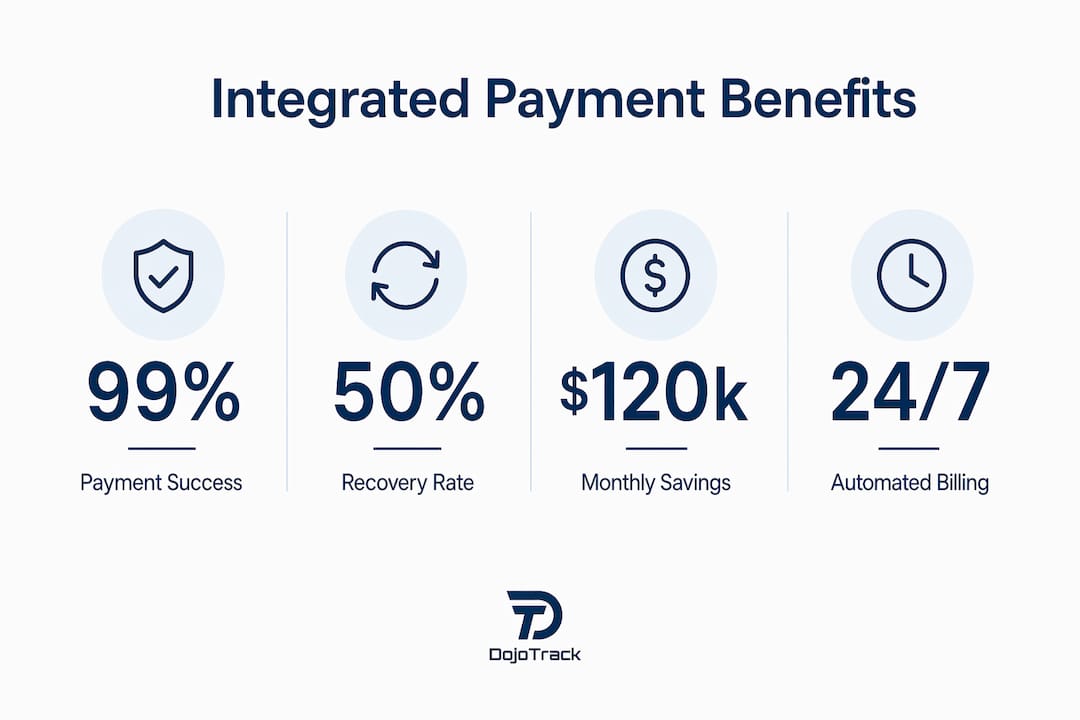
Failed payments are the most common source of silent revenue loss in a dojo. A card expires, a bank flags a charge, or a family forgets to update their payment method. Without automation, that revenue disappears unless a staff member catches it and makes an uncomfortable phone call.
Automating recurring billing and dunning reduces failed-payment rates and recovers revenue that would otherwise require manual collection or be written off entirely. Here is how a typical automated recovery flow works:
- Day 1: Charge fails. System logs the failure and queues a retry.
- Day 2–3: First retry attempt, often at a different time of day to avoid bank-side blocks.
- Day 5: Automated email to the family: “Your payment didn’t go through — please update your card.”
- Day 7: SMS follow-up with a direct link to update payment info.
- Day 10: Final retry. If still declined, membership status flags for staff review.
Consider a real scenario: a family with two kids in your program has a card expire mid-cycle. Without automation, that charge sits unpaid until someone notices, then a staff member has to track down the parent, explain the situation, and hope they update their info before the next class. With dunning automation, the system handles all of that before the parent even realizes there was a problem.
| Metric | Without automation | With dunning automation |
|---|---|---|
| Failed payment follow-up time | Manual and time-consuming | Near zero (automated) |
| Recovery rate | Variable depending on manual follow-up | Improved with automated retries |
| Revenue written off | Higher without automation | Reduced with systematic recovery |
| Staff-family friction | Frequent due to manual contact | Minimised through automated, professional follow-up |
Operators who combine integrated payments with membership management can also automate family and multi-student billing, belt-test fees, and camp charges off a single card on file, so one failed card update covers every charge for that family in one step.
How PCI compliance and tokenization protect your school
Handling card data manually, or routing it through disconnected tools, creates real liability. Every system that touches raw card numbers is a potential breach point. Integrated payments reduce that exposure by keeping card data inside a single, PCI-DSS-compliant environment that tokenizes and encrypts payment information from the moment it is captured.
Tokenization replaces a card number with a randomized token. Your system stores the token, not the actual card data. If your database were ever compromised, the tokens are useless to an attacker without the decryption keys held by the payment processor. That is a fundamentally different risk profile than storing card numbers in a spreadsheet or a generic CRM.
- Fewer touchpoints: Card data never passes through your staff’s hands or your local servers.
- Reduced breach risk: Integrated providers reduce the number of systems handling card data and provide built-in encryption.
- Simplified compliance: The processor handles PCI-DSS certification; you inherit their controls rather than building your own.
- Professional billing experience: Automated, encrypted billing removes the awkward “can I take your card number?” moment at the front desk.
Pro Tip: When a dojo uses a PCI-compliant, tokenized provider, liability for a card-data breach typically shifts to the processor, not the school. Confirm this in writing with any vendor before signing.
Dojotrack’s Stripe-powered billing operates within Stripe’s PCI-DSS-certified infrastructure. Your students’ card data is tokenized at capture and never stored directly on Dojotrack’s servers. For a deeper look at how Stripe handles security for martial-arts schools, Dojotrack’s guide covers the technical specifics.
What integrated payments actually look like inside your dojo
Integration is not just a billing feature; platforms like FlexLeague+’s pickleball league software show how secure payment integrations and league billing features can be cross-sport examples of operational benefits. It is the connective tissue between your student records, class schedule, attendance log, waivers, and financial reports. When payments are embedded in your management platform, every transaction updates the right record automatically.
Common integration points in a martial-arts school:
- Membership records: A successful charge keeps a student’s account active. A failed charge flags the account for review before the next class.
- Attendance and access: Membership status can gate class check-in, so students with lapsed accounts are flagged at the door rather than discovered at month-end.
- Digital waivers: Waiver completion and billing setup happen in the same onboarding flow, reducing the back-and-forth at the front desk.
- Family and multi-student billing: One card on file covers monthly dues for multiple siblings, plus one-time charges like belt tests, tournaments, and summer camps.
- Reporting: Every transaction feeds a live dashboard so you can see revenue by program, track outstanding balances, and pull reconciliation reports without touching a spreadsheet.
For schools migrating from a manual or disconnected system, the operational shift is significant but manageable. Map your existing student accounts to the new platform’s data fields before you go live. Collect updated card-on-file consent from families during the transition window. Then run a pilot cohort of 10–15 students for one billing cycle before full rollout. That single step catches most data-mapping issues before they affect your entire membership.
A unified software platform that connects billing to operations is what separates schools that run efficiently from those that spend Friday afternoons reconciling spreadsheets.

Which payment methods should your school actually offer?
Parents and students expect to pay the way they already pay for everything else. Offering only one method creates friction at checkout and, for recurring billing, increases the chance a family churns simply because their preferred method is not available.
| Method | Cost | Reliability | Chargeback risk |
|---|---|---|---|
| Credit/debit card | Higher per-transaction rate | High | Moderate |
| ACH/bank debit | Lower flat fee | High for recurring | Low |
| Apple Pay / Google Pay | Similar to card | High | Low to moderate |
| In-person POS | Varies by hardware | High | Low |
Integrated payments support in-person, online, and mobile wallet transactions all updating the same system, so a parent who pays at the front desk one month and via Apple Pay the next month shows up correctly in your records either way.
Priority methods for most karate schools:
- Card (credit/debit): The default for most families. Accept it everywhere.
- ACH/bank debit: Lower processing cost and lower chargeback risk, ideal for recurring monthly tuition.
- Digital wallets: Apple Pay and Google Pay reduce checkout friction on mobile, which matters when parents are signing up online.
- In-person POS: Necessary for belt-test fees, merchandise, and walk-in registrations.
Pro Tip: Promote ACH for recurring monthly tuition — the lower processing cost adds up across a full membership roster. Keep card and digital wallets available for one-time charges and in-person purchases where convenience matters more than cost.
How to evaluate payment partners and understand what you are paying
Fee structures vary more than most vendors advertise upfront. Before you commit, get clear answers on every line item.
Questions to ask every vendor:
- What is the per-transaction rate for card, ACH, and digital wallets?
- Are there monthly platform fees, statement fees, or PCI compliance fees?
- How are chargebacks handled, and what is the dispute fee?
- What is the settlement timeline (next day, two days, weekly)?
- Do you hold a reserve, and under what conditions?
- Is dunning/retry logic included, or is it an add-on?
- What does migration and onboarding cost?
- What is your support SLA for billing issues?
| Fee model | How it works | Best for |
|---|---|---|
| Flat rate | Single percentage + fixed fee per transaction | Predictable, lower volume |
| Interchange+ | Interchange cost + processor markup | Higher volume, cost-conscious |
| ACH flat fee | Fixed fee per bank transfer | Recurring monthly tuition |
Vendors offer different pricing shapes — flat-rate, interchange-plus, and ACH options — so comparing headline rates alone misses the full picture. Settlement timing and chargeback policies often matter as much as the per-transaction rate.
Red flags to watch for:
- Long-term contracts with early-termination penalties.
- Vague answers about reserve policies.
- No built-in dunning or retry logic.
- Support that routes billing disputes back to you instead of handling them.
Step-by-step checklist to switch without disrupting your school
Migration does not have to be painful. Most schools can go live in one to two weeks with the right preparation.
- Audit your current billing (Days 1–3). Pull a report of all active memberships, recurring charges, failed payments in the last 90 days, and any manual billing workarounds. This is your baseline.
- Choose your provider (Days 4–7). Use the vendor questions above. Confirm PCI compliance, dunning logic, and migration support before signing.
- Map your data (Days 8–10). Match student account fields, membership types, and card-on-file records to the new platform’s data structure. Flag any gaps before import.
- Communicate with families (Days 8–10). Send a short notice: “We’re upgrading our billing system to make payments easier for your family. You may receive a request to confirm your payment method on file. No action is needed unless you hear from us directly.”
- Run a pilot cohort (Days 11–17). Process one billing cycle for 10–15 students. Verify charges, reconciliation reports, and retry logic before expanding.
- Full rollout (Days 18–21). Migrate remaining accounts. Confirm all recurring charges are scheduled correctly.
- Post-launch monitoring (Days 22–30). Review failed-payment rates, settlement reports, and staff questions daily for the first week. Adjust retry rules if needed.
Testing checklist before full rollout:
- Run a test charge and refund on a staff account.
- Confirm reconciliation report matches expected totals.
- Trigger a test failed payment to verify retry and dunning sequence fires correctly.
- Verify family accounts with multiple students bill correctly under one card.
- Complete staff training on the new billing dashboard and how to handle exceptions.
For more detail on payment processing options for new studios, Dojotrack’s guide covers onboarding specifics.
KPIs to track after you switch and how to calculate your ROI
Switching to integrated payments is only valuable if you measure the outcome. These are the metrics that tell you whether the change is working.
Key performance indicators:
- Failed-payment recovery rate: Percentage of initially failed charges eventually collected. Track this monthly.
- Failed-payment rate: Total failed charges divided by total attempted charges. A lower rate over time signals your dunning logic is working.
- Days sales outstanding (DSO): Average days between a charge attempt and successful collection. Shorter is better.
- Admin hours per month: Time staff spend on billing-related tasks. This should drop noticeably in month two.
- Churn rate: Students who leave. Billing friction is a real, measurable contributor to churn.
- Average settlement time: How quickly collected revenue hits your bank account.
Sample ROI calculation:
Suppose your school has 150 active students at $120/month in tuition. If 5% of charges fail in a given month, that is $900 at risk. A dunning system that recovers 70% of those failures returns $630 per month that would otherwise require manual follow-up or be written off. Over 12 months, that is $7,560 in recovered revenue from one automation alone, before counting staff hours saved.
Real-time transaction data from integrated payments also feeds revenue forecasting and pricing decisions, so the analytics value compounds over time. Dojotrack’s business intelligence tools connect payment data directly to your studio dashboard for exactly this kind of reporting.
Monthly dashboard to share with stakeholders:
- Total collected vs. total billed (collection rate)
- Failed-payment rate and recovery rate
- DSO trend (30/60/90 day)
- Admin hours logged to billing tasks
- Churn rate by membership type
Why Dojotrack is built for this specific problem
Most generic billing tools were not designed for a karate school’s billing reality: family accounts with multiple students at different belt levels, one-time fees layered on top of recurring dues, and the need to link payment status directly to class access.
Dojotrack was built specifically for martial-arts schools by someone who ran them. Here is how its features map to the problems covered in this article:
- Stripe-powered recurring billing: Automated monthly tuition with PCI-DSS-compliant tokenization through Stripe’s certified infrastructure.
- Family and multi-student billing: One card on file covers multiple siblings, with individual tracking per student and automatic pricing adjustments when a student moves programs.
- Dunning automation: Retry logic and automated email/SMS sequences recover failed payments without staff involvement.
- Attendance-linked billing: Membership status connects to class check-in, so lapsed accounts are flagged before a student walks onto the mat.
- Belt-test and event fees: One-time charges for belt tests, tournaments, and camps bill against the same card on file as monthly dues.
- Analytics dashboard: Live revenue data, failed-payment tracking, and reconciliation reports in one place.
Dojotrack also offers a free core platform so you can get your student management, attendance tracking, and scheduling running before you commit to paid billing features. When you are ready to add automated payments, the upgrade path is built in. The full feature set covers everything from billing to belt tracking in one unified platform.
Key Takeaways
Integrated payments are the single most impactful operational upgrade a karate school can make to stabilize cash flow, reduce admin overhead, and protect student payment data.
| Point | Details |
|---|---|
| Automate recurring billing | Scheduled charges and retry logic eliminate manual follow-up and reduce failed-payment write-offs. |
| Protect card data with tokenization | PCI-DSS-compliant tokenization keeps card data off your servers and shifts breach liability to the processor. |
| Offer multiple payment methods | Card, ACH, and digital wallets reduce checkout friction and lower churn caused by payment method mismatches. |
| Track recovery rate and DSO | Measure failed-payment recovery rate, days sales outstanding, and admin hours monthly to confirm ROI. |
| Dojotrack fits the dojo model | Purpose-built for martial-arts schools with Stripe billing, family accounts, dunning automation, and attendance-linked payment status. |
The billing problem nobody talks about at belt tests
The conversation about integrated payments in martial arts usually focuses on convenience. That framing undersells the real issue.
The actual cost of disconnected billing is not just the failed payments you can count. It is the instructor who spends 45 minutes on a Sunday night matching bank deposits to student accounts. It is the front-desk staff member who dreads the conversation with a parent whose card declined in front of their kid. It is the school owner who cannot answer a simple question, “How much revenue did we collect this month versus last month?” without pulling three spreadsheets.
Those costs are invisible on a P&L, but they are real. They drain the energy that should go toward teaching, retaining students, and growing the school. Integrated payments do not just move money faster. They remove an entire category of operational friction that most school owners have simply accepted as part of the job.
The schools that move to integrated billing first tend to notice something unexpected: the billing system stops being a source of stress and starts being a source of data. Suddenly you can see which programs have the highest failed-payment rates, which membership types churn fastest, and where a targeted promotion might recover lapsed students. That shift, from reactive to data-driven, is worth more than any single recovered payment.
Dojotrack gives you a clear path to automated billing
If you are still chasing payments manually or reconciling billing in a spreadsheet, the gap between where you are and where you could be is smaller than you think. Dojotrack’s free core platform gets your student management, attendance, and scheduling running from day one, with no upfront cost. When you are ready to add Stripe-powered recurring billing, dunning automation, and family account management, those features are already built in.
Schools that switch to Dojotrack typically complete migration in one to two weeks, with student data, agreements, and payment info moved for you. From that point forward, failed payments, expired cards, and reconciliation are handled by the system, not your staff.
Start your free Dojotrack account today, or reach out to the team for migration support. The free tier covers the essentials; the paid features pay for themselves.
Useful sources
- Integrated Payments: What They Are and How They Work | Fiserv — Explains how transaction data flows across business systems and why embedded payments increase platform retention.
- Integrated payments 101: What you need to know | Stripe — Covers recurring billing mechanics, dunning logic, and pricing model trade-offs from Stripe’s perspective.
- What Are Integrated Payments and How Do They Work? | Square — Practical overview of tokenization, PCI compliance, and omnichannel payment flows.
- Integrated Payment Systems: The Ultimate Guide for Businesses | Razorpay — Deep dive into security, analytics, and multi-student billing use cases.
- Online Payments for Small Martial Arts Schools: 2026 Guide | Dojotrack — Dojotrack’s guide to payment fundamentals and migration for small schools.
- Stripe Payments for Martial Arts Schools: 2026 Guide | Dojotrack — Technical walkthrough of Stripe’s security architecture within Dojotrack’s platform.
- Predictive Analytics for Your Martial Arts Business | Dojotrack — How integrated payment data feeds revenue forecasting and retention analytics.
FAQ
What does “integrated payment” mean for a karate school?
An integrated payment system connects your billing directly to your membership records, attendance tracking, and reporting tools so transactions update every relevant account automatically, with no manual entry required.
How do integrated payments help with failed or declined charges?
Automated retry and dunning logic re-attempts failed charges on a schedule and sends families email or SMS prompts to update their payment info, recovering revenue that would otherwise require a manual follow-up call.
Is it safe to store families’ card information in a billing platform?
Yes, when the platform uses PCI-DSS-compliant tokenization. The card number is replaced with a randomized token stored by the payment processor, so your school never holds raw card data on its own servers.
What payment methods should a karate school accept?
At minimum: credit/debit card, ACH bank debit, and digital wallets like Apple Pay and Google Pay. ACH is the most cost-effective option for recurring monthly tuition; card and digital wallets work best for one-time fees and in-person purchases.
Can Dojotrack handle billing for families with multiple students?
Yes. Dojotrack’s family billing feature covers multiple siblings under one card on file, tracks each student individually, and automatically adjusts pricing when a student moves to a different program or belt level.