

TL;DR:
- Dojotrack is the top attendance tracking tool for U.S. karate schools, offering automated belt promotions and grading reports. Its free core tier simplifies student management, while paid plans add AI retention alerts and mobile app features. Small schools can also use DIY methods, but larger ones benefit most from purpose-built martial-arts software with integrated workflows.
For most karate schools in the United States, Dojotrack is the strongest fit among the top attendance tracking tools available today. It is the only option on this list built specifically for martial arts workflows, with automated belt promotions, grading-ready attendance, and a free core tier you can start using today. Here is the shortlist for owners who need to move fast:
- Dojotrack — Best for small to mid-size karate schools wanting a martial-arts-native platform with migration support and a free starting tier.
- Martialytics — Best for community dojos that prioritize belt group mapping and simple fee management.
- Kicksite — Best for schools that want a dedicated martial arts platform with straightforward member management.
- WellnessLiving — Best for growing studios that need broader CRM features alongside attendance.
- Zen Planner — Best for established schools that want proven scheduling and billing in one place.
- Mindbody — Best for large or multi-location academies that need enterprise-level integrations.
TL;DR: Start a free Dojotrack account today, or book a demo if you want to see the belt-tracking and grading-eligibility workflows in action before committing.
Table of Contents
- What are the top attendance tracking tools for karate schools?
- How do you choose the right attendance tool for your karate school?
- What free and DIY attendance options work for karate schools?
- Why Dojotrack stands out for karate school attendance
- Key Takeaways
- What most karate school owners get wrong about attendance software
- Dojotrack is free to start and built for your school
- Useful sources
- FAQ
What are the top attendance tracking tools for karate schools?
The table below covers every major option, from martial-arts-native platforms to general fitness software and DIY systems. Columns reflect the dimensions that matter most to karate school owners: how attendance is captured, whether belt and family logic is built in, and what you can expect to pay.
| Tool | Best For | Key Martial-Arts Features | Attendance Capture | Billing & Payments | Reporting & Analytics | Pricing / Free Tier |
|---|---|---|---|---|---|---|
| Dojotrack | Small–mid karate schools | Automated belt promotions, grading-ready attendance, family billing | Kiosk, mobile app, QR, manual | Stripe recurring, family billing, sibling discounts | AI retention alerts, at-risk students | Free core tier; paid tiers for advanced features |
| WellnessLiving | Growing multi-discipline studios | Rank tracking, class scheduling | Mobile app, kiosk, manual | Recurring billing, family accounts | Retention reports | Paid; tiered by location |
| Glofox | Boutique fitness and martial arts | Basic class management | Mobile app, manual | Recurring billing | Basic analytics | Paid; per-location pricing |
| Martialytics | Community dojos, belt-focused clubs | Belt/kyu/dan group mapping, grading workflows | Mobile app, manual | Simple membership billing | Grading eligibility reports | Paid; affordable entry tier |
| Kicksite | Dedicated martial arts schools | Student progress tracking, belt management | Manual, kiosk | Recurring billing | Basic retention reports | Paid; martial-arts-focused |
| Xplor Recreation | Parks, rec centers, multi-program facilities | General class management | Mobile app, kiosk | Family billing, POS | Program analytics | Paid; enterprise pricing |
| PushPress | CrossFit and functional fitness gyms | Limited martial-arts features | Mobile app, kiosk | Recurring billing | Retention dashboards | Free tier; paid for advanced |
| Matsync | Budget-conscious martial arts clubs | Attendance, basic belt tracking | QR, mobile app | Simple billing | Basic reports | Free and low-cost tiers |
| Spark Membership | Small martial arts schools | Belt tracking, student management | Kiosk, manual | Recurring billing | Basic analytics | Paid; entry-level pricing |
| Zen Planner | Established martial arts and fitness studios | Rank tracking, scheduling | Mobile app, kiosk, manual | Recurring billing, family accounts | Retention and attendance reports | Paid; per-member pricing |
| Wodify | CrossFit and performance gyms | Performance tracking, limited belt features | Mobile app, kiosk | Recurring billing | Performance analytics | Paid; tiered pricing |
| RhinoFit | Budget gyms and small studios | Basic class management | Mobile app, kiosk | Recurring billing | Basic reports | Low-cost paid tier |
| Mindbody | Large studios, multi-location academies | Broad integrations, class management | Mobile app, kiosk | Recurring billing, POS | Advanced analytics | Paid; enterprise pricing |
| Enterprise studio platform | Large multi-location school groups | Advanced CRM, multi-site management | Mobile app, kiosk, manual | Enterprise billing, family accounts | Advanced multi-site reporting | Paid; enterprise contracts |
| Martial-arts specific club platform | Community dojos, kyu/dan clubs | Belt group mapping, grading eligibility | Mobile app, manual | Simple fee management | Grading-ready reports | Paid; club-focused pricing |
| Fitness POS + attendance | Studios with heavy retail/POS needs | Variable; POS-first design | Mobile app, kiosk | POS, recurring billing | Sales and attendance reports | Paid; varies by platform |
| DIY attendance systems | Very small community dojos | None built in | QR + Google Form, spreadsheet | Manual invoicing | Manual spreadsheets | Free or near-free |
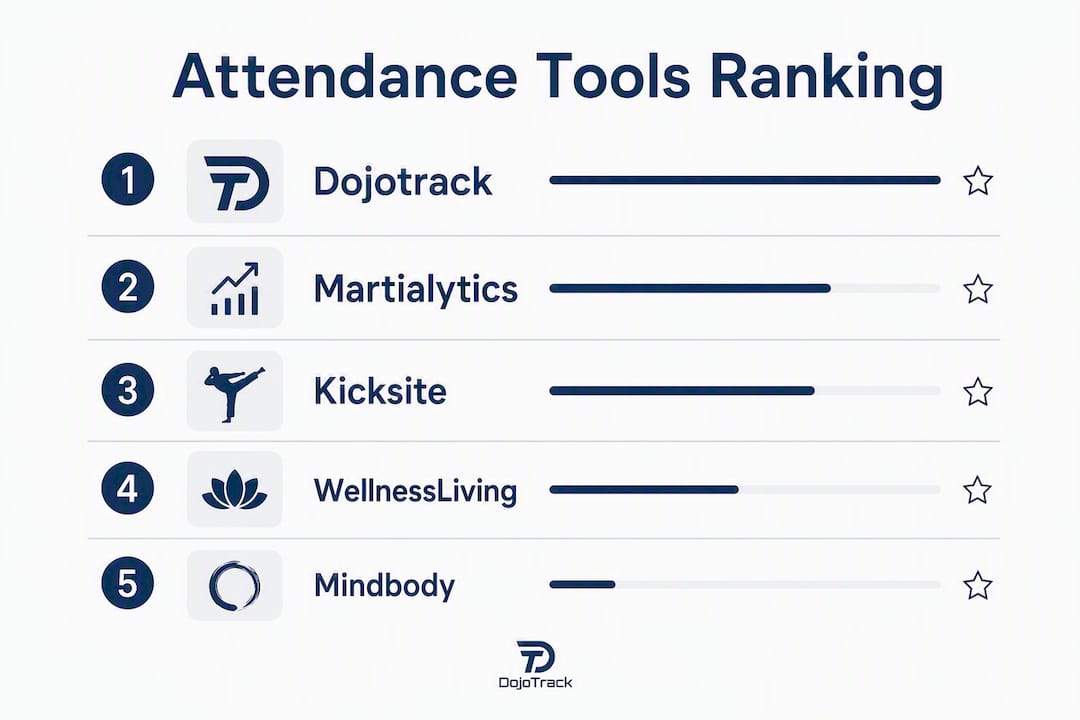
How the main platforms compare in practice
Dojotrack is the only platform on this list where attendance ties directly to grading eligibility and belt promotions are automated. That means on grading day, you are not manually cross-referencing spreadsheets. The free core tier covers student management, attendance, scheduling, and digital waivers. Paid tiers unlock AI-driven retention alerts, SMS automation, and the student mobile app.

Martialytics and Kicksite are the two strongest alternatives for schools that want a martial-arts-specific tool without Dojotrack’s AI layer. Martialytics maps students to kyu/dan groups and generates grading eligibility reports. Kicksite focuses on student progress and belt management with a clean interface. Neither offers the automated belt-promotion workflow Dojotrack provides, but both are purpose-built for martial arts rather than adapted from fitness software.

WellnessLiving and Zen Planner are solid choices for schools that have grown beyond a single discipline or need deeper CRM features. Both handle recurring billing and family accounts well. Zen Planner’s per-member pricing can get expensive at scale, and WellnessLiving’s feature depth comes with a steeper learning curve than a martial-arts-native tool.
Mindbody and enterprise-class platforms make sense for large, multi-location academies. The trade-off is cost and complexity. Neither is designed around belt tracking or grading cycles, so you will likely need workarounds for those workflows.
PushPress and Wodify are built primarily for CrossFit and functional fitness. They handle attendance and billing competently, but martial-arts-specific features like belt group mapping are limited or absent. RhinoFit and Matsync occupy the budget end of the paid market. Matsync in particular offers free attendance tracking options worth considering for very small schools.
Glofox and Spark Membership sit in the middle ground. Glofox works well for boutique fitness studios that happen to teach martial arts. Spark Membership targets small martial arts schools specifically and is worth a look if you want something simpler than Dojotrack without going fully DIY.
Xplor Recreation is designed for parks and recreation departments managing multiple programs. It handles family billing and POS well, but it is not a natural fit for a standalone karate school.
How do you choose the right attendance tool for your karate school?
Must-have features checklist
Before you book a single demo, confirm each tool on your shortlist handles these five things:
- Belt and rank tracking — Can the system map students to kyu/dan groups and flag grading eligibility automatically?
- Grading-ready attendance reports — Can you pull a report showing classes attended since a student’s last grading, with a defined attendance window?
- Flexible attendance capture — Does it support at least two of: kiosk sign-in, QR code, mobile app, and manual entry?
- Family and sibling billing logic — Can one parent account cover multiple students with sibling discounts applied automatically?
- Retention alerts — Does the platform flag students who have gone quiet before they cancel?
Questions to ask on a demo
- How does the system link attendance records to grading eligibility? Can I set a custom attendance window (for example, 12 classes since last grading)?
- What does data migration look like? Will you help import my existing student list, attendance history, and belt records?
- What payment processor do you use, and can families pay by ACH, card, or both?
- What is your support SLA? Is there a live chat or phone option, or is it email only?
- How long does a typical school take to go live, and what does the onboarding process include?
Red flags to watch for
- No martial-arts-specific features at all (belt tracking, grading reports). A generic gym platform will cost you time on every grading cycle.
- Mobile check-in that requires students to download a separate app with no kiosk fallback. Families with young students will not always have the app ready.
- Payment processing through an unfamiliar processor with no Stripe option. Stripe’s reliability and fraud protection matter when you are running recurring billing.
- Vague setup timelines. If a vendor cannot tell you how long onboarding takes, that is a sign their process is not well-defined.
Typical implementation timeline
Most martial-arts-specific platforms take one to two weeks to go live. The main tasks are: importing your student list (CSV export from your current system), mapping belt groups and schedules, setting up recurring billing rules for families, and configuring your kiosk or tablet for sign-in. A two-week parallel run, where instructors sign in on both the old and new systems simultaneously, is the most reliable way to catch schedule mismatches and billing edge cases before you cut over.
Pricing expectations
Most platforms price by active members, by location, or by a flat monthly fee. Martial-arts-native tools like Dojotrack offer a free core tier, which is rare. General fitness platforms typically start at $100–$200 per month for a single location. Enterprise platforms price by contract. If a vendor will not publish starting prices, ask for a written quote before investing time in a full demo.
Pro Tip: Define your required attendance window for grading eligibility (for example, “12 classes since last grading”) before your first demo. Vendors who cannot show you that report in under two minutes during the demo will not be able to build it for you later.
What free and DIY attendance options work for karate schools?
Free and low-cost options are worth knowing, especially if you are running a small community dojo with fewer than 60–80 active members. Once you cross that threshold, the manual reconciliation time tends to outweigh the cost savings.
Three DIY approaches
-
QR code plus Google Form — Print a unique QR code for each class and post it at the door. Students scan it and submit a Google Form with their name and class. Responses feed a Google Sheet automatically. Setup takes under an hour; the ongoing cost is zero. The limitation is that data lives in a spreadsheet with no belt-group logic or grading-eligibility calculation built in.
-
Tablet kiosk with a free app — Set up a shared tablet at the entrance running a free check-in app (OneTap and similar tools offer QR and mobile check-in options at low or no cost). Students tap their name or scan a code. This is faster than a paper roster but still requires manual export and reconciliation for grading reports.
-
Manual roster to spreadsheet — Instructors mark attendance on a paper or digital roster after each class and enter it into a shared spreadsheet weekly. This is the most familiar method for small schools but the most time-intensive to maintain as membership grows.
DIY vs. dedicated platform: trade-offs at a glance
| Method | Setup Time | Monthly Cost | Grading-Ready Reports | Data Portability | Admin Time per Week |
|---|---|---|---|---|---|
| QR + Google Form | Under 1 hour | — | No | High (CSV export) | 1–2 hours |
| Tablet kiosk app | 1–2 hours | —–$20 | No | Moderate | 1–2 hours |
| Manual roster + spreadsheet | — | — | No | Low | 2–4 hours |
| Martial-arts platform (e.g., Dojotrack) | 1–2 weeks | Free tier available | Yes | High | Under — |
Pro Tip: DIY works well for a community dojo running two or three classes a week with a stable roster. The moment you start running grading cycles, family accounts, or retention outreach, a dedicated platform pays for itself in hours saved.
Why Dojotrack stands out for karate school attendance
Built from the mat up
Dojotrack was founded in Utah by Jared Reed, a martial arts veteran who ran schools himself and hit the same operational walls most owners face: manual belt tracking, disconnected billing, and no reliable way to know which students were at risk of dropping out before they actually did. That firsthand experience shaped every feature decision.
The result is a platform where attendance, belt tracking, and grading eligibility are not separate modules bolted together. They are a single workflow. When a student checks in, that record counts toward their grading eligibility automatically. When they fall below the threshold, the AI retention system flags them for outreach before they cancel.
Core features for karate schools
- Automated belt promotions — Belt advancement triggers based on attendance milestones and instructor approval, with no manual data entry required.
- Grading-ready attendance — Define your attendance window (for example, classes required since last grading) and pull a report on any student instantly.
- Family billing with sibling discounts — One parent account, multiple students, Stripe-powered recurring billing with automatic sibling discount logic.
- Kiosk and mobile check-in — Students sign in at a tablet kiosk or through the Dojotrack student mobile app, which also shows belt curriculum progress and class schedules.
- AI retention alerts — The platform identifies at-risk students based on attendance patterns and triggers automated SMS or email outreach.
- Digital waivers and event registration — Collect waivers at signup and manage grading events, seminars, and tournaments in the same system.
Onboarding and migration
Dojotrack offers a dedicated data migration service that covers student lists, schedules, and attendance history. The typical path is to export class-by-class CSVs from your current system, map them to student IDs in Dojotrack, and validate belt group assignments before going live. Most schools are fully operational within one to two weeks.
The free core tier includes student and membership management, attendance tracking, scheduling, and digital waiver collection. Advanced automation, AI analytics, SMS campaigns, and the student mobile app are available on paid tiers.
Key Takeaways
Dojotrack is the strongest martial-arts-native attendance tracking option for U.S. karate schools, combining automated belt promotions, grading-ready reporting, and a free core tier that most competitors do not offer.
| Point | Details |
|---|---|
| Prioritize martial-arts-native features | Belt tracking, grading-eligibility reports, and family billing logic are the three features that separate purpose-built tools from adapted gym software. |
| Dojotrack leads for most karate schools | Its free core tier, automated belt promotions, and AI retention alerts make it the strongest starting point for small to mid-size U.S. schools. |
| DIY works only at very small scale | QR and spreadsheet workflows are viable under roughly 60–80 active members; above that, manual reconciliation costs more time than a paid platform. |
| Run a two-week parallel migration | Signing in on both old and new systems for two weeks catches billing edge cases and schedule mismatches before you cut over fully. |
| Mobile app quality matters in 2026 | Students and families expect a mobile-first experience; platforms without a dedicated student app will feel dated to new members. |
What most karate school owners get wrong about attendance software
The conventional wisdom says to pick the platform with the most features. That is usually the wrong call. More features mean more configuration, more training time, and more monthly cost. What actually matters for a karate school is whether the software understands how a martial arts school operates, not just how a gym operates.
The distinction is real. A general fitness platform can track who showed up to class. A martial-arts-native platform knows that the same attendance record also determines whether that student is eligible to test for their next belt, whether their family account is current, and whether they are trending toward cancellation. Those three things are connected in a karate school in a way they are not in a cycling studio or a CrossFit gym.
Owners who switch from a general platform to a martial-arts-specific one consistently report that the biggest gain is not the feature count. It is the time saved on grading day, when the system already knows who qualifies and who does not. That is the outcome worth optimizing for when you are evaluating tools.
Dojotrack is free to start and built for your school
If you have been running attendance on spreadsheets or a platform that was not designed for martial arts, the gap between what you have and what is possible is probably larger than you think. Dojotrack’s free core tier gives you student management, attendance tracking, scheduling, and digital waivers at no cost. You can be up and running in days, not months.
When you are ready to add automated belt promotions, AI retention alerts, or the student mobile app, paid tiers are available without a long-term contract. And if you are switching from another platform, Dojotrack’s data migration service handles the heavy lifting on student records, attendance history, and belt group assignments.
Start your free Dojotrack account today, or book a demo to see the grading-eligibility and retention workflows before you commit.
Useful sources
- Dojotrack product overview (vendor page) — Full feature list and product philosophy for Dojotrack’s martial-arts CRM, including belt tracking, billing, and the student mobile app.
- Dojotrack data migration guide (docs) — Step-by-step migration workflow covering CSV imports, student ID mapping, and belt group setup.
- How to track student attendance in martial arts schools (Dojotrack blog) — Practical capture methods and best practices tailored to martial arts class schedules and grading cycles.
- Why instructors need attendance data to retain students (Dojotrack blog) — Explains how attendance analytics connect to retention outreach and at-risk student identification.
- Top martial arts attendance software options (external roundup) — WellnessLiving’s overview of leading martial arts attendance platforms; useful for a second perspective on the category.
- Attendance tracking free options for martial arts schools (Matsync blog) — Covers free and low-cost attendance workflows including QR-code and app-based approaches.
- 5 best attendance tracker apps for 2026 (DIY guide, OneTap) — Roundup of free and paid attendance apps including QR and mobile check-in options; good reference for DIY comparisons.
FAQ
What is the best attendance management system for a karate school?
Dojotrack is the strongest choice for most U.S. karate schools because it connects attendance directly to belt tracking, grading eligibility, and retention alerts in one platform. Martialytics and Kicksite are solid alternatives if you want a simpler martial-arts-specific tool.
What is the best way to track attendance at a karate school?
A kiosk or mobile app check-in tied to a martial-arts platform gives you the most accurate data with the least admin work. QR-code and Google Form workflows are a workable starting point for very small schools, but they require manual reconciliation for grading reports.
Are there free attendance tracking apps for martial arts schools?
Yes. Dojotrack offers a free core tier covering attendance, scheduling, and student management. Matsync also offers free and low-cost attendance options. DIY approaches using Google Forms and QR codes cost nothing but require more manual effort as your school grows.
How long does it take to set up attendance software for a karate school?
Most martial-arts-specific platforms take one to two weeks to go live, covering student data import, schedule setup, billing configuration, and kiosk or tablet setup. Running both old and new systems in parallel for two weeks before cutting over is the most reliable way to avoid data gaps.
What features should karate school attendance software include?
Look for belt and rank tracking, grading-eligibility reports with a configurable attendance window, flexible check-in methods (kiosk, QR, mobile app), family billing with sibling discount logic, and retention alerts that flag at-risk students before they cancel.