

TL;DR:
- Membership tracking in MMA gyms involves systematically analyzing attendance, payments, and engagement to identify at-risk members early.
- Utilizing MMA-specific platforms enhances retention through automated data collection, behavioral insights, and tailored features.
Membership tracking in an MMA gym is the practice of systematically recording and analyzing member attendance, payment behavior, and engagement patterns to identify at-risk students before they quit. This is the single most effective operational practice for improving MMA gym subscriber retention, and gyms that treat it as an afterthought consistently lose revenue they never see leaving. In 2026, purpose-built platforms like DojoTrack and Glossa have made membership management for MMA accessible to gyms of every size, replacing spreadsheets and gut instinct with real data and automated alerts. The role of membership tracking in an MMA gym extends beyond simple record-keeping. It is the foundation of every smart retention and scheduling decision you make.
How membership tracking improves MMA gym student retention
Membership tracking gives you a factual picture of who is disengaging before they cancel. Most gym owners notice a member is gone only after the cancellation call. Tracking flips that sequence entirely.
The core mechanism works through engagement signals. Every time a member checks in, pays on time, or books a class, that action adds to their engagement profile. When those actions slow down or stop, the data flags it. The most reliable signals to watch are:
- Visit frequency: How many times per week a member attends compared to their personal baseline
- Gap length: The number of days between their last visit and today
- Payment timeliness: Whether billing is processed cleanly or triggering failed payment retries
- Class booking patterns: Whether they are booking ahead or simply not showing up
Member cancellations are rarely sudden; small attendance changes almost always precede them by weeks or months. That gap is your window to act.
The math on early outreach is compelling. Predictive retention programs see 5 to 15% improvements in retaining at-risk members when outreach begins early. Identifying at-risk members 90 or more days before their renewal can double retention effectiveness compared to scrambling in the final 30 days. That difference, compounded across a full membership roster, is the difference between a gym that grows and one that churns through students year after year.
Weighted engagement scoring is the mechanism behind this. Engagement scores in the bottom 25% correlate with a 3 to 4 times higher lapse rate compared to highly engaged members. Weighted scoring outperforms gut instinct by 40 to 60% in predicting who will actually cancel. That means you stop wasting outreach budget on members who were never at risk and focus your energy where it counts.
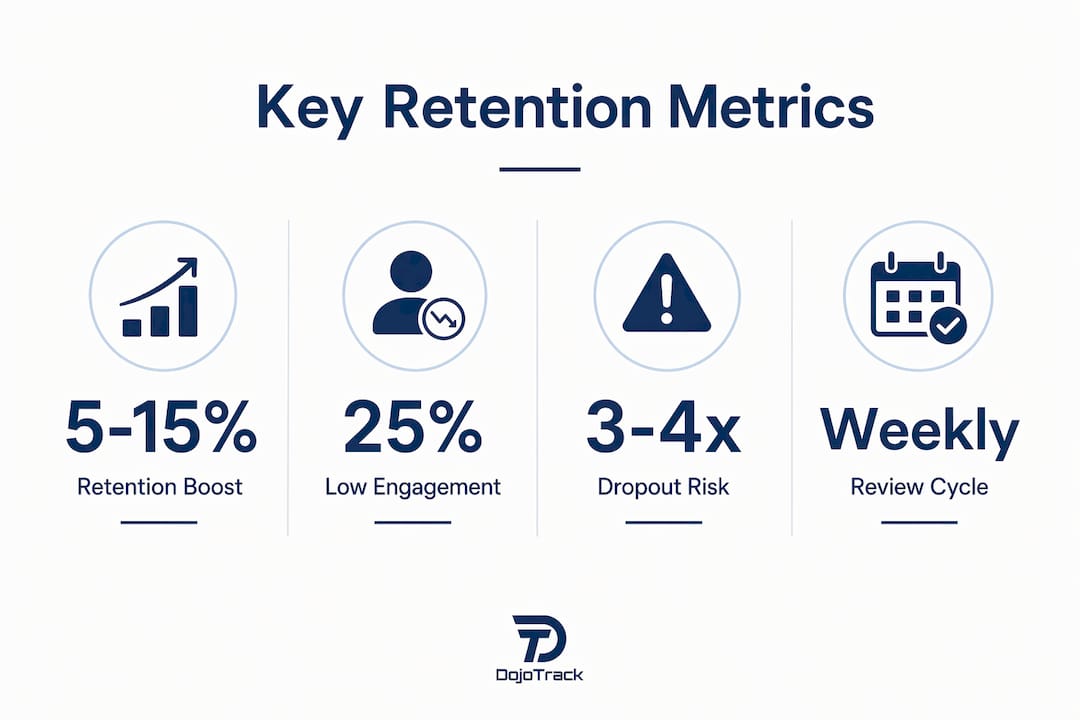
Pro Tip: Set a weekly calendar reminder to review your bottom 25% engagement list. Five minutes of review every Monday morning can prevent three or four cancellations per month in a mid-sized gym.
What tools support effective membership tracking in MMA gyms?
The right software turns raw attendance and billing data into a usable retention system. Generic fitness apps were not built for combat sports, and the gap shows quickly when you need belt tracking, coach-marked attendance, or family billing under one roof.
MMA-specific platforms handle this differently. Glossa, for example, combines membership, scheduling, attendance, billing, and retail on one platform with QR and RFID check-in, automated billing, and CRM integration built specifically for combat sports gyms. Starch takes a different approach, using browser automation to pull daily data for member health scoring without requiring API integration, which makes setup faster for smaller operations. DojoTrack combines a full martial arts CRM with AI-driven retention alerts, Stripe-powered recurring billing, and a student mobile app, all designed around the specific workflows of MMA and martial arts schools.
Here is how MMA-specific platforms compare to generic fitness software on the features that matter most for membership management:
| Feature | MMA-specific platforms | Generic fitness apps |
|---|---|---|
| Belt and rank tracking | Yes (automated promotions) | No |
| Coach-marked attendance | Yes | Rarely |
| Combat sports class scheduling | Yes | Limited |
| AI retention risk scoring | Yes (DojoTrack) | Rarely |
| Family billing and discounts | Yes | Sometimes |
| Student mobile app with curriculum | Yes (DojoTrack) | No |
| Recurring billing automation | Yes | Yes |
| CRM with lead scoring | Yes | Sometimes |
The operational advantage of a purpose-built martial arts CRM over a generic tool is not marginal. It is the difference between a system that fits your workflow and one that forces you to work around it.
Pro Tip: Before choosing a platform, list the three manual tasks that consume the most admin time in your gym each week. Any software you evaluate should eliminate at least two of them automatically.
What metrics and behavioral changes indicate member risk in MMA gyms?
Behavior-based risk scoring, which focuses on changes in visit frequency and engagement over time rather than static member attributes like age or membership tier, produces the most accurate early churn detection in combat sports gyms. A member who joined six months ago and attended four times a week is far more at risk if they drop to once a week than a member who has always attended once a week.
The following numbered framework gives you a practical starting point for building your own risk scoring model:
- Attendance drop: A 50% or greater reduction in weekly visits over a two-week period triggers a yellow flag.
- Extended absence: Any gap of 14 or more consecutive days without a check-in moves a member to medium risk.
- Failed payment: A single failed billing attempt combined with reduced attendance moves a member directly to high risk.
- No class bookings: A member who stops booking future classes but has not yet canceled is showing a strong pre-cancellation signal.
- App disengagement: In platforms like DojoTrack, a member who stops logging into the student app or stops tracking belt progress is showing reduced psychological investment.
Here is a sample risk scoring table you can adapt for your gym:
| Risk level | Warning signals | Recommended action |
|---|---|---|
| Low | Slight attendance dip, no payment issues | Monitor weekly, send encouragement message |
| Medium | 14-day absence or 40% attendance drop | Personal text or call from instructor |
| High | Failed payment plus 21-day absence | Direct outreach from owner within 48 hours |
| Critical | No attendance in 30 days, failed billing | Immediate personal call, offer re-engagement incentive |
Timely, tailored intervention strategies vary by risk level. High-risk members need personal outreach from someone they respect, typically an instructor or the gym owner. Moderate-risk members often respond to a re-engagement campaign or a check-in text. Matching the intervention to the risk level maximizes your retention budget and your instructors’ time.
Pro Tip: Track your student attendance patterns by day of week, not just total weekly visits. A member who always trained Tuesday and Thursday but has missed three consecutive Tuesdays is showing a pattern worth acting on immediately.
How membership data improves MMA gym operational efficiency
The benefits of gym membership tracking extend well beyond retention. The same data that flags at-risk members also tells you which classes are underperforming, where your instructors’ hours are being wasted, and whether your pricing structure is sustainable.

Class fill rates and attendance trends directly inform schedule adjustments. Consolidating poorly attended classes has been shown to free instructor slots and improve booking rates across the remaining schedule. If your Monday 6 AM Muay Thai class consistently runs at 30% capacity while your Tuesday 7 PM class is overbooked, the data makes the decision obvious. Without tracking, that imbalance persists for months while you pay an instructor to teach four students.
Financial forecasting also becomes reliable when billing data is centralized. Recurring membership revenue, lapse trends, and failed payment rates give you a monthly cash flow picture that manual tracking simply cannot produce. Recurring billing automation reduces the administrative time spent chasing payments and eliminates the human error that comes with manual invoicing.
The cumulative effect on admin workload is significant. When attendance, billing, scheduling, and member communication all feed into one platform, your front desk staff stops spending hours reconciling data across disconnected systems. That time goes back to member interaction, which is where it creates the most value for your gym’s culture and retention.
Pro Tip: Review your class fill rate report monthly and set a minimum threshold, such as 60% capacity, below which a class gets evaluated for consolidation or time change. This single habit can recover several instructor hours per week.
Best practices for implementing membership tracking in your MMA gym
Getting membership tracking right does not require a data science team. Basic predictive retention programs can be set up within six to eight weeks using existing attendance, billing, and login data. The following steps give you a clear path to implementation:
- Define “at risk” for your gym specifically. A gym with primarily competitive fighters has different attendance norms than a family-focused MMA school. Set your thresholds based on your actual member behavior, not industry averages.
- Choose software that automates data collection. Manual tracking fails because it depends on staff consistency. Platforms like DojoTrack log attendance, billing events, and app engagement automatically, so your risk scores update daily without anyone entering data by hand.
- Build outreach workflows into your tracking system. Risk scoring is only useful if it triggers a response. Connect your member risk levels to automated SMS alerts or staff task assignments so no flagged member falls through the cracks.
- Review and refine your thresholds quarterly. Your first risk scoring model will not be perfect. After 90 days, compare which flagged members actually canceled versus which ones re-engaged. Adjust your thresholds accordingly.
- Use your CRM tips and best practices to keep member records clean. Garbage data produces garbage risk scores. Standardize how attendance is recorded and make sure billing records are reconciled monthly.
Pro Tip: Assign one staff member as your “retention lead” who owns the weekly review of medium and high-risk members. Accountability for follow-up is what separates gyms that use tracking data from gyms that just collect it.
Key takeaways
Membership tracking is the operational foundation that separates MMA gyms with strong retention from those that constantly replace churned members with new ones.
| Point | Details |
|---|---|
| Early outreach doubles effectiveness | Contacting at-risk members 90+ days before renewal outperforms 30-day reactive efforts significantly. |
| Bottom 25% engagement predicts churn | Members with the lowest engagement scores lapse 3 to 4 times more often than engaged peers. |
| MMA-specific software outperforms generic tools | Platforms like DojoTrack and Glossa include combat sports features that generic fitness apps lack. |
| Behavioral trends beat static attributes | Changes in visit frequency and payment timing are more predictive than member demographics. |
| Operational data reduces admin waste | Class fill rates and billing trends enable smarter scheduling and financial forecasting. |
What we have learned from watching gyms use tracking data
Most MMA gym owners who come to DojoTrack are not failing because they lack passion for their sport. They are failing because they are making retention decisions based on memory and instinct instead of data. The gym owner who “knows” which members are at risk is almost always wrong about two or three of them every month. Those are the cancellations that feel like surprises.
The uncomfortable truth about membership tracking is that the data rarely lies, but it does require you to act on what it shows you. Gyms that pull up their risk reports and then do nothing with them get no benefit from the software. The value is entirely in the response. A personal call from an instructor to a member who has been absent for three weeks costs five minutes. Replacing that member costs months of marketing spend and onboarding time.
We have also seen gyms overcomplicate their first tracking setup by trying to score every possible variable at once. Start with two metrics: attendance frequency and payment status. Those two data points alone will surface 80% of your at-risk members. Add complexity only after your team has built the habit of acting on what the simple model shows.
The gyms that win long-term are not the ones with the most sophisticated algorithms. They are the ones where someone looks at the data every week and picks up the phone.
— DojoTrack
See how DojoTrack handles membership tracking for your gym
DojoTrack is built specifically for MMA gyms and martial arts schools in the United States that want to stop losing members they could have kept. The platform combines AI-powered membership management with automated attendance tracking, Stripe-powered billing, and a student mobile app, all in one place. Risk scoring runs automatically so your team sees who needs attention before a cancellation call comes in. Setup takes days, not months, and the automation handles the data collection so your instructors can stay focused on teaching. If you want to understand the lifetime value each member brings to your gym, the lifetime value calculator gives you a concrete number to work with. DojoTrack is the system that makes the role of membership tracking in your MMA gym something your whole team can actually use.
FAQ
What is membership tracking in an MMA gym?
Membership tracking is the systematic recording and analysis of member attendance, payment behavior, and engagement patterns to identify at-risk students early and improve retention. It replaces manual record-keeping with automated data collection and risk scoring.
How does tracking memberships improve MMA gym retention?
Predictive retention programs that use attendance and billing data see 5 to 15% improvements in retaining at-risk members. Outreach that begins 90 or more days before a renewal is twice as effective as last-minute efforts.
What are the most important metrics to track for MMA gym members?
Visit frequency, gap length between sessions, payment timeliness, and class booking patterns are the four most reliable indicators of churn risk. Changes in these behaviors over time are more predictive than any static member attribute.
Can small MMA gyms set up membership tracking without a tech team?
Yes. Basic predictive retention programs can be operational within six to eight weeks using existing attendance and billing data. Platforms like DojoTrack automate data collection so no technical expertise is required from gym staff.
How does MMA-specific software differ from generic gym management tools?
MMA-specific platforms include features like belt and rank tracking, coach-marked attendance, combat sports scheduling, and AI retention alerts that generic fitness apps do not offer. These features align directly with how martial arts schools operate and retain students.