

TL;DR:
- Effective lead management in a martial arts school requires quick response, structured follow-up, and ongoing tracking to convert inquiries into students. Automating initial contact and maintaining consistent communication improves enrollment rates and shortens the time to convert prospects. Building this proactive system from the start ensures long-term growth and maximizes revenue potential.
Lead management in a new martial arts school is the systematic process of capturing, responding to, nurturing, and converting prospective students into enrolled members. The role of lead management in a new martial arts school goes far beyond answering a few phone calls. Without a structured system, most inquiries go cold within hours, and the revenue loss compounds every week. Schools that treat lead management as a core business function, not an afterthought, consistently outperform those that rely on teaching talent alone. The right combination of speed, follow-up discipline, and technology determines whether your school fills its mats or struggles to cover rent.
Why lead response speed defines enrollment success
Speed is the single biggest predictor of whether a prospect becomes a student. Responding within 5 minutes increases lead qualification likelihood by 21 times compared to waiting 30 minutes. That number is not a rounding error. It reflects how quickly a prospect’s attention shifts to the next option on their search results page.

New school owners face a specific problem here. You are on the mat teaching when a lead submits a form at 10:15 AM on a Tuesday. By the time class ends and you check your phone, 45 minutes have passed. That lead has already contacted two other schools. Manual follow-up is inconsistent by nature, and no amount of good intentions fixes the timing gap when you are mid-class.
Automation solves this. An automated SMS sent within 60 seconds of a form submission keeps the conversation alive while you teach. Platforms like Dojotrack send instant, personalized text messages the moment a prospect inquires, so your school responds faster than any competitor relying on manual outreach. The goal is to get a reply, not to close the sale in that first message.
Pro Tip: Set up an automated SMS that asks one simple question, such as “Are you interested in classes for yourself or your child?” A question triggers a reply, and a reply keeps the lead warm until you can call personally.
Do paid intro offers convert better than free trials?
Paid introductory offers convert at 50–60% of leads to full membership, while free trials convert less than 20%. That gap exists because money signals commitment. A prospect who pays $49 to try two weeks of classes has already made a decision. A prospect who signs up for a free trial is still browsing.
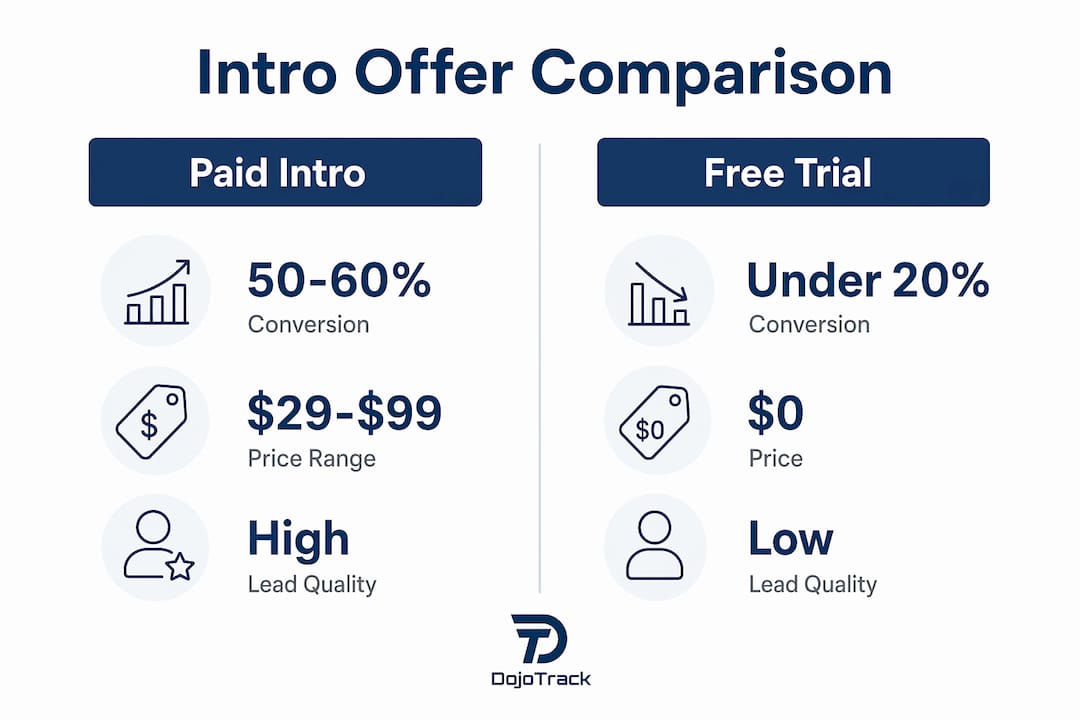
Pricing your intro offer in the $29–$99 range filters out low-intent prospects before they consume your coaching time. This matters especially for new schools where instructor hours are limited and every class slot has real value. You want the mat filled with people who showed up because they chose to invest, not because it cost them nothing.
Communicating the offer clearly is just as important as the price itself. Lead with the outcome, not the discount. “Start your two-week Jiu Jitsu program for $49 and learn your first three submissions” outperforms “Try us free for a week.” The first message tells the prospect what they get. The second tells them nothing about the experience.
Use a price comparison tool to benchmark your intro offer against local competitors and confirm your pricing sits in the conversion-friendly range without underselling your program.
| Factor | Paid intro offer | Free trial |
|---|---|---|
| Conversion rate | 50–60% | Below 20% |
| Lead quality filter | High | Low |
| Coaching time ROI | Strong | Weak |
| Prospect commitment signal | Clear | Absent |
Pro Tip: Pair your paid intro offer with a satisfaction guarantee. “Love it or your money back” removes the last objection without lowering the price or attracting low-intent prospects.
How referral programs accelerate conversions and retention
Referral-sourced enrollments convert 30% faster than leads from paid ads and retain at significantly higher rates. The reason is trust. A friend’s recommendation removes the hesitation that a Facebook ad cannot. The prospect already knows someone who trains at your school, which answers the social proof question before they ever walk through the door.
The data reinforces this pattern. 41% of prospects ask a friend before visiting a martial arts school. That means nearly half of your paid ad leads are quietly consulting someone in your existing student base before they decide. A formal referral program turns that behavior into a predictable lead source.
Effective referral programs share four characteristics:
- Clear incentives. Offer something your students actually want, such as a free month of tuition, branded gear, or a private lesson. Vague rewards produce vague results.
- Simplicity. A referral card, a unique link, or a text message is enough. If the process takes more than 30 seconds, participation drops.
- Constant awareness. Mention the program at belt promotions, in your student app, and in monthly emails. Students forget what they do not hear regularly.
- Tracking. Log every referral source in your CRM so you know which students generate the most new enrollments and can recognize them publicly.
Run a monthly referral campaign tied to a specific event or goal. “Help us hit 100 students by the end of march and everyone who refers a friend gets a free private lesson” creates urgency and community momentum at the same time.
What does a systematic lead follow-up process look like?
Most sales happen between the 5th and 12th contact, yet most school owners give up after two attempts. That gap is where enrollment revenue disappears. A structured follow-up sequence closes it.
A proven multi-touch cadence for martial arts schools looks like this:
- Minute 1. Automated SMS confirms receipt of the inquiry and asks a qualifying question.
- Hour 1. Personal phone call from the owner or front desk staff.
- Hour 3. Automated email with school details, class schedule, and the intro offer.
- Day 2. Second phone call attempt, followed by a ringless voicemail if no answer.
- Day 3. SMS with a direct booking link for a free consultation or trial class.
- Day 5. Email featuring a student success story or testimonial.
- Day 7. Final phone call with a time-sensitive offer tied to the current intro program.
The sequence works because it reaches prospects across multiple channels at different times of day. Someone who ignores a Tuesday morning call may respond to a Thursday evening text. Embedding an online self-scheduler in your Day 3 message removes friction and lets prospects book without waiting for a callback.
A CRM system consolidates all of this communication into one view. Instead of checking separate email threads, text chains, and voicemail logs, you see every touchpoint for every lead in one place. Dojotrack’s automated lead follow-up tools handle the sequence automatically, so no lead falls through the cracks while you are teaching.
Pro Tip: Never end a follow-up sequence without a clear reason. If a lead goes silent after seven touches, send one final message that says “I’ll close your file unless I hear back.” That message often generates a reply from prospects who were simply waiting for the right moment.
Which KPIs actually measure lead management performance?
Tracking the right numbers tells you exactly where your enrollment funnel breaks down. Key performance indicators for lead management include three core ratios that diagnose specific problems.
| KPI | What it measures | Healthy benchmark |
|---|---|---|
| Lead-to-appointment ratio | How many inquiries become scheduled visits | 40–60% |
| Appointment-to-show rate | How many scheduled visits actually arrive | 70–85% |
| Show-to-enrollment conversion | How many visitors sign up for a program | 60–80% |
Each ratio points to a different leak. A low lead-to-appointment ratio means your follow-up speed or messaging is weak. A low show rate means your confirmation process needs work, such as a reminder SMS the morning of the appointment. A low enrollment conversion means your in-person presentation or offer structure needs adjustment.
Cost per enrolled student is a more useful metric than cost per lead. A $10 lead that never shows up costs more than a $40 lead that enrolls and stays for two years. Use a lifetime value calculator to understand what each enrolled student is actually worth over their membership, then set your marketing budget against that number rather than against the cheapest lead source.
Review these KPIs weekly during your first year. Growth for martial arts schools depends on consistent execution and data-driven adjustments, not on finding a new marketing channel every month. Fix the leak before you pour in more water.
Key Takeaways
Effective lead management in a new martial arts school requires fast response, structured follow-up, and consistent tracking to convert inquiries into long-term enrolled students.
| Point | Details |
|---|---|
| Speed wins leads | Responding within 5 minutes increases qualification likelihood by 21 times. |
| Paid offers filter quality | Intro offers priced $29–$99 convert at 50–60%, far above free trials. |
| Referrals convert faster | Referral leads enroll 30% faster and retain longer than paid ad leads. |
| Multi-touch follow-up closes deals | Most enrollments require 5–12 contacts; one or two attempts leave revenue on the table. |
| KPIs reveal the real problem | Track lead-to-appointment, show rate, and enrollment conversion to find and fix funnel leaks. |
The discipline gap no one talks about
Running a new martial arts school teaches you something quickly: the skills that make you a great instructor are not the same skills that fill your mats. Teaching is reactive. Lead management is proactive. You wait for a student to struggle, then you correct them. But leads do not wait for you to get around to them.
The most common mistake I see new school owners make is blaming lead quality when conversion rates are low. The real problem is almost always a missing follow-up system, not bad leads. A prospect who submitted a form at noon and heard nothing by 5 PM is not a bad lead. They are a lost opportunity caused by a process gap.
The fix is not working harder. It is building a system that works while you teach. Automation handles the first three touches. Your CRM tracks where every lead stands. You step in for the personal call when the timing is right. That combination, automation plus human relationship, is what maximizes enrollment without burning you out.
New school owners who adopt this mindset in their first six months build a compounding advantage. Their referral base grows because enrolled students stay longer. Their follow-up costs drop because automation handles volume. Their KPIs improve because they review them regularly and make targeted fixes. The schools that wait until they are “big enough” to need a system are the ones that never get there.
Lead management is not a marketing task you delegate eventually. It is a core operational discipline you build from day one.
— Dojotrack
How Dojotrack supports your lead management system
Dojotrack is built specifically for martial arts schools that need to manage leads, automate follow-up, and track enrollment without adding hours of administrative work. The platform sends automated SMS responses the moment a prospect inquires, scores leads based on engagement, and consolidates all communication into one view so nothing gets missed. Dojotrack integrates with ad platforms and scheduling tools, supports multi-touch follow-up sequences, and gives you real-time visibility into your enrollment funnel. Explore Dojotrack’s AI-powered platform to see how it handles the lead management work that happens while you are on the mat. Schools in the United States can get started with a free core plan and scale up as enrollment grows.
FAQ
What is lead management in a martial arts school?
Lead management is the process of capturing prospect inquiries, responding quickly, nurturing interest through follow-up, and converting prospects into enrolled students. A structured system prevents leads from going cold before you can reach them.
How fast should a new school respond to a lead?
Responding within 5 minutes increases qualification likelihood by 21 times compared to a 30-minute delay. Automation is the only reliable way to meet that standard when you are teaching classes.
Why do paid intro offers convert better than free trials?
Paid intro offers priced between $29 and $99 convert 50–60% of leads to full membership because the payment signals genuine commitment. Free trials attract low-intent prospects and convert below 20%.
How many follow-up attempts does it take to enroll a student?
Most enrollments happen between the 5th and 12th contact. Schools that stop after one or two attempts lose the majority of leads who would have enrolled with more consistent outreach.
Which KPIs should a new school track for lead management?
Track lead-to-appointment ratio, appointment-to-show rate, and show-to-enrollment conversion. These three metrics identify exactly where prospects drop out of your enrollment process.
Recommended
- The Ultimate Guide to Martial Arts School Automation: Everything You Need to Succeed in 2025 | DojoTrack
- Staff management in martial arts schools: A complete guide
- What to Look for in Martial Arts School Software (2026 Buyer’s Guide) – DojoTrack
- Martial Arts Multi-Location Management: A Practical Guide