

Dojotrack is the top choice for U.S. dojo owners who need AI-powered studio management and analytics built specifically for martial arts. It pairs attendance-based churn prediction, automated belt tracking, and Stripe-powered recurring billing in one platform so you can spot at-risk students before they quit and recover failed payments before they become lost revenue. Start with the free core tier to test the fundamentals with zero upfront cost.
Table of Contents
- Why do AI analytics tools matter for dojo owners?
- What should you look for in dojo AI analytics software?
- How does Dojotrack map to what your dojo actually needs?
- How do you implement Dojotrack without disrupting your classes?
- What does Dojotrack cost, and when does the ROI make sense?
- What trust signals should you verify before committing?
- Key Takeaways
- The dojo owner’s perspective
- Ready to see what Dojotrack does for your school?
- Useful sources and Dojotrack resources
- FAQ
Why do AI analytics tools matter for dojo owners?
Most dojo owners lose students gradually, not all at once. A student misses two classes, then three, then quietly cancels. Without data, you notice it too late. AI analytics changes that by turning attendance patterns into early warnings your staff can act on the same week.
Connected AI across booking, billing, and engagement delivers the strongest operational and retention outcomes when all systems share the same data. That means your attendance tracker, billing engine, and communication tools need to talk to each other, not operate as separate spreadsheets.
| Metric | Typical Range | Why It Matters |
|---|---|---|
| No-show rate | 15%–30% | Lost class revenue and underutilized mat space |
| Voluntary churn reduction (with AI) | 15%–25% | Direct impact on monthly recurring revenue |
| Churn model accuracy (behavioral data) | High when visit frequency is included | Reliable early-warning signals for at-risk students |
A practical example: when your analytics flag a student who has attended fewer than two classes in three weeks, your front desk sends a check-in text that same day. That single touchpoint, triggered automatically, is often enough to re-engage the student before they decide to quit.
Key metrics to monitor from day one: attendance trends by student and class, churn risk scores, monthly recurring revenue (MRR) per student, no-show rate by time slot, and payment recovery rate on failed billing cycles.
What should you look for in dojo AI analytics software?
Not every platform marketed as “AI-powered” delivers what a martial arts school actually needs. Use this checklist to cut through the noise quickly.
Must-haves:
- Belt tracking with automated promotion triggers
- Timestamped attendance capture (kiosk or app check-in)
- Integrated billing with Stripe recurring payments
- AI churn prediction tied directly to attendance signals
- Member-facing mobile app with curriculum progress
- Data migration tools for importing existing member records
Should-haves:
- Behavior-triggered SMS and email messaging (missed session, billing failure)
- Waitlist automation that fills canceled spots in real time
- Class scheduling analytics showing utilization by time slot and instructor
- Coach-level performance dashboards
Nice-to-haves:
- Two-way SMS for member conversations
- Conversational analytics (plain-language queries like “who hasn’t visited in two weeks?”)
- Multi-location rollup reporting
For a single-location school under 150 members, the must-haves alone will produce measurable results. Multi-location academies should prioritize the should-haves from the start, since rollup reporting and coach dashboards become critical once you manage more than one mat.
Pro Tip: Enable billing recovery and missed-session outreach automations first. These two flows produce the fastest, most measurable return before you invest time in any other AI feature.
Martial-arts-specific platforms include belt tracking and student progress features that generic gym software consistently lacks. That gap matters more than it sounds: belt progression is a primary retention driver in martial arts, and software that cannot track it forces you back to spreadsheets.
How does Dojotrack map to what your dojo actually needs?
Dojotrack covers every must-have on the checklist above and most of the should-haves, purpose-built for martial arts rather than adapted from a generic fitness template.
| Checklist Criteria | Dojotrack Coverage |
|---|---|
| Belt tracking | Automated belt promotions with curriculum milestones |
| Attendance capture | Timestamped check-ins via kiosk or student mobile app |
| Churn prediction | AI retention system flags at-risk students by attendance pattern |
| Billing | Stripe-powered recurring billing with failed-payment recovery |
| Member mobile app | Students track belt progress, view schedules, get push notifications |
| Data migration | Import tools for member records, billing history, and waivers |
| Scheduling analytics | Class utilization dashboards by time slot and instructor |
| SMS/email automation | Behavior-triggered messaging for missed sessions and billing events |
The free core tier includes student and membership management, attendance tracking, scheduling, digital waiver collection, and basic communication tools. Paid subscriptions unlock advanced AI analytics, SMS automation, Stripe billing, and the student mobile app. Dojotrack is available exclusively to U.S.-based studios, which means support, compliance, and integrations are scoped to the American market.
For a deeper look at how AI analytics drives karate school growth, Dojotrack’s blog walks through real implementation scenarios worth reading before your demo.
How do you implement Dojotrack without disrupting your classes?
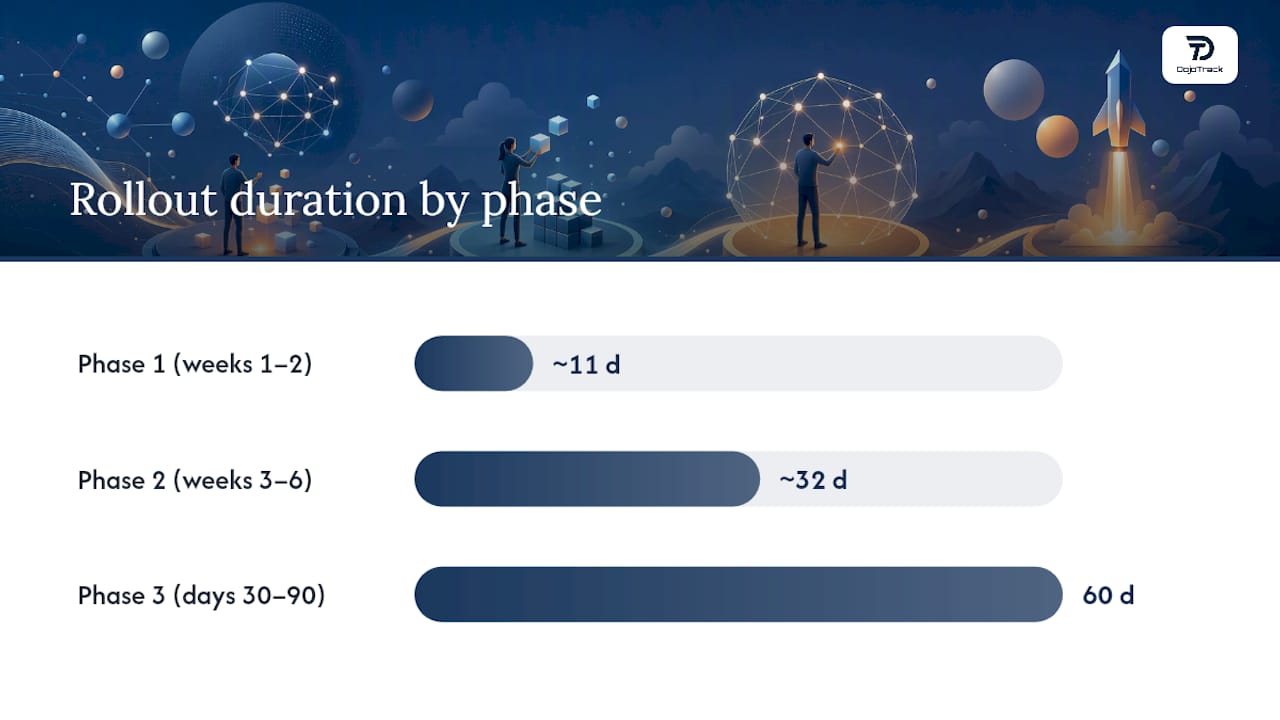
A realistic rollout runs in three phases. Most schools are fully operational within six weeks.
Phase 1: Trial and setup (weeks 1–2)
- Sign up for the free core tier and configure your class schedule, instructor roster, and membership types.
- Export your current member list as a CSV from whatever system you use now.
- Import members into Dojotrack and reconcile active vs. inactive records.
Phase 2: Migration and training (weeks 3–6)
4. Map belt and attendance history for active students.
5. Connect Stripe and run billing in parallel with your existing processor for one full cycle before cutting over.
6. Enable automations in dry-run mode: review every triggered message before it goes live.
7. Train front desk staff on the check-in kiosk and dashboard.
Phase 3: Optimization (days 30–90)
8. Review churn risk scores weekly and assign follow-up tasks to a single staff owner.
9. Measure no-show rate, MRR, and payment recovery rate against your pre-migration baseline.
Data migration priority order:
- Active member records and billing tokens first
- Attendance history (minimum 90 days for churn model accuracy)
- Belt history and current rank for every active student
- Active digital waivers and signed agreements
Running billing in parallel for one cycle is the single most important operational safeguard. It catches mapping errors before they affect a student’s payment and gives your team confidence in the new system.
What does Dojotrack cost, and when does the ROI make sense?
Dojotrack uses a freemium model. The free core tier covers daily operations for schools getting started. Paid tiers unlock advanced automation, AI analytics, SMS messaging, Stripe billing, and the student mobile app.
| Studio Size | Recommended Tier | Upgrade Trigger |
|---|---|---|
| Under 150 active members | Free core tier | When you need automated billing or SMS |
| 150 members | Paid subscription | When churn risk and billing recovery matter |
| Multi-location | Paid subscription + advanced features | When you need rollup reporting and coach dashboards |
Simple ROI example: If your average student pays $120/month and AI-driven retention saves just five students from canceling over 60 days, that is $600 in recovered monthly revenue, or $7,200 annually. Studios that deploy retention automations commonly see positive ROI within 60–180 days, with billing recovery and missed-session outreach producing the fastest returns.
The math gets more compelling when you factor in failed payment recovery. A school with 150 members and a 5% monthly payment failure rate has roughly seven or eight failed charges per month. Automated retry and outreach flows recover a meaningful share of those without any staff time.
What trust signals should you verify before committing?
Dojotrack’s founder background is a genuine differentiator. Jared Reed built the platform after running martial arts schools himself, which means the feature set reflects real operational pain rather than market research alone.
Before committing to any studio management platform, verify these trust signals during your evaluation:
- U.S.-based customer support with a clear response-time commitment
- Migration assistance included in onboarding (not sold separately)
- Transparent free tier with no credit card required to start
- Published case studies or school-specific testimonials you can read before signing
- Active product blog with implementation guidance (Dojotrack publishes resources on AI tools for school owners and automation adoption)
During your demo, ask specifically for a migration walkthrough using your own data, a live view of the retention dashboard with sample at-risk students, and a demonstration of the belt-tracking and promotion workflow.
Key Takeaways
Dojotrack is the strongest AI analytics and studio management platform for U.S. dojo owners because it combines martial-arts-specific features, attendance-based churn prediction, and Stripe billing in one free-to-start platform.
| Point | Details |
|---|---|
| Start with the free tier | Sign up at no cost and run a 30-day attendance and churn baseline before upgrading. |
| Prioritize billing and retention automations | These two flows produce the fastest ROI, often within 60–180 days of deployment. |
| Migration order matters | Import active members and billing tokens first; add belt and attendance history before enabling churn models. |
| Track five core KPIs | Monitor attendance trends, churn risk score, MRR per student, no-show rate, and payment recovery rate. |
| Dojotrack is built for dojos | Purpose-built belt tracking, AI retention alerts, and Stripe billing make it the recommended platform for U.S. martial arts schools. |
The dojo owner’s perspective
We built Dojotrack because the tools available to martial arts school owners were either too generic to handle belt tracking and promotion workflows, or too expensive for a school still growing past 100 students. The administrative burden was real: hours spent on billing reconciliation, manual attendance logs, and chasing leads that went cold because follow-up was inconsistent. Dojotrack exists to give that time back so you can spend it on the mat, not behind a screen. If you have been managing your school on spreadsheets or a generic CRM, the free core tier is the lowest-risk way to see what purpose-built software actually feels like. Try it, run a 60-day baseline, and measure the difference.
Ready to see what Dojotrack does for your school?
Dojotrack gives you a free core platform with no credit card required, covering attendance, scheduling, member management, and digital waivers from day one. When you are ready to see the AI retention dashboard, automated belt tracking, and Stripe billing in action, request a demo or sign up free at DojoTrack.com.
Before your demo, have these ready: a CSV export of your active member list, your current Stripe account credentials, and a list of your top 10 longest-tenured students. The demo covers a migration review using your actual data, a live walkthrough of the retention and churn dashboard, and the full belt-tracking and promotion workflow. You can also use Dojotrack’s free price-comparison tool to estimate costs across tiers before you commit.
Useful sources and Dojotrack resources
- AI in Fitness: The Complete Guide for Gym & Studio Operators in 2026 — ABC Fitness
- AI for Fitness Studios & Gym Owners: What Actually Works in 2026 | Evolved Solutions
- How AI Is Transforming Studio Operations in 2026 — Nutripy
- Martial arts software — Software Advice
- Gym scheduling software — GymRoute
- How to Measure AI ROI in Your Fitness & Wellness Business | AI Business OS
- AI Powered Martial Arts Software | DojoTrack
- AI Analytics for Karate School Growth in 2026 | DojoTrack
FAQ
What makes AI analytics tools different for dojo owners?
Dojo-specific AI analytics platforms include belt tracking, attendance-based churn prediction, and promotion workflows that generic gym software lacks. These features directly support the student progression model unique to martial arts schools.
How quickly can a dojo expect ROI from AI analytics software?
Studios that deploy billing recovery and retention automations commonly reach positive ROI within 60–180 days, with missed-session outreach and failed-payment recovery producing the fastest measurable returns.
Does Dojotrack offer a free plan for martial arts schools?
Yes. Dojotrack’s free core tier includes student management, attendance tracking, scheduling, and digital waivers with no upfront cost, available to U.S.-based schools only.
How accurate are AI churn predictions for martial arts studios?
Behavioral models that include visit frequency are the strongest predictors of member churn, with high accuracy when trained on quality attendance data. The more attendance history you import, the more reliable the early-warning signals become.
What data do I need to migrate to a new dojo management platform?
Prioritize active member records and billing tokens first, then at least 90 days of attendance history, current belt ranks, and active signed waivers. Running billing in parallel for one cycle before cutting over prevents payment disruptions during the transition.