

A martial arts liability waiver limits your exposure to ordinary-negligence claims, but it will not save you from a gross-negligence, willful-misconduct, or willfully unlawful act, and some states restrict enforcement outright regardless of your wording. State law on this varies enough that a template alone is never enough; you need local counsel to check yours. The practical answer: pair a well-drafted waiver with real safety protocols and clean records, and treat the document as one layer of protection, not the whole wall.
TL;DR:
- Waivers do not protect against gross negligence, willful misconduct, or violations of law, and some states may refuse to enforce them altogether.
- To be effective, waivers must specifically name risks, activities, and injuries, and include clear language on assumption of risk, negligence release, and indemnity.
- Regular review and updates are essential, especially after incidents, activity changes, or legal developments, with re-signing mandatory for current records.
- Electronic signatures are valid when timestamped and linked to signed PDFs, streamlining storage, parental consent, and auditability.
- A simple, well-structured waiver combined with safety protocols and staff training offers reliable legal protection and risk reduction.
Table of Contents
- What Is a Martial Arts Liability Waiver, and Why Do Schools Use Them?
- What Clauses Belong in a Martial Arts Waiver Form?
- When Does a Waiver Fail? Enforceability Limits by State
- Building a Usable Martial Arts Waiver: Checklist and Template Essentials
- How Should You Collect and Store Signed Waivers?
- When Should You Review or Update Your Waiver?
- How Studio Software Operationalizes Your Waiver Policy
- What Actually Matters When You’re Running a School, Not a Law Firm
- Get Your Waiver Workflow Off Paper and Into DojoTrack
- Sources
- FAQ
What Is a Martial Arts Liability Waiver, and Why Do Schools Use Them?
A martial arts liability waiver is a pre-activity contract in which a student, or a parent on a minor’s behalf, releases your school from claims tied to ordinary negligence during training. It works alongside a separate legal concept called assumption of risk, which recognizes that contact sports carry inherent dangers a reasonable participant should expect. Courts generally treat these as related but distinct: the waiver is the contractual release, while assumption of risk is the doctrine that supports it.
Schools rely on waivers for three practical reasons. First, a signed waiver reduces the odds a routine sparring injury turns into a lawsuit, because it documents that the student knew the risks and agreed to accept them. Second, it creates a paper trail of informed consent, which matters if a dispute ever reaches a courtroom. Third, insurers often expect a signed waiver on file before they will fully back a claim, which means your paperwork habits directly affect your coverage.
It helps to know the difference between three terms owners often blur together:
- Waiver: a broad term for giving up a legal right in advance, usually the right to sue for certain harms.
- Release: the specific clause (or document) that discharges the school from liability for named claims.
- Indemnity: a separate promise where the student agrees to cover the school’s costs if the student’s own actions cause a third-party claim.
Most martial arts consent forms bundle all three into a single document, which is efficient but only works if each piece is drafted with the martial arts context specifically in mind, not borrowed from a generic gym template.
What Clauses Belong in a Martial Arts Waiver Form?
A generic fitness waiver will not hold up the way a martial arts injury waiver needs to, because striking, grappling, and weapons drills carry risks a treadmill simply doesn’t. Courts have been more willing to enforce releases when the risks named in the document actually match the activity, so specificity is not optional decoration. Here’s the clause order that gives you the strongest, most readable document:
- Party identification and activity description. Name the school, the signer, and describe the covered activities in plain terms: sparring, takedowns, submissions, striking, pad work, and conditioning. A basic release of liability needs clear parties and a clear activity description to meet contract requirements in the first place.
- Assumption-of-risk language with named injuries. Don’t just write “risk of injury.” List realistic outcomes: joint hyperextension from locks, concussive impacts from strikes, mat-impact injuries from throws, and cervical strain from chokes. Generic language invites a court to find the waiver too vague to cover what actually happened.
- Release of negligence claims and covenant not to sue. State plainly that the signer releases the school, its owners, and instructors from claims arising from ordinary negligence, and agrees not to sue over those covered risks.
- Indemnity clause. This shift costs back to the student if their own conduct triggers a third-party claim, such as injuring a training partner during unsupervised sparring. Indemnity language is common in martial arts waivers, but draft it narrowly. An indemnity clause that reads as one-sided or punitive risks being struck as unconscionable.
- Severability and governing law. If one clause is found unenforceable, severability keeps the rest of the document intact. Governing law tells a court which state’s rules apply, which matters more than most owners assume.
- Emergency medical authorization and parental consent. Authorize staff to seek emergency care, and if the student is a minor, add a distinct parental consent block, not a buried sentence.
- Signature block. Printed name, signature, date, and (for minors) the parent or guardian’s printed name and signature.
Pro Tip: Don’t hide your indemnity and release clauses in dense paragraph blocks. Bold the key sentences and put an initial box next to the assumption-of-risk section so a signer physically acknowledges reading it. That small design choice does real work if enforceability is ever challenged.
When Does a Waiver Fail? Enforceability Limits by State
Waivers fail for predictable reasons, and knowing them in advance saves you from a false sense of security. Enforceability turns on a handful of legal doctrines courts apply differently depending on where your school operates:
- Assumption of risk: courts ask whether the injury arose from a risk inherent to martial arts training, or from something outside what a reasonable participant would expect.
- Contracts of adhesion: if a waiver is presented as take-it-or-leave-it with no chance to negotiate, some courts scrutinize it more closely, though this alone rarely voids a sports waiver.
- Unconscionability: a waiver written so one-sided it shocks the conscience of the court can be thrown out entirely.
- Public policy: some jurisdictions refuse to enforce waivers for activities involving instruction or supervision by a professional, treating the relationship as one the public has an interest in protecting.
The most important limit for any school owner to internalize: waivers generally do not protect against claims for gross negligence, willful misconduct, or violations of law, and some courts void waivers entirely as against public policy in certain contexts. That means a waiver won’t help you if an instructor ignores an obvious safety hazard, continues a drill after a serious injury is reported, or lets an unqualified assistant run high-risk sparring unsupervised.
Minors complicate this further. Many states require a parent or legal guardian’s signature and treat that consent differently from an adult’s own waiver, sometimes limiting how much a parent can waive on a child’s behalf regardless of the wording used. Courts in several jurisdictions apply extra scrutiny to minor releases specifically because a child cannot consent to give up their own future right to sue.
None of this is uniform. Enforceability of waivers, releases, and exculpatory agreements varies significantly by state, and some states enforce contact-sport waivers routinely while others treat them with real suspicion. Consult local counsel before you assume your template travels well across state lines, and revisit your waiver whenever your state’s appellate courts issue a new ruling touching sports releases.
Building a Usable Martial Arts Waiver: Checklist and Template Essentials
A waiver that nobody reads protects nobody. The goal is a document that is legally sound and actually gets read, which usually means keeping the core waiver to one page with bolded key lines and initial boxes next to your highest-risk clauses.
Follow this clause order for a clean, readable document:
- Party identification and activity description
- Assumption-of-risk statement with named injury examples
- Release of claims and covenant not to sue
- Indemnity clause
- Severability and governing law
- Emergency medical authorization
- Parental consent block (if applicable)
- Signature, printed name, and date
Add a separate sparring or competition addendum when students move into live contact training or off-site tournaments. A distinct contact-sport addendum strengthens your informed-consent argument, because it shows the student specifically agreed to that heightened risk rather than a general acknowledgment buried in enrollment paperwork.
Avoid three common mistakes: writing an overbroad waiver that tries to cover every conceivable harm (courts read these skeptically), tucking indemnity language somewhere the signer won’t notice, and running a perpetual waiver that never gets re-signed even as your programs change.
| Waiver element | Why it matters | Common mistake to avoid |
|---|---|---|
| Named risks | Supports informed-consent argument | Vague “risk of injury” language |
| Indemnity clause | Shifts third-party cost exposure | Overbroad or one-sided wording |
| Minor consent block | Meets state parental-signature rules | Treating minors like adult signers |
| Re-signing cadence | Keeps consent current with activities | Letting a signed form run indefinitely |
How Should You Collect and Store Signed Waivers?
Electronic signatures are legally valid for martial arts waivers when collected properly, and most schools are better off going paperless than managing folders that go missing or fade. The standard for a defensible electronic record includes a timestamp, an explicit consent checkbox the signer actively clicks, and an archived PDF copy tied to that signature event. Electronic-signature platforms that log this audit trail give you far stronger evidence than a stack of paper in a filing cabinet.
For minors, build a workflow where the parent or guardian completes the e-signature themselves, with an in-person ID check at the front desk if your school wants extra verification. Keep the minor consent block visually separate from the adult signature section so nobody signs the wrong part by mistake.
- Require a signed waiver before a student’s first class, no exceptions.
- Store signed PDFs with timestamps in a system separate from general marketing files.
- Keep medical information separate from records that staff access for day-to-day administration.
- Re-collect signatures whenever your waiver language changes materially.
Pro Tip: Link every signed waiver directly to that student’s attendance record. If a claim ever surfaces years later, you want to pull up the signature, the timestamp, and the student’s class history in one search, not three different filing systems.
When Should You Review or Update Your Waiver?
Review your waiver annually at minimum, and immediately after any incident, near-miss, or claim, whether or not it resulted in a lawsuit. Waiting until a problem forces the issue means your language is reactive instead of protective.
Specific triggers should prompt an off-cycle review:
- Adding live sparring or new contact drills to a program that previously didn’t include them
- Introducing weapons training, which carries different risk categories than empty-hand curriculum
- Running off-site events, seminars, or tournaments not covered by your standard waiver
- Changing insurance carriers or policy terms, since some insurers require specific waiver language
When you update language, run a batch re-sign campaign rather than letting old signatures linger indefinitely. A short in-software prompt at check-in captures nearly everyone within a couple of weeks without disrupting class schedules.
How Studio Software Operationalizes Your Waiver Policy
A well-drafted waiver only works if it actually gets signed, stored, and retrieved when you need it, and that’s an operations problem as much as a legal one. Software built for martial arts schools should give you:
- Digital signature capture built into enrollment, not a separate step staff forget to run
- Parental and guardian workflows that route minor consent to the right signer automatically
- Automatic re-sign reminders when waiver language changes
- Archived, timestamped PDFs linked to each student’s record
- Connections between waiver status and attendance, so nobody trains without a signed form on file
The payoff is fewer front-desk bottlenecks during enrollment and an audit-ready file if an insurer or attorney ever asks for proof. None of this replaces legal review of your actual waiver language. Software handles the collection and recordkeeping; a lawyer handles whether the words themselves hold up in your state.
What Actually Matters When You’re Running a School, Not a Law Firm
Most owners over-legalize their waivers and under-invest in the habits that actually reduce risk. A three-page document nobody reads is worse than a clear one-pager students actually understand and sign. Pair that clarity with staff training on spotting unsafe drills and consistent incident logging. A waiver documents consent; it doesn’t build a safety culture, and courts notice the difference when a claim actually gets tested.
Get Your Waiver Workflow Off Paper and Into DojoTrack
Every clause covered above only matters if it actually reaches students and gets stored somewhere you can find it fast. DojoTrack’s free core platform includes digital waiver capture built directly into student enrollment, so a signed form isn’t a separate errand your front desk has to chase down. Parental consent routes automatically for minor students, timestamped PDFs archive themselves, and waiver status links straight to each student’s attendance record, so you’re not digging through folders if a claim or insurer request ever lands on your desk.
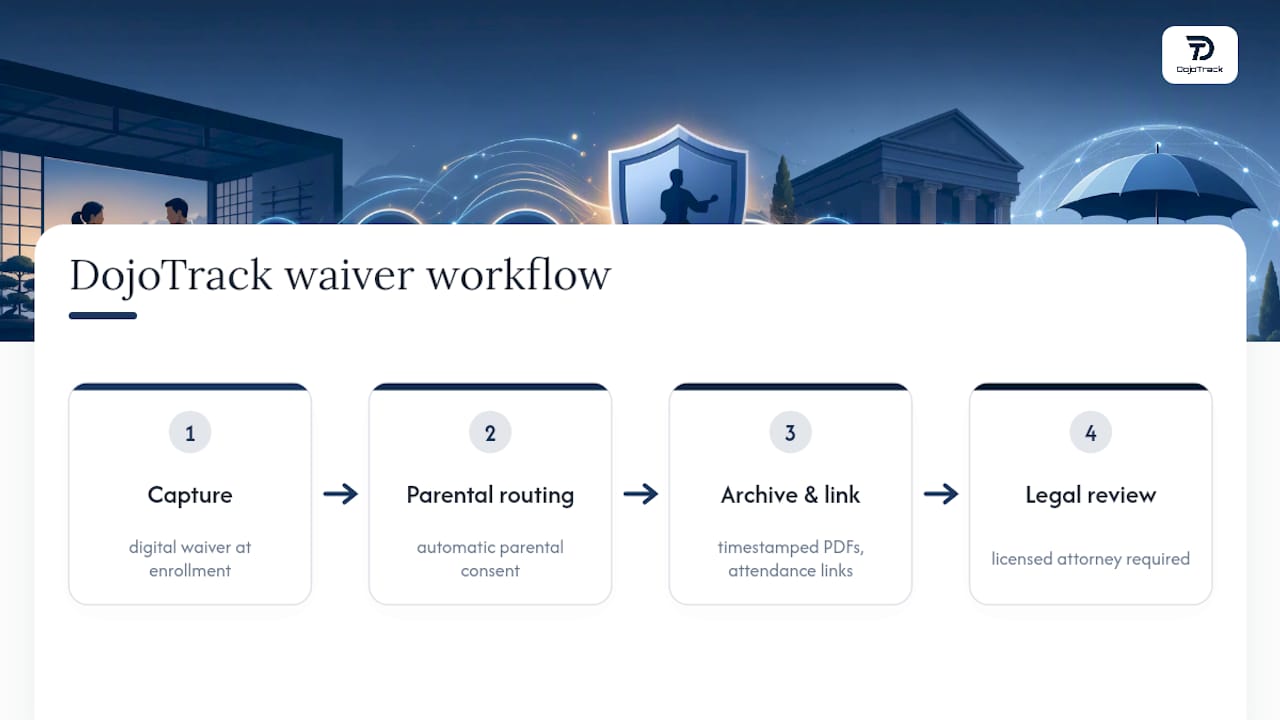
That’s the operational half of the equation. The legal half still belongs to a licensed attorney in your state, and no software replaces that step. If your waiver policy needs a real system behind it, start a free DojoTrack account and see how enrollment, waivers, and attendance connect in one place.
Sources
- Unenforceable Waivers (Vanderbilt law review article)
- Are waivers, releases, and exculpatory agreements enforceable? (Barrett Law blog)
- Docusign liability waiver template and guidance
- LawDepot: Release of liability (US)
FAQ
Is a martial arts liability waiver legally binding?
Yes, when it meets basic contract requirements: clear parties, a defined activity description, disclosed risks, consideration, and a valid signature. It will not protect against gross negligence or willful misconduct, and enforceability still depends on your state’s law.
Do minors need a special waiver for martial arts classes?
Yes. A parent or legal guardian typically must sign on the minor’s behalf, and many states scrutinize minor releases more closely than adult waivers regardless of the wording used.
Can electronic signatures be used for martial arts consent forms?
Yes. A properly collected e-signature with a timestamp, consent checkbox, and archived PDF creates a defensible audit trail that holds up better than paper records in most disputes.
How often should a martial arts school update its waiver?
Review it annually and immediately after any incident, new activity (like adding sparring or weapons training), or insurance policy change, then run a batch re-sign campaign for current students.
Does a signed waiver affect martial arts liability insurance?
Often, yes. Many insurers expect a signed waiver on file as part of standard risk management, and some carriers specify waiver language requirements as a condition of coverage.