

The strongest studio billing setup combines monthly recurring membership on a card on file, discounted six or twelve month prepaid terms, an installment option for big-ticket items like testing fees or gear bundles, and simple family billing for households with multiple students. None of that matters, though, if you skip the one rule that protects your revenue: require a payment method at enrollment and automate billing and recovery from day one. A tool exists specifically to run that stack without you chasing declined cards every month.
TL;DR:
- Offering both prepaid six or twelve-month plans and flexible month-to-month billing can maximize revenue and accommodate different family commitment levels.
- Automating billing recovery with card updater services, auto-retry, and household billing reduces revenue loss from declined payments and manual management efforts.
- Test new pricing only on new enrollments for 60 days to assess conversions without risking current family satisfaction.
- Clear legal contracts and transparent auto-renewal disclosures are essential to avoid disputes and ensure compliance with state regulations.
- Using specialized studio billing software like DojoTrack streamlines recurring payments, family billing, testing fees, and seamless integration with your accounting system.
Table of Contents
- What Payment Plan Options Should a Martial Arts Studio Offer?
- How Do You Design Plans That Protect Cash Flow and Retention?
- How Do You Automate Billing to Stop Payment Failures?
- How Should You Bill Families With Multiple Students?
- How Do You Handle Testing Fees and One-Off Charges?
- Sample Pricing Templates You Can Adapt Today
- How DojoTrack Maps to These Payment Plan Recommendations
- Does a Payment Plan Affect a Student’s Credit Score?
- What Legal Rules Apply to Studio Payment Plans?
- How Do Payment Plans Connect to Your Accounting?
- Owner Perspective: The One Change to Test First
- Ready to Automate Your Studio’s Payment Plans?
- Sources
- FAQ
What Payment Plan Options Should a Martial Arts Studio Offer?
Every studio needs a mix, not a single plan. Month-to-month billing is your default for most students. It is flexible, easy to sell, and keeps friction low for anyone unsure about long-term commitment. Prepaid term plans, typically six or twelve months, reward committed students with a discount and give you predictable cash flow you can actually plan around.
Installment plans matter for anything expensive. A high-cost black belt program or a testing cycle bundle feels less painful split into several payments than paid in one lump sum. Drop-in and day passes cover visiting students and trial visitors who aren’t ready for a membership decision. Class packs or punch cards still work for programs with irregular attendance, like adult conditioning classes.
On payment methods: cards on file dominate for a reason. They work for drop-ins, retail, and recurring tuition alike. ACH debits cost less per transaction and work well for recurring tuition once a family is established, though card-on-file plus ACH where supported is the realistic U.S. combination.
- Month-to-month: highest flexibility, highest churn risk
- 6 or 12-month prepaid: lower churn, better cash flow, needs a discount to sell
- Installment plans: unlock big purchases without sticker shock
- Drop-in/day pass: captures visitors who aren’t ready to commit
- Class packs: fits sporadic attendance patterns
How Do You Design Plans That Protect Cash Flow and Retention?
Commitment length and discount size are the two levers that do the heavy lifting. A longer commitment locks in revenue but only works if the discount is worth the trade. Rules of thumb that hold up across studios:
- Discount 6-month prepaid terms moderately below month-to-month equivalent
- Discount 12-month prepaid terms notably below month-to-month equivalent
- Cap installment plans at a few payments so the per-payment amount still feels manageable
- Reserve enrollment fees for programs with real onboarding cost (uniform, gear, orientation time)
Enrollment fees make sense when there’s a genuine cost behind them, gear, a uniform, staff time spent on assessment. A no-fee model works better for studios competing hard on price in a crowded market, since it removes a barrier at the point of sign-up.
Match the plan to where your studio actually is. A brand-new school building its first fifty students should lean on flexible month-to-month with a light enrollment fee, because trust hasn’t been earned yet. A studio in growth mode benefits from pushing 12-month prepaid harder, since predictable revenue funds hiring and space expansion. A mature, community-anchored school can lean on family plans and loyalty pricing, since retention there is already strong and the goal shifts to lifetime value.
Pro Tip: Run new pricing on new enrollments only for 60 days before touching existing student contracts. You’ll see whether the plan actually converts before you risk upsetting current families.
How Do You Automate Billing to Stop Payment Failures?
Card-on-file at enrollment is non-negotiable. Every membership agreement should capture a payment method before the student steps on the mat for a second class, and recurring billing should be the default setting, not an opt-in.
From there, automation does the work you don’t have time for:
- Auto-retry failed charges on a staggered schedule (day 1, day 3, day 7) instead of one single attempt
- Automatic card updater services that catch expired or reissued cards before they decline
- Dunning messages with a one-tap update link, sent by text and email, not just a form letter
- Multiple billing date options so families can align tuition with payday
- An overdue-accounts dashboard that flags the gap between what’s enrolled and what’s actually collected
That collected-versus-enrolled gap is the number every owner should watch weekly. Unmanaged declines quietly cost studios thousands of dollars a year in revenue that simply never gets recovered, and the fix is almost entirely automation, not more staff hours.
Setting up recurring membership payments properly from the start avoids most of this pain later. And if you’re weighing ACH against card processing costs, ACH billing for gyms is worth a look before you lock in a single processor.
How Should You Bill Families With Multiple Students?
A single household invoice beats separate per-student invoices for almost every family situation. One invoice means one payment date, one card on file, and far less confusion when a parent asks “why did we get charged twice this month?” Per-student invoicing only makes sense when different family members are on genuinely different plans, say, one child on a 12-month term and a parent on drop-in adult classes.
Sibling discount structures that work well in practice:
- Flat dollar discount on the second child ($20 to $40 off monthly tuition)
- Percentage discount scaling with each additional child (10% off child two, 15% off child three)
- Capped family rate once you hit three or more enrolled kids
Record one designated payer per household and attach a single payment mandate that covers every enrolled child under that account. For split-payer situations, divorced parents splitting tuition are common, note each parent’s portion in the billing system and send separate reminder notices even if the mandate stays under one account. Automating family billing removes most of the manual reconciliation that eats an office manager’s afternoon.
How Do You Handle Testing Fees and One-Off Charges?
Testing fees, uniforms, and event registration should never ride on the same invoice line as monthly tuition. Mixing them muddies your recurring revenue number and makes it harder to spot when core membership pricing needs adjusting.
Automate one-off billing around the trigger event itself: a belt test scheduled in your system should auto-generate the fee, not require a staff member to remember to charge it manually. Large retail bundles, a full sparring gear set, for instance, are a good candidate for a short 2 to 3 payment installment rather than one big charge.

Keep refund and chargeback policy language plain: state the refund window in days, whether testing fees are refundable if a student withdraws before the test date, and how retail returns are handled. Prepay for anything consumable or sized to order (uniforms, belts); bill after delivery only for services rendered, like a private lesson package already completed.
Sample Pricing Templates You Can Adapt Today
Real numbers help more than theory. Here’s a template based on common structures studios publish publicly, including family discount patterns seen across academy pricing pages:
Enrollment fee scenario: a $75 one-time fee covering a uniform and orientation session, waived during promotional enrollment windows. Before rolling a price change out school-wide, test it on new enrollments in one program for a full billing cycle and compare conversion and churn against your existing plan before touching current contracts.
How DojoTrack Maps to These Payment Plan Recommendations
Some software solutions are built around exactly this workflow, not adapted from generic gym software. They handle Stripe-powered recurring billing, family billing with sibling discounts, auto-dunning and card recovery, event and testing-fee billing, and in-app purchases through student mobile apps.
- Recurring billing with card-on-file enforcement at enrollment
- Family billing under one household mandate
- Auto-retry and dunning messages built into the billing engine
- Event and belt-test fee automation separate from tuition
- Free core tier for studios getting started, with paid tiers unlocking advanced billing automation
The platform was developed by a founder with experience running martial arts schools, shaping its martial-arts-specific approach to billing and student management.
Does a Payment Plan Affect a Student’s Credit Score?
No, a standard martial arts membership or tuition installment plan does not affect a student’s credit score, and it shouldn’t show up on a credit report at all. Studio payment plans are private agreements between the school and the family, billed through a card or ACH mandate, not financing products reported to credit bureaus.
That changes only if a studio sends unpaid balances to a third-party collections agency, which can report the debt and hurt the payer’s credit. It also changes if a family chooses to finance a large purchase through an outside lender that does report activity, but that’s a decision made outside your billing system, not something your studio’s payment plan itself triggers.
There’s also no credit check involved in setting up a normal tuition installment plan through your studio. You’re collecting a payment method, not underwriting a loan. This matters when you’re talking to prospective families: some hesitate at the word “installment” because they associate it with financing applications and credit pulls. Being clear that your installment plans are simply a payment schedule, not a loan product, removes that objection before it becomes a reason to walk away.
Keep this distinction in your enrollment paperwork and staff talking points. If a parent asks whether signing up will “affect their credit,” the honest answer is no, as long as the account stays current and never gets escalated to outside collections.
What Legal Rules Apply to Studio Payment Plans?
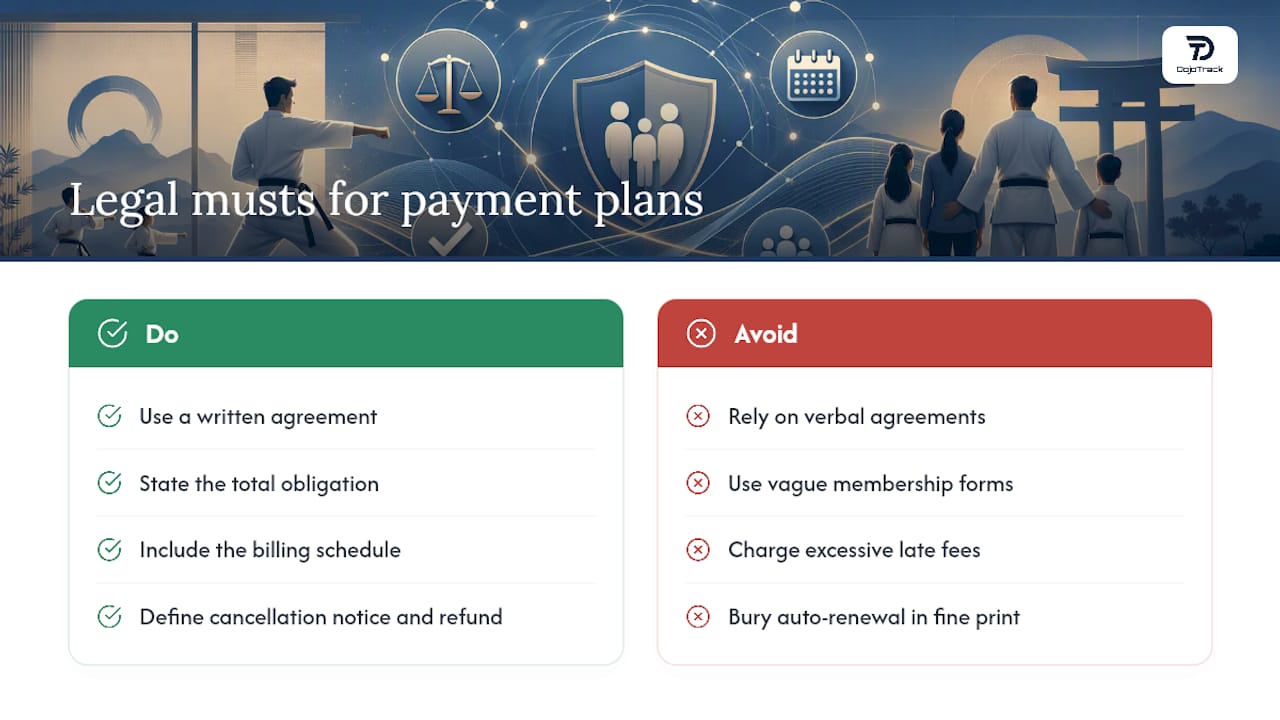
Contract clarity is the biggest legal issue most studios overlook. Every payment plan, whether month-to-month, prepaid, or installment, needs a written agreement stating the total obligation, the billing schedule, cancellation terms, and refund conditions. Verbal agreements or vague membership forms create disputes that are hard to win even when you’re in the right.
Cancellation policy is where most disputes start. State clearly how much notice is required to cancel a recurring plan and whether prepaid terms are refundable on a prorated basis if a student withdraws early. Many states have specific rules governing health club and membership contracts, including required cancellation windows and disclosure language, so it’s worth having a local attorney review your standard agreement rather than copying another studio’s template.
Late fees and collections practices have limits too. Charging excessive late fees or threatening collections action improperly can expose a studio to complaints or legal action in some states. Keep late fees reasonable and clearly disclosed in the signed agreement before you enforce them.
Automatic renewal clauses deserve particular attention. If a prepaid term auto-renews into another prepaid term or converts to month-to-month, that needs to be disclosed plainly at signup, not buried in fine print. A handful of states require an active notice before an auto-renewal charge hits a family’s card.
None of this replaces legal advice specific to your state. It does mean your payment plan structure and your contract language need to move together, not get treated as separate problems.
How Do Payment Plans Connect to Your Accounting?
Manual reconciliation between a billing system and your books is where hours disappear every month. If your studio management software and your accounting software don’t talk to each other, someone is retyping every transaction, or worse, guessing at totals during tax season.
The fix is a billing platform that exports clean transaction data, ideally with automatic sync, into whatever accounting software you already use. Recurring charges, one-off fees, refunds, and family billing all need to land in your books with the right categorization automatically, not as one lump “membership revenue” number that hides testing fees inside tuition.
This matters most at tax time and during any lender or investor conversation, when you need clean, categorized revenue history rather than a shoebox of Stripe statements. It also matters for spotting problems early: if your collected-revenue percentage suddenly drops, you want that visible in your dashboard the same week, not discovered three months later during a bank reconciliation.
Look for platforms built to export in formats your bookkeeper or accountant already recognizes, and confirm whether family billing and installment plans get itemized correctly rather than bundled. Reviewing your payment processing setup before you scale to more locations or more students saves a genuinely painful cleanup later.
Owner Perspective: The One Change to Test First
If you change nothing else, require card on file at enrollment and turn on auto-retry. Watch your decline-recovery rate for 60 days before and after. Most owners who make this single change see collections time drop and monthly cash flow stop swinging unpredictably, without touching pricing at all.
— DojoTrack
Ready to Automate Your Studio’s Payment Plans?
Spreadsheets and manual invoicing can’t run auto-retry, card updater logic, or household billing at the same time, which is exactly why so many studios lose revenue to declined cards nobody catches. Some martial arts billing software solutions address the manual payment chasing problem by handling card-on-file enrollment, recurring charges, family mandates, and dunning messages automatically, and offer free core tiers covering student management and scheduling. If your current setup still depends on someone remembering to check a declined-payments report, start with DojoTrack’s free core platform and turn on automated billing before your next renewal cycle hits.
Sources
- How to Streamline Billing & Collections in Your Martial Arts
- Limitless BJJ memberships and pricing examples
FAQ
Do I Need Both a Prepaid Plan and Monthly Billing?
Yes. Offering both lets you capture price-sensitive families on flexible month-to-month while rewarding committed students with a discounted prepaid term, which improves both conversion and lifetime value.
Should Testing Fees Be Included in Monthly Tuition?
No. Testing fees, uniforms, and event costs should bill separately from recurring tuition so your core membership revenue stays clean and easy to track.
Is ACH or Card Better for Recurring Tuition?
Card on file works everywhere and handles drop-ins and retail, while ACH typically costs less per transaction for established recurring tuition where it’s supported.
Will a Studio Payment Plan Show Up on a Credit Report?
No, a standard tuition or membership payment plan is not reported to credit bureaus unless the account is sent to outside collections.
Can DojoTrack Handle Family Billing With Sibling Discounts?
Yes, DojoTrack supports household-level billing with sibling discount rules built into its recurring billing and family management features.