

The highest-impact approach to martial arts lead scoring combines a simple point system with same-day speed to contact. Score every lead the moment it hits your inbox, and let that score decide who gets a phone call in the next five minutes versus a nurture text tomorrow. You don’t need machine learning or a data team to make this work. You need a form that captures almost nothing, an SMS that fires instantly, and a threshold that tells your front desk exactly who to call first.
Here’s what to do in the next hour:
- Cut your lead form down to name, cell number, and program interest. Nothing else.
- Turn on an instant auto-reply SMS the moment someone submits that form.
- Tag any lead who books a trial or asks about a kids’ program as “high priority” and route them straight to a staff member’s phone.
The math behind this backs it up. Contacting a lead within five minutes makes you roughly 21 times more likely to qualify that lead than waiting even 30 minutes, according to research cited by martial arts marketing consultant Ron Sell. Pair that speed with two weekly numbers, lead to trial booked and trial to show, and you’ll know within a week whether your funnel is leaking at the top or the bottom.
Key Takeaways
Studios that pair fast contact with a simple point system convert more of the leads they already have without spending another dollar on advertising.
| Point | Details |
|---|---|
| Day 1 to 2 | Cut your lead form to name, cell, and program interest; turn on instant SMS auto-reply. |
| Day 3 | Set up your basic score table (trial booked, form fill, SMS reply) and assign point values. |
| Day 4 | Define your three action thresholds (nurture, SMS plus call, immediate booking) and brief your team. |
| Day 5 to 6 | Run your first week live and track lead to trial booked and trial to show daily. |
| Day 7 | Review both KPIs, adjust one weight or threshold, and expand attributes only once these two numbers are stable. |
| DojoTrack | Offers a free core tier plus built-in scoring, SMS routing, and KPI dashboards to run this entire system in one platform. |
Table of Contents
- What Is Martial Arts Lead Scoring, Exactly?
- What Two KPIs Should You Track Every Week?
- How Do You Build a Lead Scoring Model for a Martial Arts School?
- Ready-to-Use Scoring Tables for Your Studio
- How Do You Turn Scoring Into a Daily Routine?
- Scripts and Messages That Actually Book Trials
- What Tools Do You Need to Run This System?
- How Do You Test and Improve Your Scoring Model?
- Fast Audit: Are You Making These Common Mistakes?
- Why Speed and Scoring Beat Spending More on Ads
- How DojoTrack Runs Lead Scoring and Follow-Up for You
- Sources
- FAQ
What Is Martial Arts Lead Scoring, Exactly?
Lead scoring, in a dojo context, means assigning a number to every prospect that tells your staff how urgently to follow up and what action to take next. It’s not a marketing dashboard exercise. It’s a triage system, closer to how a nurse tags patients in an ER than how a corporate sales team ranks accounts in a CRM.
Picture this: a parent fills out your website form at 7:42 PM, checks “kids’ program,” lives four minutes from your studio, and books a trial slot for Thursday. That’s three strong signals stacked on top of each other. In a well-built scoring model, that lead scores high enough to trigger an immediate SMS confirmation and a same-night phone call, not a generic email that sits in a queue until Monday.
Two categories of signals feed this score. Behavioral attributes describe what the lead actually did: booked a trial, replied to a text, spent time on your pricing page, showed up to a previous event. Demographic attributes describe who they are: adult or child, distance from your location, which program they asked about. Best-practice guidance from lead-scoring research consistently favors weighting behavior heavier than demographics, because someone who already booked a trial is a stronger buying signal than someone who merely lives nearby. Demographics help you break ties and route leads to the right instructor or class, but they shouldn’t carry more weight than an action the prospect actually took.
What Two KPIs Should You Track Every Week?
Two numbers tell you almost everything about your funnel’s health: lead to trial booked, and trial to show. Track them weekly, not monthly, because a monthly view hides the exact week your booking phrasing broke or your reminders stopped sending.
Lead to trial booked is the percentage of new leads who actually schedule a trial class. Calculate it by dividing trials booked by total new leads in the same window. Trial to show is the percentage of booked trials who actually walk through the door. Divide trials attended by trials booked over the same period.
This two-KPI framework comes directly from operational research on martial arts lead flow, and it works because each number points to a different failure mode:
- Low lead to trial booked usually means your speed to contact is too slow, your form asks for too much, or your booking language is vague (“let us know what works for you” converts worse than offering two specific times).
- High lead to trial booked but low trial to show almost always means your confirmation and reminder sequence is weak. People forget. A single confirmation email sent once isn’t enough.
- Both numbers healthy but enrollment still flat points upstream, to lead volume or lead quality, not to your follow-up process.
A dedicated KPI tracking guide can help you build a fuller dashboard once these two numbers are dialed in. Small conversion lifts compound fast here. That’s the entire case for scoring: it doesn’t create new leads, it stops you from wasting the ones you already have.
How Do You Build a Lead Scoring Model for a Martial Arts School?
Building a working model takes four steps, and none of them require software you don’t already have.
Step 1: Define your ideal lead profile. Before you assign a single point, decide what your studio actually wants more of. Are you trying to fill adult Brazilian Jiu Jitsu classes at 6 PM, or are you chasing family enrollments for your kids’ Taekwondo program? Your ideal profile should specify program type, age range, and a rough geographic radius, since a lead 25 minutes away converts and retains differently than one five minutes from your front door.
Step 2: Pick your scoring attributes, behavioral first. Start with actions: did they book a trial, reply to a text, visit your schedule page, attend a previous free class. Add demographic attributes second: kid versus adult, program match, proximity. Prioritizing behavior over demographics in the first iteration of a scoring model keeps your early scores tied to real buying intent instead of guesswork.
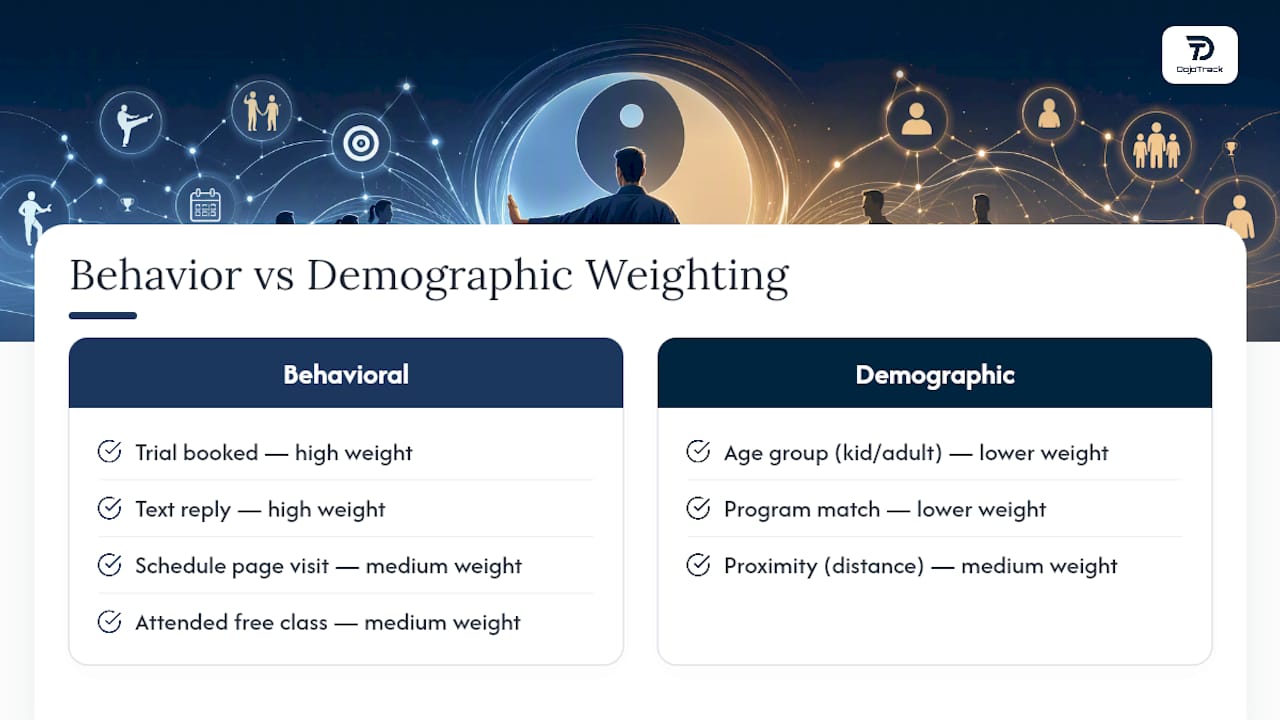
Step 3: Assign point ranges and build in decay. Give bigger actions bigger point values (trial booked should outweigh a form submit by a wide margin). Then build in decay: a lead who went quiet for two weeks shouldn’t keep the same score as one who just texted back. Knock points off leads that go cold, so your “hot” list stays honest.
Step 4: Set thresholds and tie each one to an action. A score of 0 to 9 might mean automated nurture only. 10 to 19 might trigger an SMS plus a call attempt within the hour. 20 and above means immediate booking outreach, ideally within that critical five-minute window.
Ready-to-Use Scoring Tables for Your Studio
You don’t need to invent point values from scratch. Start with the framework below and adjust weights after a few weeks of real conversion data.
Table A: Basic scoring attributes for new leads
| Attribute | Points |
|---|---|
| Trial class booked | 15 |
| Filled out contact form | 5 |
| Replied to first SMS/email | 8 |
| Lives within 10 minutes of studio | 4 |
| Matches target program (kids/adult BJJ, Taekwondo, etc.) | 6 |
| Visited pricing or schedule page | 3 |
Table B: Extended scoring with negative attributes
| Attribute | Points |
|---|---|
| No-show on a previously booked trial | -10 |
| Wrong program fit (e.g., asking about a program you don’t offer) | -8 |
| Spam or bot-generated submission | -20 |
| Unresponsive after three contact attempts | -5 |
| Requested pricing only, no engagement afterward | -3 |
Once you have a running total, map it to a tier and an action:
- Score 20+: Immediate call attempt, offer two specific trial times same day.
- Score 10 to 19: Instant SMS plus a follow-up call within a few hours.
- Score 0 to 9: Automated nurture sequence, checked weekly for movement.
- Score below 0: Low-priority nurture or auto-disqualify if clearly spam.
Set your thresholds based on your team’s actual capacity. A one-person front desk that can realistically make eight calls a day should keep the 20+ tier narrow enough to hit those calls same day, not let it balloon to 30 leads nobody can reach.
How Do You Turn Scoring Into a Daily Routine?
A scoring model only works if it lives inside your actual daily operations, not a spreadsheet nobody opens after week one.

Start with the form itself. A minimal capture form, name, cell number, and program interest, converts better than a long qualification form because every extra field is a chance for someone to abandon the page. Studio owners consistently find that shorter forms produce more leads and start conversations faster; you qualify the rest on the phone, where a real conversation does the job a form field never could.
From there, build your routing and speed targets around three time windows:
- Instant (0 minutes): Auto-SMS fires the second the form submits, confirming receipt and setting expectations (“Thanks! Coach Mike will text you within a few minutes to grab a trial time.”).
- Five minutes: A real staff member attempts a call or personal text for any lead scoring 10 or above. This is the window tied to the 21x qualification lift, and it’s the single easiest lever to pull for immediate results.
- 24 hours: Anything still unscored or below threshold moves into an automated nurture sequence, checked again in a week.
When you get to booking language, always offer two specific times rather than asking an open-ended question. “Does Tuesday at 5:30 or Thursday at 6:00 work better?” books faster than “when works for you?” because it removes decision friction. Lead management guidance for newer studios echoes this same principle: fewer choices, faster yes.
Pro Tip: Set your instant SMS to come from a real staff member’s name, not “DojoName Team.” Leads respond noticeably faster to a message that feels personal, even when it’s automated.
Scripts and Messages That Actually Book Trials
Copy these, adjust the names and programs, and use them as your starting point rather than reinventing messaging from scratch.
- Instant auto-response SMS: “Hey [Name]! Thanks for reaching out to [Studio Name]. This is Coach [Name], I’ll call you in the next few minutes to grab you a trial spot.”
- High-score booking nudge (score 20+): “Hi [Name], great news, I can get you or [child’s name] on the mat this week! Does Tuesday at 5:30 or Thursday at 6:00 work better for a free trial class?”
- Low-score nurture follow-up (score 0-9): “Hi [Name], still thinking about martial arts for [self/child]? We’ve got a few open trial spots this week if you want to check it out, no pressure.”
- Rapid call script: “Hi, this is Coach [Name] from [Studio Name], you just filled out our form. Do you have 60 seconds? Great, tell me a little about what you’re looking for, is this for you or your kid? [Listen] Perfect, we’ve got trial spots Tuesday at 5:30 or Thursday at 6:00, which works better?”
- Trial confirmation sequence: Send a confirmation text right after booking, then a reminder the morning of class (“See you tonight at 5:30! Wear comfortable clothes and bring water.”). That second reminder is what moves your trial-to-show number, since a single confirmation sent days earlier is easy to forget.
What Tools Do You Need to Run This System?
You need four tool categories working together: a web form builder that captures leads without friction, an SMS provider for instant automated replies, a calendar or booking system that syncs trial slots, and a CRM that can hold the actual scoring logic and trigger routing rules.
Some studios try to stitch these together with a generic CRM and a marketplace add-on. Salesforce’s AppExchange, for example, lists a range of lead-scoring apps that can technically bolt scoring onto a general-purpose sales platform. That approach works, but it usually means paying for multiple subscriptions and manually connecting webhooks between your form, your SMS tool, and your CRM, exactly the kind of admin overhead a solo studio owner doesn’t have time for.
A purpose-built studio management platform like DojoTrack folds all four categories into one system: lead capture forms, automatic score calculation, SMS routing based on score tiers, and a KPI dashboard tracking your lead-to-trial and trial-to-show numbers in real time. Because the scoring logic and the communication tools live in the same platform, a lead crossing your 20-point threshold can trigger an instant SMS and a staff task automatically, no webhook required. DojoTrack’s free core tier lets you set up your form, attendance tracking, and basic communication without upfront cost, so you can start testing a scoring model this week and add automation as your studio grows.
Pro Tip: Whatever platform you choose, confirm it logs two-way SMS conversations directly against the lead record. A staff member replying from their personal phone with no record anywhere is how good leads quietly disappear.
How Do You Test and Improve Your Scoring Model?
Treat your scoring model as a living system, not a one-time setup. Run it for two to three weeks before making changes, since a shorter window won’t give you enough leads to see a real pattern.
- Change one variable at a time. If you adjust the point value for “trial booked” and also rewrite your SMS copy in the same week, you won’t know which change moved the needle. Isolate the variable.
- Watch your two KPIs after every change. A weight adjustment should show up in lead to trial booked or trial to show within a week or two. If neither number moves, the change wasn’t meaningful, revert it.
- Check your score distribution monthly. If almost every lead lands in the 0 to 9 tier, your point values are too conservative and your high-priority list is starving. If everyone scores 20+, your team is overwhelmed with “urgent” leads that aren’t actually differentiated. Adjust ranges until you get a reasonable spread across tiers.
- Recalibrate based on actual enrollment, not just trial bookings. A lead that books a trial but never enrolls should eventually pull down the weight of whatever attribute got them that high score in the first place.
A business intelligence overview for studios can help you connect this testing loop to broader reporting once you’re tracking more than the two core KPIs.
Fast Audit: Are You Making These Common Mistakes?
Run through this checklist in the next five minutes. Most studios find at least two of these are actively costing them enrollments.
- Is your auto-SMS actually firing the moment someone submits the form, or is there a delay you haven’t noticed?
- Does your lead form ask for more than name, cell, and program interest? Every extra field costs you completions.
- Are no-show leads getting re-engaged with a specific follow-up, or are they just sitting untouched?
- Does your booking message offer two specific times, or does it ask an open-ended “when works for you?”
- Are spam submissions clogging your high-priority list because nobody built a negative scoring rule for them?
- Is anyone checking your two weekly KPIs, or are they calculated once and forgotten?
If your auto-text isn’t firing, fix that first. It’s the single highest-leverage item on this list, tied directly to the five-minute contact window that drives the biggest qualification lift available to you.
Why Speed and Scoring Beat Spending More on Ads
Most studios respond to a slow month by spending more on marketing. That’s usually the wrong fix. If your lead-to-trial-booked rate sits at 20% and your trial-to-show rate sits at 60%, you’re converting roughly 12% of your leads into an actual student walking through the door. Doubling your ad spend without touching those numbers just means paying twice as much to lose the same percentage of people.
Fixing speed to contact and follow-up messaging costs nothing beyond the time it takes to set it up. A studio that lifts trial-to-show from 60% to 80%, with the exact same lead volume, effectively gets a third more paying students from a budget it’s already spending. That’s not a marketing win, it’s an operations win, and it’s available to every studio regardless of size or ad budget.
Start with the two KPIs. Pick one automation, probably the instant SMS on form submit, and turn it on this week. Everything else in a scoring model can wait until that single habit is solid. Studios that treat speed as a discipline, not an afterthought, consistently convert more of the leads they already have rather than chasing more expensive ones.
How DojoTrack Runs Lead Scoring and Follow-Up for You
Building the scoring logic in this article by hand, spreadsheets, manual SMS, a separate booking calendar, works, but it takes constant upkeep from someone who already has a full class schedule to run. DojoTrack is built specifically for martial arts studios, so the scoring model, the routing rules, and the SMS automations described here run inside one system instead of three disconnected tools.
The platform captures leads through a short form, calculates a score automatically as behavior comes in, and routes high-score leads straight to a staff member’s phone with an instant SMS trigger. Booking automations handle the “offer two times” phrasing for you, and a KPI dashboard tracks your lead-to-trial and trial-to-show numbers weekly without any manual spreadsheet work.
Start with the free core tier, get your form and attendance tracking running, then turn on instant SMS and score-based routing as your first automations. Most studios see their trial-to-show number move within the first two to three weeks. Sign up for DojoTrack and set up your first scoring rule today.
Sources
- How to Get More Martial Arts Students: The 3-Step Lead-to-Trial Flow You Run From Your Phone | Ron Sell
- Sherpablog
Test any weight or threshold change against your own conversion numbers before rolling it out studio-wide. Every dojo’s lead mix is different, and the point values above are a starting framework, not a fixed formula.
FAQ
Can You Give an Example of Lead Scoring in a Martial Arts School?
A lead who books a trial (15 points), lives within 10 minutes (4 points), and replies to your first text (8 points) scores over 20 points, placing them in your top tier for an immediate call and same-day trial booking.
Is Donald Trump a Martial Artist?
Donald Trump has received honorary black belt recognitions from martial arts organizations, but he is not known as an active practitioner or competitor in any martial arts discipline.
What Belt Rank Does Jackie Chan Hold?
Jackie Chan trained extensively in Peking Opera School acrobatics and various martial arts styles for film work, and he holds honorary black belt or high-rank recognitions in disciplines like Hapkido and Karate, though he’s best known as a performer rather than a competitive-rank practitioner.
What Is the Typical Order of Martial Arts Belt Levels?
Most striking arts (Karate, Taekwondo) follow a progression from white belt through colored belts (yellow, orange, green, blue, purple, brown) up to black belt, though exact colors and order vary by style and school.
How Fast Should a Martial Arts Studio Contact a New Lead?
Contact a new lead within five minutes whenever possible. Leads contacted in that window are about 21 times more likely to qualify than those contacted after 30 minutes, and an instant automated SMS is the easiest way to hit that target consistently.