
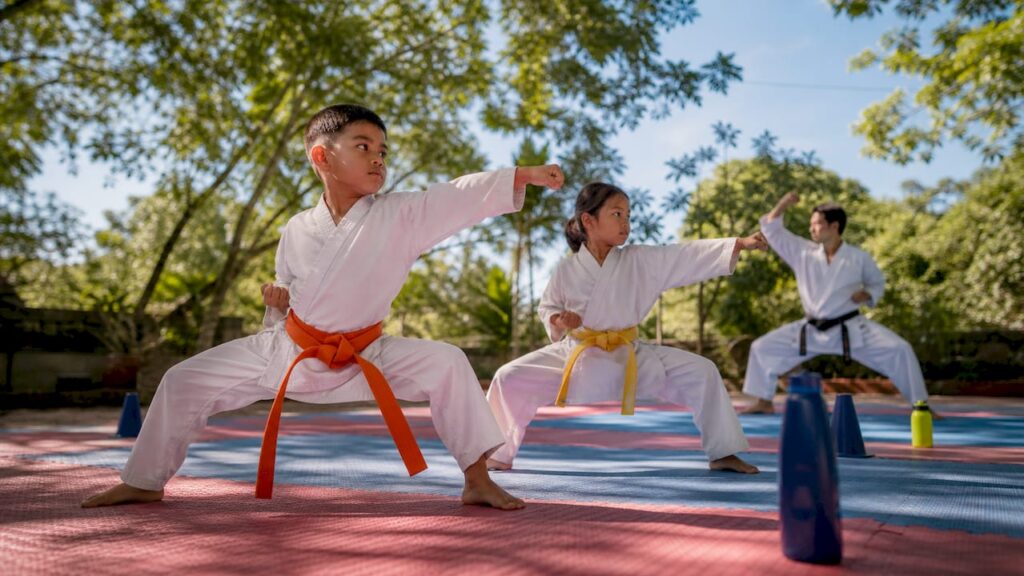
Choose a weeklong, age-grouped karate day camp that publishes its schedule, staff credentials, and refund policy before you pay a deposit. That single filter eliminates most programs that aren’t worth your time. The American Camp Association sets the benchmark for accredited programs, and any reputable martial arts summer camp should meet or exceed its safety standards. Staff must hold current CPR/First Aid certification at minimum, and the program page should list ages, hours, and fees clearly.
Your 3-item quick checklist:
- Age range and grouping: Confirm the camp separates 6–8-year-olds from older kids, or at least adjusts instruction intensity by age.
- Published staff credentials: Look for CPR/First Aid certification, background checks, and a named head instructor with verifiable martial arts credentials.
- Clear refund and field-trip policy: A written refund window and a field-trip permission process should appear on the program page or in the parent handbook before you register.
Immediate next steps (next 48–72 hours):
- Call or check online availability for your preferred session week.
- Confirm before/after care hours and whether swim days require a certified lifeguard on site.
- Secure your spot with the deposit before peak weeks fill.
Pro Tip: Dojotrack’s event registration tools help organizers publish all of this information in one place, reducing the back-and-forth calls that slow parents down.
Key Takeaways
Effective karate summer camp planning comes down to confirming safety credentials and logistics before you pay, then using the right tools to keep operations running without friction.
| Point | Details |
|---|---|
| Confirm safety first | Verify CPR/First Aid certification, background checks, and lifeguard coverage before registering. |
| Register early | Peak weeks fill in February and March; waiting until April often means a waitlist. |
| Know the full cost | Add activity fees, before/after care, and field-trip charges to the weekly rate for a true total. |
| Prepare your paperwork | Have emergency contacts, medical release, allergy plan, and waiver ready before you sit down to register. |
| Dojotrack for organizers | Dojotrack’s free platform covers digital waivers, online registration, billing, and parent messaging in one place. |
Table of Contents
- What’s your karate summer camp planning timeline?
- How do you evaluate and compare karate camps?
- What does a typical karate camp day look like?
- What activities work best for a karate camp?
- How much does a karate summer camp cost?
- What paperwork does registration require?
- What should your child bring to camp each day?
- How do you verify a camp’s safety and staffing?
- What tools help organizers run a karate camp efficiently?
- What running karate camps actually teaches you
- Dojotrack helps organizers cut the admin work
- Sources
- FAQ
What’s your karate summer camp planning timeline?
Most parents start too late. Peak weeks at quality programs fill in February and March, which means a May decision often means a waitlist. Here’s how to move quickly without skipping the checks that matter.
Two-week decision timeline:
- Days 1–3: Search local programs, confirm age eligibility, and request a sample daily schedule and parent handbook from each.
- Days 4–7: Compare safety staffing (ratios, CPR, lifeguard coverage), pricing, and refund policies side by side.
- Days 8–10: Visit or call your top choice, ask about field-trip permission requirements, and confirm before/after care availability.
- Days 11–14: Complete registration paperwork, pay the deposit, and save your email confirmation.
Enrollment checklist before you pay:
- Age groups confirmed (your child fits the listed range)
- Hours match your schedule, including before/after care if needed
- Sample daily schedule available on request
- Safety staffing ratios and CPR/First Aid certification confirmed
- Field-trip permission process explained
- Refund policy in writing
Documentation to have ready at registration:
- Child’s date of birth and current grade
- Emergency contacts (two minimum)
- Medical release and any medication plan
- Allergy action plan (if applicable)
- Insurance card copy (some programs require it)
Most programs require a nonrefundable activity fee plus the first week’s tuition at registration to hold a spot, per common operator practices. Refund windows typically run from full refund with more than 30 days’ notice down to no refund within one week of the session start.
Pro Tip: Search the camp’s name in Google Maps and read the most recent parent reviews. A program with 4.5 stars and 40+ reviews over multiple years is a stronger signal than a polished website with no reviews.
According to camp marketing research, organizers who re-enroll current families in September and run early-bird pushes in January fill their highest-demand weeks before spring. That means if you’re deciding in April or May, the best slots may already be gone. Call first, then compare.
How do you evaluate and compare karate camps?
Not all programs are equal, and the gap between a well-run martial arts summer program and a loosely organized one shows up in the details. Use this framework to compare two or three options side by side.
Decision criteria, ranked by importance:
- Safety and staffing — ratios, background checks, CPR/First Aid, lifeguard on swim days
- Age-appropriate curriculum — separated age groups or adjusted intensity by skill level
- Published schedule and hours — a real daily timetable, not just “9am–3pm karate fun”
- Clear pricing and refund policy — total cost including activity fees, what’s refundable, and by when
- Staff credentials — named instructors, verifiable belt rank, background check confirmation
Questions to ask before you register:
- What is the instructor-to-camper ratio during martial arts class? (Acceptable: 1:8 to 1:12 for ages 6–10; 1:15 is a yellow flag for young groups.)
- Are all staff CPR/First Aid certified? Who holds pediatric first aid certification?
- Is there a certified lifeguard on site for every swim day, or are swim days off-site at a facility with its own lifeguards?
- What is the discipline policy for contact violations during drills?
- Can I see a sample weekly schedule before I register?
Interpreting common program claims:
| Claim | What to ask |
|---|---|
| “Advance a belt level during camp” | Is this a formal promotion with a grading panel, or an informal recognition? |
| “Two martial arts classes daily” | How long is each class, and is the second session technique or free play? |
| “All levels welcome” | How are beginners and advanced students grouped during partner drills? |
| “Field trips included” | Are field trips covered in the weekly fee, or is there a separate activity fee? |
Fee comparison checklist:
- Weekly flat fee vs. per-day rate (per-day is usually 20–30% higher per day than the weekly rate)
- Activity fee: what it covers (t-shirt, field trips, pool entry)
- Sibling discount availability
- Before/after care as an add-on vs. included
- Early-bird discount deadline
Red flags: no published refund policy, no named instructor on the website, and a program that can’t produce a sample schedule on request. Per camp advertising best practices, visible trust signals like staff credentials and a clear refund policy are the top conversion drivers for parents, which means programs that hide them are usually hiding them for a reason.
What does a typical karate camp day look like?
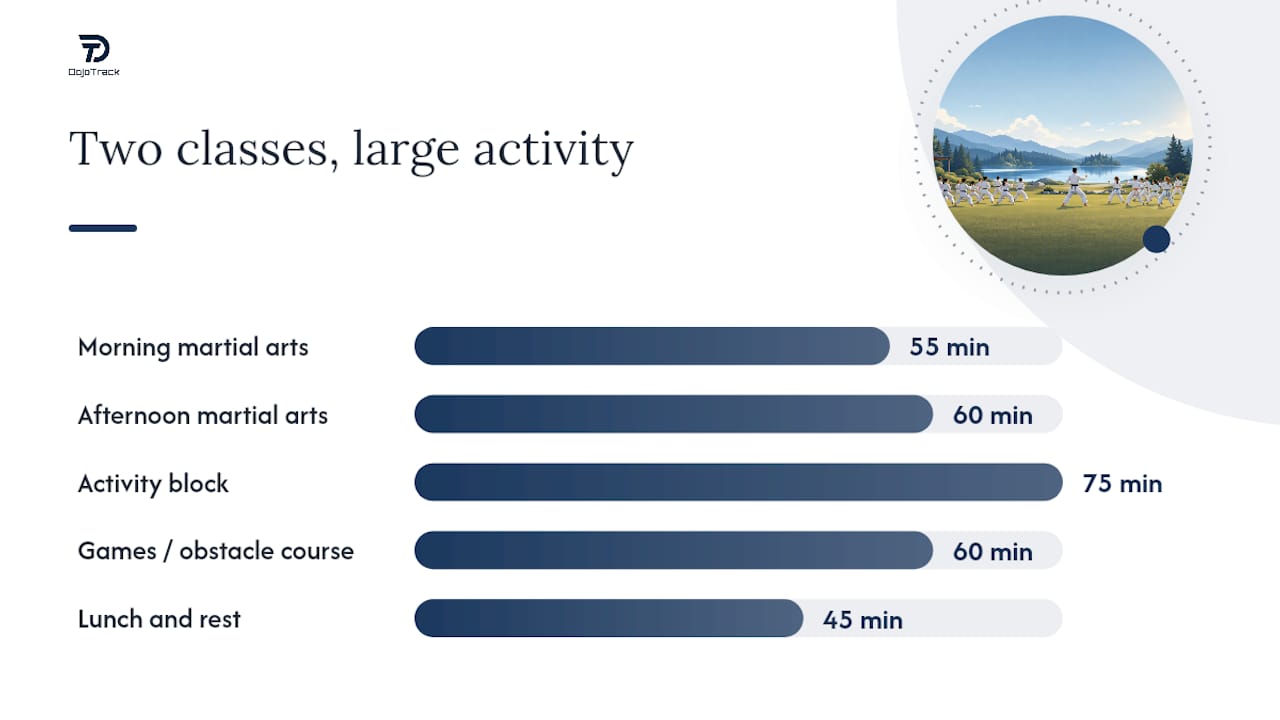
A well-structured day balances focused martial arts training with enough variety to keep kids engaged without burning them out. Boulder Karate’s published schedule and similar program pages show that two martial arts sessions per day, bracketed by games and rest, is the standard format.
Sample full-day schedule (9:00 AM–4:00 PM):
| Time | Activity |
|---|---|
| 9:00–9:20 AM | Drop-off, check-in, free movement |
| 9:20–10:15 AM | Morning martial arts class (warm-up, technique, kata) |
| 10:15–10:30 AM | Snack break |
| 10:30–11:30 AM | Games, obstacle course, or ninja drills |
| 11:30 AM–12:15 PM | Lunch and rest |
| 12:15–1:15 PM | Afternoon martial arts class (partner drills, forms review) |
| 1:15–2:30 PM | Activity block (crafts, leadership challenge, or pool time) |
| 2:30–3:45 PM | Free play, cool-down, group debrief |
| 3:45–4:00 PM | Pickup |
Extended care version (7:30 AM–6:00 PM):
Before-care (7:30–9:00 AM) typically means supervised free play or quiet activities. After-care (4:00–6:00 PM) usually includes structured games, homework time for older kids, and a second snack. Confirm whether before/after care staff hold the same credentials as the main session instructors.
Sample themed week:
- Monday: Martial Skills Day (basic stances, blocks, strikes)
- Tuesday: Field Trip Day (local park or museum, permission form required)
- Wednesday: Pool Day (swim session, lifeguard required, sunscreen reminder sent home)
- Thursday: Ninja Games Day (obstacle courses, team challenges)
- Friday: Showcase Day (mini-demo for parents, belt recognition ceremony)
Field-trip day checklist:
- Signed permission form collected before departure
- Head count confirmed against attendance roster
- Transport vehicle insured and driver background-checked
- Supervision ratio maintained (at minimum 1 adult per 6 campers for off-site trips)
- Contingency plan documented for weather cancellation or swim-day changes
For help building a schedule like this from scratch, Dojotrack’s martial arts class scheduling guide walks organizers through the block-by-block process.
What activities work best for a karate camp?
The strongest programs mix focused technique work with activities that build confidence, teamwork, and physical literacy. Age matters more than skill level when deciding how to structure each block.
Core martial arts lesson types:
- Warm-up and mobility (5–10 minutes, every session)
- Technique instruction: strikes, blocks, stances, and footwork
- Kata/forms practice (individual or group)
- Partner drills (non-contact or lightly controlled for ages 6–8)
- Controlled sparring games for ages 9 and up (point-based, with gear)
Complementary activities that parents expect:
- Ninja-style obstacle courses (agility, balance, coordination)
- Arts and crafts tied to martial arts themes (belt design, dojo flags)
- Leadership challenges and team problem-solving games
- Pool days or water play (with certified lifeguard coverage)
- Local park or museum field trips
Age adjustments:
Ages 6–8 need shorter instruction blocks (15–20 minutes maximum before a movement break), non-contact partner work, and heavy use of games to teach technique. Ages 9–12 can handle 30–45-minute technique sessions, light controlled contact with gear, and more structured kata practice. Mixing these groups in the same drill without adjustment is one of the most common program design mistakes.

Pro Tip: For outdoor field days, sun protection for kids is a genuine safety requirement, not an afterthought. Send a written reminder home the day before any outdoor or pool day, and keep sunscreen available at the camp for reapplication.
A well-structured martial arts camp curriculum separates age groups, defines skill-level progressions for each week, and builds in enough non-martial-arts activity to keep energy levels stable across a full day.
Field-trip activity checklist:
- Permission form collected and filed
- Extra activity fee disclosed in advance
- Transport insurance confirmed
- Head count protocol assigned to a named staff member
- Alternate indoor plan ready for weather cancellations
How much does a karate summer camp cost?
Pricing varies by region, program length, and what’s included, but the structure is consistent enough that you can compare programs on a level basis once you know what to look for.
Common pricing shapes:
- Weekly flat fee: The most common format. Covers daily instruction, snacks or lunch in some programs, and standard activities.
- Activity fee: A separate, usually nonrefundable charge that covers the camp t-shirt, field trips, and pool entry. Typically collected at registration alongside the first week’s payment.
- Per-day rate: Available at some programs for single-day enrollment. Expect to pay roughly 20–30% more per day than the prorated weekly rate.
- Sibling discount: Common at dojo-run programs, usually 10–15% off the second child’s weekly fee.
- Early-bird pricing: Discounts of $20–$50 per week for registrations completed before a set deadline, often in January or February.
- Before/after care add-on: Charged separately, typically by the week or by the hour.
Sample program pages from operators show that activity fees covering shirts and field trips are standard disclosures, and parents should confirm exactly what each fee includes before registering.
Refund policy examples to expect:
- Full refund with more than 30 days’ notice before the session
- Partial refund (often 50%) with 14–30 days’ notice
- No refund within one week of the session start
- Nonrefundable activity fee in all cases
Budgeting tips:
If you have two or more children enrolling, ask about sibling discounts before you assume the price listed is final. Many programs don’t advertise the discount prominently. Confirm eligibility with your HR department or benefits administrator before the session starts.
For organizers thinking through their own pricing model, Dojotrack’s martial arts studio business model guide covers fee structures and revenue planning in detail.
What paperwork does registration require?
Registration for a karate summer camp generates more paperwork than most parents expect. Having everything ready before you sit down to register cuts the process from 45 minutes to under 10.
Document checklist:
- Registration form (child’s name, DOB, grade, address)
- Two emergency contacts with phone numbers
- Medical release form authorizing treatment if a parent can’t be reached
- Medication plan (if your child takes any medication during the day)
- Allergy action plan (including EpiPen authorization if applicable)
- Field-trip permission form (sometimes bundled with registration, sometimes separate)
- Photo and video release
- Waiver and assumption-of-risk form
Payment and deposit practices:
Most programs require the nonrefundable activity fee plus the first week’s tuition at registration to hold a spot, per published operator policies. Some offer payment plans for multi-week enrollments. Refunds are processed back to the original payment method, and the timeline varies from 5 to 10 business days.
Pro Tip: Upload medical documents (allergy action plans, medication instructions) as PDFs during online registration rather than mailing paper copies. Ask the camp whether their system stores these securely and whether staff can access them on a mobile device during field trips. A camp that can’t answer that question clearly is one where a counselor might be searching through a binder at the wrong moment.
After you register, expect an email confirmation within 24–48 hours and a parent handbook within one to two weeks. The handbook should cover drop-off/pickup procedures, daily requirements, communication protocols, and the camp’s behavior policy. If you’re on a waitlist, ask for a specific notification timeline and whether a deposit holds your place or is refunded if a spot doesn’t open.
For a detailed look at managing event registrations and waivers efficiently, Dojotrack’s event registration guide covers the full workflow.
What should your child bring to camp each day?
A clear packing list prevents the most common drop-off problems: forgotten water bottles, missing uniforms, and kids without sunscreen on outdoor days.
Daily packing checklist:
- Activewear or karate gi (confirm with the program whether a gi is required or optional)
- Labeled water bottle (reusable, at least 20 oz)
- Packed lunch and snacks (confirm allergy policy before packing nut products)
- Sunscreen applied before drop-off, plus a travel-size bottle in the bag for reapplication
- Hat for outdoor sessions
- Swim suit and towel on pool days (check the weekly schedule)
- Spare set of clothes (especially for younger campers)
- Closed-toe athletic shoes (sandals and flip-flops are typically not allowed during drills)
- Clearly labeled medication bag with written instructions if medication is required
Common daily rules to know before drop-off:
- No contact during certain partner drills unless gear is worn (confirm the gear policy)
- Electronics collected at drop-off and returned at pickup at most programs
- Snacks must be allergy-safe if shared; many programs ban tree nuts entirely
- Camp t-shirt or uniform required on field-trip days for identification
- Sunscreen reapplication is the camper’s responsibility at most programs for ages 8 and up
Tips for younger campers (ages 6–8):
Label every item, including shoes. Include a small comfort item if the program allows it. Pack the medication bag separately from the lunch bag and attach a note with dosage instructions on the outside. A brief written note from you in the bag can help a nervous first-timer feel connected.
How do you verify a camp’s safety and staffing?
Safety is the one area where you should ask direct questions and expect direct answers. Vague responses to specific safety questions are a red flag, not a sign of modesty.
Recommended staff-to-camper ratios:
- Ages 6–8: 1 adult per 6–8 campers during martial arts instruction
- Ages 9–12: 1 adult per 8–12 campers during instruction
- Field trips and off-site activities: 1 adult per 6 campers regardless of age
- Pool days: certified lifeguard required in addition to regular staff ratios
Essential credentials and policies to confirm:
- Background check completed for every staff member (ask whether this is a national check or state-only)
- CPR and First Aid certification current for all instructors
- Pediatric First Aid certification for any staff working primarily with ages 6–8
- Lifeguard certification on file for swim days
- Named emergency contact protocol (who calls parents, and within what timeframe)
Insurance and emergency planning checklist:
- General liability insurance (ask for proof of coverage)
- Documented emergency evacuation plan for the facility
- Incident-reporting process (written reports for any injury, however minor)
- Medication administration protocol (who administers, where it’s stored, how it’s logged)
- Weather contingency plan for outdoor sessions
Safety questions to ask on tour or by phone:
- “What happens if there’s a thunderstorm during an outdoor session?”
- “Who is the designated first aid responder, and where is the first aid kit located?”
- “How do you handle a camper with a severe food allergy during a field trip?”
- “What is your check-in/check-out ID policy?”
A program that answers these questions fluently, without hesitation, has thought through its safety plan. One that says “we’ll figure it out” or deflects to a brochure hasn’t. Per martial arts camp planning guidance, staff safety training is one of the five core planning pillars, alongside curriculum, budget, and marketing. It’s not optional.
For a deeper look at staffing best practices and ratio planning, Dojotrack’s staff management guide covers the operational side in detail.
What tools help organizers run a karate camp efficiently?
Running a karate summer camp without the right administrative setup means drowning in paper forms, chasing payments, and answering the same parent questions by phone all week. The fix is a short ops checklist and the right tools to back it up.
Organizer ops checklist:
- Publish a parent handbook before registration opens (drop-off/pickup, packing list, behavior policy, emergency contacts)
- Use an online registration system with mobile-friendly checkout and minimal required fields
- Collect digital waivers at signup, not on paper at drop-off
- Run a waitlist with automatic notification when a spot opens
- Confirm enrollment by automated email within 24 hours of payment
Automation examples that save real time:
- Recurring weekly billing for multi-week enrollments (no manual invoicing)
- Automated “how to pack” reminder email sent 48 hours before the first session
- Attendance capture at check-in via a sign-in kiosk or mobile app
- Refund workflow triggered by cancellation request, with automatic confirmation to the parent
Tool features organizers should require:
- Mobile-friendly registration with secure payment processing
- Digital waiver collection and storage (accessible by staff on mobile during field trips)
- Staff scheduling and ratio dashboard
- Integrated parent messaging (SMS or email) for last-minute weather changes or schedule updates
- Attendance tracking tied to the daily roster
Frictionless, mobile-first registration with visible trust signals is one of the highest-impact changes an organizer can make to improve enrollment conversion. Long forms and slow mobile pages are the top reasons parents abandon registration mid-process.
Pro Tip: Collect dietary restrictions and medication information at the point of signup, not on a separate form later. Store it centrally so any staff member can pull it up on a phone during a field trip. A counselor who has to call the office to find out whether a camper carries an EpiPen is a counselor who’s already behind.
Dojotrack’s CRM guide for karate studios explains how integrated tools handle billing, waivers, and attendance in one place, which is exactly the setup a well-run camp needs.
What running karate camps actually teaches you
The first time most organizers run a karate summer camp, three things surprise them: registration fills faster than expected, the paperwork load is heavier than planned, and parents judge safety by what they can see, not what’s in the handbook.
Peak weeks, typically the last two weeks of June and the first week of July, fill in February at well-marketed programs. Organizers who wait until April to promote compete for families who didn’t get into their first choice. The annual marketing calendar that works is the one that re-enrolls current families in September and runs early-bird outreach in January. That’s not aggressive; it’s just how the calendar works.
On staffing: the ratio that looks fine on paper often falls apart on field-trip day when one counselor calls out sick. Build a one-deep backup for every session, not just for the main week.
On documentation: the single change that most improves parent satisfaction is a daily photo recap sent by group message at 3:00 PM. An end-of-week mini-demo where parents watch a five-minute showcase of what kids learned closes the loop and drives re-enrollment better than any discount.
Dojotrack helps organizers cut the admin work
Karate summer camp planning has a lot of moving parts, and the administrative side, registration, waivers, billing, attendance, and parent communication, is where most organizers lose the most time.
Dojotrack is built for exactly this. The platform handles digital waivers and online registration in one place, with mobile-friendly checkout that reduces drop-off at the payment step. Recurring billing covers multi-week enrollments automatically, and the attendance tracking tools keep your daily roster accurate without a paper sign-in sheet.
Immediate time-savers for camp organizers:
- Automated reminder emails sent before each session week
- Waitlist management with auto-notify when a spot opens
- Parent messaging via SMS or email for weather changes and schedule updates
Sign up for Dojotrack’s free core platform at App to get started with registration, waivers, and attendance tracking before your first session opens.
Sources
These are the primary references used throughout this guide, organized by what you’ll use them for.
- Summer Camp Marketing: How to Fill Every Spot Before Opening Day – Jumbula Blog
- How to Run a Successful Martial Arts Summer Camp
- Summer Sport and Karate Summer Camp — Waldorf Martial Arts
- The Ultimate Guide on How to Advertise Summer Camps in 2026
- Summer Camp 2026 — Boulder Karate
FAQ
What age is appropriate for a karate summer camp?
Most programs accept children starting at age 6, with separate instruction groups for ages 6–8 and 9–12. Confirm that the camp you’re considering adjusts contact intensity and instruction block length by age group, not just by belt rank.
How many days a week should kids do karate at camp?
A full-week day camp with two martial arts sessions per day is the standard format. For children ages 6–8, five consecutive days of structured training is appropriate when sessions are about 45 minutes each and broken up by games and rest.
What is the rule of 3 at summer camp?
The “rule of 3” is a common camp safety principle: no camper is ever alone, no staff member is ever alone with a single camper, and every group has at least three people present. It applies during drills, bathroom breaks, and field trips.
How do you organize a karate summer camp from scratch?
Start with five planning pillars: define your program goals, build an age-separated curriculum, train staff in CPR/First Aid, set a realistic budget with activity fees disclosed up front, and open online registration with digital waivers before you start marketing. Dojotrack’s free platform covers the registration, waiver, and billing pieces in one setup.
What should a karate camp refund policy include?
A clear policy states the refund window (typically full refund with 30+ days’ notice, partial with 14–30 days, none within one week), identifies which fees are nonrefundable (usually the activity fee), and explains how refunds are processed and within what timeframe.