

TL;DR:
- Karate belt management software automates tracking, ensuring accurate student records and reducing administrative errors.
- It supports multiple styles, programs, and integrates with billing and attendance for efficient dojo operations.
Karate belt rank management software is defined as a digital platform that tracks, automates, and organizes student belt progressions and promotion workflows within martial arts schools. If you run a karate program, whether Shotokan, Goju-Ryu, or a mixed curriculum, you already know how fast manual tracking breaks down. A missed promotion, a lost testing record, or a spreadsheet error can frustrate a student and cost you a renewal. The right belt rank management tool eliminates those gaps by centralizing every student’s rank history, exam eligibility, and promotion status in one place.
What is karate belt rank management software and what does it do?
Karate belt rank management software is a purpose-built system that replaces paper logs and spreadsheets with automated, discipline-specific tracking. Top-tier platforms support separate tracking for multiple martial arts styles simultaneously, so you can run a Shotokan adult program and a Goju-Ryu kids’ class without mixing up their rank hierarchies. That separation matters because each style carries its own belt color sequence, testing criteria, and curriculum milestones.

The industry term for this category is “rank and promotion management,” and it sits inside the broader umbrella of martial arts school management software. Karate belt tracking software handles the specific logic of who is eligible for the next rank, when their exam is scheduled, and what skills they need to demonstrate. Without that logic built in, you are left reconciling records by hand every testing cycle.
Dojotrack, founded in Utah by martial arts veteran Jared Reed, was built specifically to solve this problem. The platform combines rank tracking with attendance, billing, and AI-powered retention tools so instructors spend less time on administration and more time on the mat.
Core features of karate belt rank management software
The features below represent what a full-featured karate belt promotion software should deliver. Entry-level tools may cover only a few of these. Enterprise-level platforms cover all of them within a single interface.
- Customizable rank hierarchies. Software allows owners to configure belt colors, rank names, and discipline-specific requirements for each program. A Shotokan school and a Goju-Ryu school use different sequences, and the system should reflect that without workarounds.
- Automated promotion tracking. The system flags students who meet attendance thresholds, skill checkpoints, and time-in-rank requirements. You see who is ready to test without manually reviewing every file.
- Age-group-specific belt tracks. Distinct belt rank systems can be built for kids’ programs and adult programs within the same platform. A 7-year-old earning a yellow belt follows a different path than an adult in the same color.
- Exam and testing workflow management. The software schedules exams, tracks results, and updates rank records automatically after a student passes. No manual data entry required after the test.
- Progress dashboards and reports. Instructors and owners see real-time snapshots of where every student stands, which cohorts are approaching promotion, and which students have stalled.
- Automated notifications. Schools report improved motivation and retention when families receive timely updates about upcoming exams and promotion results. The software sends those alerts without you drafting a single email.
- Integration with billing and attendance. Karate belt rank management software connects promotion history, attendance records, and billing in one profile, so you can tie exam fees to the payment system directly.
Pro Tip: Set up your rank hierarchies and testing criteria before you import any student data. Fixing the structure after onboarding is far more time-consuming than building it correctly from the start.
How belt tracking software improves dojo operations and student experience
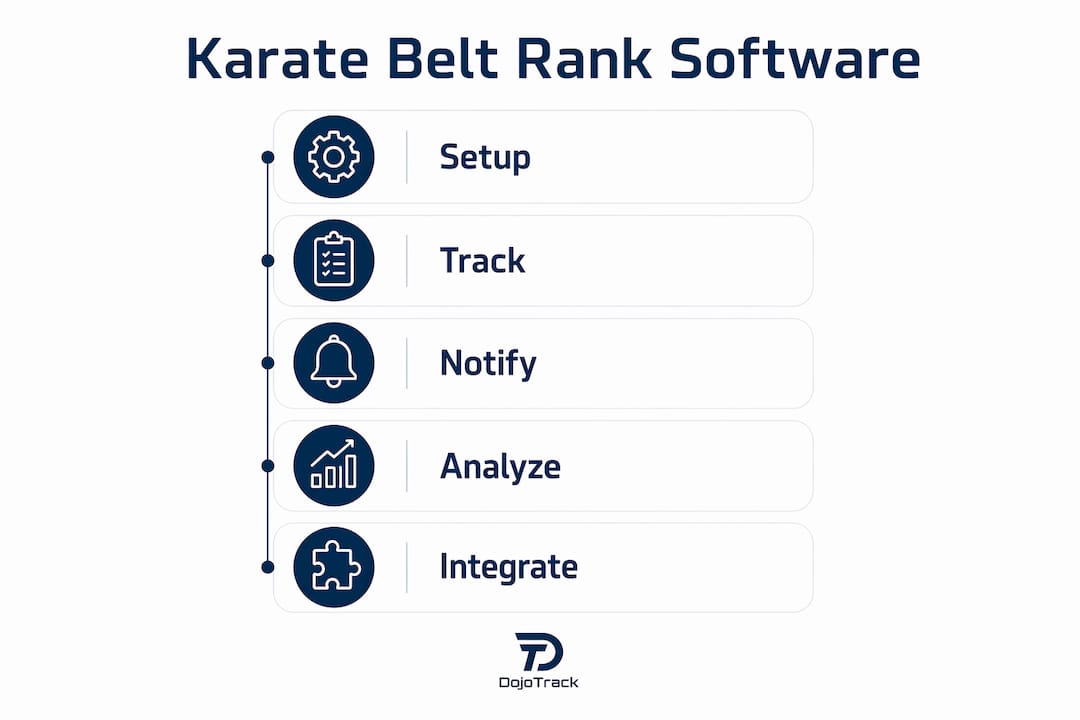
Manual spreadsheet tracking produces inconsistent records and missed promotions. Schools using spreadsheets for belt tracking face these problems regularly, and the result is frustrated students and lost revenue. When a student expects to test and finds out their record was not updated, that is a retention risk you created with a process failure, not a teaching failure.
Belt tracking software removes that risk by maintaining a single, accurate record for every student. The benefits extend well beyond accuracy.
- Fewer administrative errors. Automated eligibility checks replace manual review. The system catches discrepancies before they reach the student.
- Clearer student motivation. Students who can see their progress toward the next rank stay more engaged. Dojotrack’s student mobile app lets members track their curriculum progress, view class schedules, and receive push notifications between classes.
- Stronger family communication. Automated exam reminders and promotion announcements keep parents informed without adding to your workload.
- Data-driven retention decisions. Progress reports reveal which students are falling behind or disengaging. Successful school owners who migrate away from manual tracking early see measurable gains in consistency and revenue stability.
- Accurate historical records. Every rank change, exam result, and attendance milestone is logged permanently. If a student leaves and returns two years later, their full history is still there.
A student progress tracking system that connects rank data to attendance gives you a complete picture of each student’s development. That picture is what separates schools that retain students through black belt from schools that lose them at green.
How to choose the right karate belt rank management software
Selecting the right tool requires evaluating several factors before you commit. Prioritizing customization, ease of use, integration, and scalability helps you avoid buying a system you will need to replace in two years.
| Evaluation factor | What to look for |
|---|---|
| Multi-style support | Can the system run Shotokan, Goju-Ryu, and kids’ tracks separately? |
| Customization depth | Can you set your own belt colors, rank names, and testing criteria? |
| Ease of use | Can your front desk staff learn the system in under a day? |
| Integration | Does it connect to your billing, attendance, and communication tools? |
| Scalability | Will it handle 300 students as easily as 30? |
| Support and training | Does the vendor offer onboarding help and ongoing customer support? |
Entry-level field apps often cover rank tracking but lack billing integration or multi-style support. Enterprise platforms cover everything but may carry pricing that does not fit a small school. Dojotrack sits in the middle: purpose-built for martial arts schools of all sizes, with a free core layer that includes student management, attendance tracking, and scheduling so you can start without upfront cost.
Pro Tip: Ask any vendor for a live demo using your actual belt structure. A system that looks clean in a generic demo may not handle your specific rank hierarchy without workarounds.
Common pitfalls when implementing belt rank management software
Getting the software is only half the work. How you set it up and train your team determines whether it actually helps.
- Skipping discipline-specific configuration. Failure to configure multi-discipline tracking correctly leads to significant errors in belt rank reports. Set up each program’s rank path before you add a single student.
- Rushing the data import. Entering student ranks incorrectly during onboarding creates records that are wrong from day one. Audit your existing data before migrating it.
- Undertrained staff. If your front desk team does not know how to update a rank or schedule an exam in the system, they will default to spreadsheets. Block time for proper training before launch.
- Ignoring the reports. The dashboards exist to help you catch problems early. Regular review of rank and testing records keeps your data accurate and your students on track.
- Treating setup as a one-time event. Curricula change, new programs launch, and age groups shift. Revisit your rank configurations at least once per year to keep them current.
Pairing your belt rank tool with solid attendance tracking practices closes the loop between class participation and promotion eligibility. A student who has not attended in six weeks should not be flagged as ready to test.
Key Takeaways
Karate belt rank management software is the most direct way to eliminate promotion errors, improve student retention, and reduce administrative workload in a martial arts school.
| Point | Details |
|---|---|
| Define before you deploy | Configure your belt hierarchies and testing criteria before importing any student data. |
| Multi-style support matters | Choose software that tracks Shotokan, Goju-Ryu, and age-group programs separately within one platform. |
| Automation reduces errors | Automated eligibility checks and notifications replace manual review and prevent missed promotions. |
| Integration drives efficiency | Software connected to billing and attendance creates a complete student profile in one place. |
| Early adoption pays off | Schools that move away from manual tracking early see stronger consistency and revenue stability. |
The honest truth about belt tracking in karate schools
Running a karate school taught me something that no software vendor will tell you upfront: the technology is not the hard part. The hard part is admitting that your current system, whether it is a binder, a spreadsheet, or a whiteboard, is costing you students you cannot see leaving.
When a student misses a promotion they earned, they do not always tell you. They just stop showing up. By the time you notice the empty spot on the mat, they have already enrolled somewhere else. That is the real cost of manual tracking, and it is invisible until it is not.
The schools I have seen grow consistently are the ones that treat rank management as a core business function, not an afterthought. They configure their software correctly from day one, they train their staff, and they actually look at the reports. The technology does not replace the instructor. It gives the instructor time to instruct.
Balancing tradition with technology is a real tension in karate. Some instructors worry that software makes the dojo feel corporate. The opposite is true. When your administrative process is clean, you show up to class present. You are not mentally running through who needs to test next month. That presence is what students remember.
Dojotrack’s all-in-one platform was built by someone who lived this problem. That origin matters when you are evaluating whether a tool actually fits how a dojo operates.
— Dojotrack
Why Dojotrack is built for karate belt management
Dojotrack gives karate instructors and studio owners a purpose-built platform that handles belt rank tracking, automated promotions, multi-style curriculum support, and student communication in one place. The AI-powered retention system identifies students at risk of dropping out before they disappear, and the student mobile app keeps members engaged with their curriculum progress between classes. Dojotrack’s free core layer means you can get started with student management, attendance, and scheduling at no upfront cost, then add advanced automation as your school grows. For US-based schools ready to replace manual tracking with a system built for martial arts, explore Dojotrack’s full feature set or sign up and get started today.
FAQ
What is karate belt rank management software?
Karate belt rank management software is a digital platform that tracks student belt progressions, automates promotion eligibility, and manages testing workflows within martial arts schools. It replaces manual spreadsheets with accurate, discipline-specific records.
Can one platform handle multiple karate styles?
Yes. Top-tier platforms support separate rank hierarchies for styles like Shotokan and Goju-Ryu, as well as distinct tracks for kids’ and adult programs, all within the same student management system.
How does belt tracking software improve student retention?
Automated notifications about upcoming exams and promotion results keep students and families informed and motivated. Schools that use these tools report stronger engagement and fewer unexpected dropouts.
What should I set up first when implementing this software?
Configure your discipline-specific rank paths and testing criteria before importing any student data. Errors in the initial setup create records that are difficult to correct once students are active in the system.
Does karate belt management software integrate with billing?
The best karate belt promotion software connects rank tracking directly to billing, so exam fees and membership payments are managed within the same student profile, reducing administrative overlap.