

TL;DR:
- Prospect follow-up automation sends immediate, scheduled, or behavior-triggered messages to leads, improving conversion without manual effort. It includes time-based and behavior-triggered sequences that pause upon engagement, ensuring personalized and timely outreach. Successful implementation relies on quality data, integration with a CRM, and a blend of automation and personal contact to build trust and grow martial arts studios effectively.
When a parent fills out a trial class form on your website at 9 p.m., what happens next? If the answer is “someone checks it in the morning,” you’ve already lost ground. Prospect follow-up automation, formally called sales follow-up automation or lead nurturing automation, is the system that sends immediate, scheduled, and behavior-triggered messages to every new lead without you lifting a finger. For martial arts studio owners juggling classes, billing, and belt testing, automated follow-up isn’t a luxury. It’s the difference between a full class roster and a waiting room that never fills up.
Table of Contents
- Key Takeaways
- What is prospect follow-up automation and how it works
- Building sequences that actually convert martial arts leads
- Time-based vs. behavior-triggered sequences
- How to implement automation in your studio
- Common pitfalls to avoid
- What I’ve actually seen work in martial arts schools
- See how DojoTrack handles this for you
- FAQ
Key Takeaways
| Point | Details |
|---|---|
| Speed-to-lead is critical | Leads contacted within 5 minutes are far more likely to convert than those reached after 30 minutes. |
| Sequences stop on engagement | Good automation pauses or halts when a prospect replies or books, so you never send a follow-up to someone who already said yes. |
| Time-based and behavior-triggered | Starting with fixed-schedule sequences is practical; adding behavior triggers improves personalization over time. |
| Human touch still matters | Automation handles consistency, but personal calls and personalized messages close the deal in a dojo context. |
| CRM integration is the backbone | Connecting your automation to a CRM lets you score, route, and prioritize leads without any manual sorting. |
What is prospect follow-up automation and how it works
At its core, prospect follow-up automation is a system that enrolls leads after first contact, then sends timed or event-based messages until the prospect either engages or the sequence ends. Think of it as a reliable staff member who never forgets to follow up, never sends the wrong message at 2 a.m., and always stops talking once someone says “I’m ready to sign up.”
Two types of triggers power most systems:
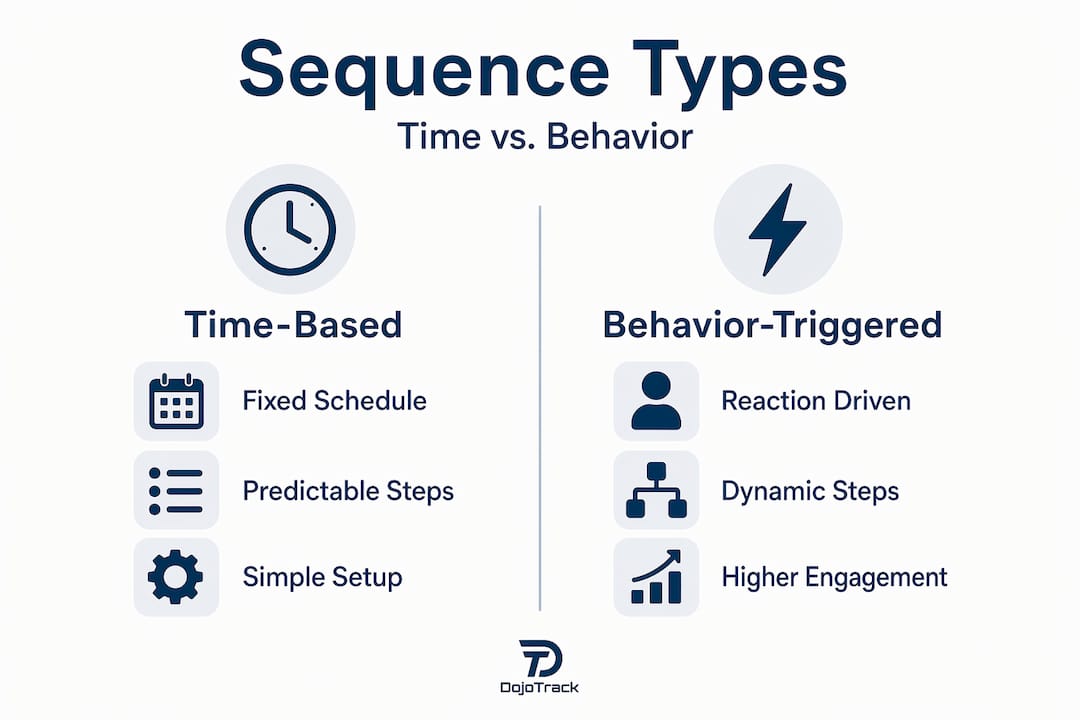
- Time-based triggers: A message goes out on day one, another on day three, another on day seven. The schedule runs regardless of what the prospect does.
- Behavior-based triggers: If a prospect opens your email, clicks a link, or visits your pricing page, the system detects that signal and sends a relevant next message based on that specific action.
Most studios benefit from understanding a second distinction: the difference between sequences and workflows. Sequences handle 1:1 outreach from your inbox and auto-pause when someone replies or books a trial. Workflows are broader. They handle lead routing, scoring, and status updates behind the scenes. Both matter, and splitting these responsibilities makes testing and optimizing much easier over time.
Speed-to-lead is where automation earns its keep fastest. Leads contacted within 5 minutes are approximately 21 times more likely to qualify than those reached after 30 minutes. No human can consistently hit that window for every inbound lead, especially during a 7 p.m. class. Automation can.

Pro Tip: Set up an instant SMS reply the moment a lead submits your contact form. Even a simple “Thanks for your interest in our school. We’ll reach out shortly. Here’s how to book your free trial” message dramatically improves the odds that prospect stays warm.
Building sequences that actually convert martial arts leads
Knowing that automation works is one thing. Knowing how to structure it for a dojo is another. Typical follow-up sequences run 3 to 5 steps, spaced days apart, and stop the moment a prospect engages. Here’s what a practical five-step sequence looks like for a new trial inquiry:
- Day 0, within minutes: Automated SMS confirms the inquiry and shares a direct booking link for a free trial class.
- Day 1: Personalized email from the head instructor introducing the studio, what makes your program different, and a brief student success story.
- Day 3: A follow-up SMS asking if they have any questions. Short, warm, human in tone.
- Day 5: Email featuring a parent or student testimonial, a class schedule, and a low-friction call to action like “Pick a time that works for you.”
- Day 8: Final outreach, either a phone call reminder set as a manual task or a last-chance SMS offering an extended trial period.
The sequence stops the moment the prospect books, replies, or opts out. Without those stop rules, you risk damaging trust by sending follow-ups to people who are already enrolled, which is exactly the kind of mistake that makes parents post negative reviews.
Multi-channel contact matters more than people realize. Email alone gets ignored. SMS alone can feel intrusive. Combining both, and including one or two manual tasks like a personal phone call, improves outreach coverage and conversion velocity.
Segmentation takes this further. A prospect who clicked “adult BJJ classes” should not receive the same sequence as a parent asking about kids’ karate. Segment your leads by interest, age group, or source, and personalize accordingly. Even small adjustments, like changing “your child” to “you” in the opening line, make sequences feel less like mass email blasts.
Pro Tip: Keep your automated messages written in first person from your instructor or owner account, not from a generic “DojoName Team” address. Prospects respond far better when the message reads like it came from a real person.
Time-based vs. behavior-triggered sequences
This distinction matters more as your lead volume grows. Here’s a direct comparison:
| Feature | Time-based sequences | Behavior-triggered sequences |
|---|---|---|
| How it runs | Fixed schedule, regardless of prospect action | Adapts steps based on prospect signals like opens or clicks |
| Setup complexity | Low. Easy to build from day one | Higher. Requires data collection and defined trigger rules |
| Personalization | Moderate. Same timing for everyone | High. Next step changes based on what the lead does |
| Best for | Studios new to automation | Studios with enough lead data to identify behavior patterns |
| Risk | Can feel generic if messaging isn’t tailored | Can over-trigger if rules aren’t carefully defined |
| Ideal hybrid use | Foundation of the sequence | Layered on top once basic sequences are running |
Most teams start with time-based sequences and then layer in behavior triggers after they’ve gathered enough data to understand how their specific prospects engage. That’s the right order. Don’t let the perfect be the enemy of the functional. A basic five-step time-based sequence running today beats a sophisticated behavior-triggered system that never gets built.
How to implement automation in your studio
Getting this running doesn’t require a technical background. It requires a clear process.
- Choose software built for your context. Generic CRM tools can work, but a purpose-built martial arts CRM handles the nuances of your lead types, class structures, and enrollment flows far better.
- Map your prospect journey first. Write down every touchpoint from the moment someone fills out a form to the moment they sign a membership agreement. Identify where leads go cold. Those gaps are where automation slots in.
- Build your templates before you build your sequences. Write the SMS and email copy for each step. Make sure each message has one clear purpose and one call to action.
- Connect automation to your lead capture. Your contact form, social media ads, and website chat should all feed into your CRM automatically, triggering the appropriate sequence based on where the lead came from.
- Set up pause and stop rules immediately. These are non-negotiable. Any lead who replies or books a trial must exit the active sequence before the next message fires.
Here’s a simple performance tracking table to review monthly:
| Metric | What it tells you | Target benchmark |
|---|---|---|
| Open rate (email) | Whether subject lines and sender names are working | 35% or higher |
| Reply rate | Whether content is compelling enough to start a conversation | 5 to 10% |
| Booking conversion rate | Whether the sequence is moving prospects to action | 15 to 25% |
| Time to first response | How quickly your automation reaches new leads | Under 5 minutes |
| Sequence completion rate | How many leads reach the final step without engaging | Below 40% is healthy |
Pro Tip: Run A/B tests on your Day 1 email subject line before optimizing anything else. That single message has the highest open potential in any sequence, and small wording changes can shift your open rate by 10 to 15 percentage points.
Also, re-engagement sequences deserve attention. If a lead completes your initial sequence without converting, don’t delete them. Route them into a longer nurture sequence that checks in monthly. People’s timing changes. A parent who wasn’t ready in January may be ready in April after the school semester shift.
For a deeper look at converting leads into students with these methods, DojoTrack has covered the fastest practical approaches specific to martial arts schools.
Common pitfalls to avoid
Automation fails when it’s treated as a fire-and-forget solution. The most frequent mistakes studio owners make include:
- Over-sending. More than five or six messages in a short window signals spam. Spread your sequence thoughtfully.
- Skipping stop rules. Sequences that keep running after a prospect replies or books erode trust fast. Always set exit conditions.
- Generic messaging. A sequence that reads like it was written for any gym in the country won’t perform. Reference your specific programs, instructors, and community.
- Ignoring deliverability. If your emails land in spam, none of this works. Use a verified sending domain, avoid trigger words, and keep your contact list clean.
- Replacing human contact entirely. Automation handles the consistent outreach. But a real phone call or personal text from an instructor remains one of the highest-converting touches in a dojo context, especially for parents enrolling children.
- Skipping opt-out compliance. Every sequence must include an easy way for prospects to unsubscribe. This isn’t just good practice. It’s legally required under CAN-SPAM and TCPA regulations for SMS.
What I’ve actually seen work in martial arts schools
I’ve watched plenty of studio owners treat automation like a vending machine. Set it up, press go, and wait for students to appear. That’s not how it works, and the studios that learn that lesson the hard way tend to learn it through a drop in enrollment, not a gentle reminder.
What actually works is a hybrid approach. Automation handles the volume and the consistency, but the human moments are the ones that close. When a parent receives an instant SMS confirmation at 9 p.m. and then gets a personal call from an instructor the next morning, the combination is nearly impossible to beat. The automation earned the trust. The human call sealed it.
The other thing I’ve seen get overlooked constantly is CRM data quality. Your martial arts CRM is only as useful as the lead information inside it. If your intake forms are collecting name and email but nothing about interest, age group, or referral source, your sequences will always be generic. Better data means better segmentation, and better segmentation means sequences that actually feel personal.
The studios that convert the most leads aren’t sending the most messages. They’re sending the right messages to the right people at the right moment, and they have automation in place to make that consistent across every single inquiry, not just the ones staff remembered to follow up on.
— DojoTrack
See how DojoTrack handles this for you
DojoTrack is built specifically for martial arts studios, and that shows in how the automation tools are designed. The platform connects lead capture directly to SMS and email sequences, scores incoming leads automatically, and stops sequences the moment a prospect books or replies. No manual monitoring required.
If you want to see the real financial impact of converting more leads, use the Lifetime Value Calculator to understand exactly what each new student is worth to your school. Then explore the full suite of AI-powered features at DojoTrack to see how automated follow-up fits into a complete studio management system designed to help you grow without adding hours to your week.
FAQ
What is prospect follow-up automation in simple terms?
It’s a system that automatically sends scheduled or behavior-triggered messages to new leads after they make first contact with your studio, replacing the need for manual reminders and follow-up tasks.
How soon should the first automated message go out?
Within minutes of a prospect submitting a form. Leads contacted within 5 minutes are roughly 21 times more likely to qualify than those reached after 30 minutes, making speed the single biggest lever in early engagement.
How many steps should a follow-up sequence have?
A 3 to 5 step sequence spaced over one to two weeks is the standard starting point. Each step should have one clear purpose, and the sequence should stop automatically when the prospect replies or books.
Do I need a CRM to use follow-up automation?
Yes. A CRM is what connects your lead intake forms to your sequences, tracks engagement, and applies the stop rules that prevent over-messaging. Without it, automation has no memory of what each prospect has already received.
Can automation replace personal outreach entirely?
No, and it shouldn’t try to. Automation handles consistency and speed, but personal calls and direct messages from instructors remain among the highest-converting touches, especially when a parent is deciding where to enroll their child.