

TL;DR:
- A unified software platform manages billing, scheduling, and member communication for MMA gyms, reducing errors and saving staff time. It offers purpose-built features like belt tracking and automated retention alerts that generic fitness apps lack. Switching to such a system can recover revenue, improve retention, and streamline operations through automation and data centralization.
A unified software platform is a single integrated system that manages billing, scheduling, attendance, member communication, and access control under one roof. MMA gyms that rely on disconnected spreadsheets, standalone billing apps, and separate scheduling tools pay a real price in lost revenue, wasted staff time, and frustrated members. The case for why MMA gyms need a unified software platform comes down to one fact: fragmented tools create gaps, and gaps cost you money. Platforms like Dojotrack and Glossa are built specifically for combat sports facilities, solving problems that generic fitness software was never designed to handle.
Why MMA gyms need a unified software platform
Running an MMA gym means managing a lot of moving parts at once. You have recurring memberships, drop-in students, belt promotions, multiple class disciplines, retail inventory, and a front desk that needs to handle all of it without missing a beat. Most gym owners start by stitching together separate tools: one app for billing, another for scheduling, a spreadsheet for attendance, and maybe a group chat for member communication. That patchwork approach breaks down fast.
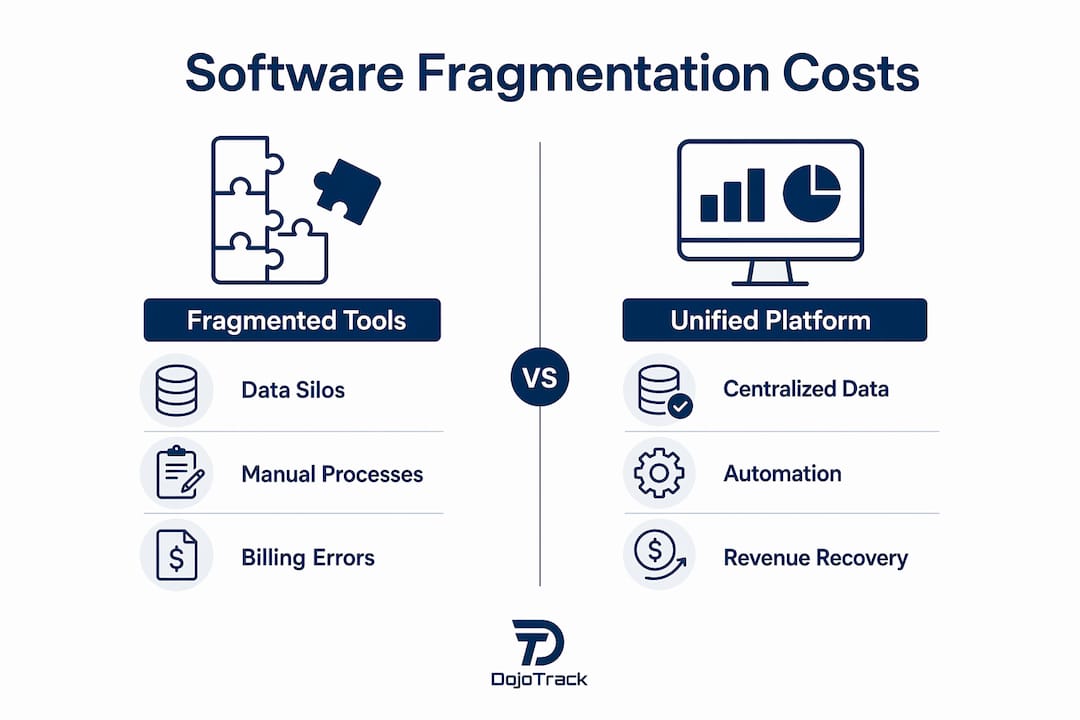
Fragmented tech stacks create administrative friction at every handoff. When your billing system does not talk to your access control, a member whose payment failed can still walk through the door. When your attendance tracker is separate from your CRM, you cannot see which students are quietly drifting toward quitting. These are not minor inconveniences. They are revenue leaks and retention failures hiding in plain sight.
A unified platform closes those gaps by making every function part of one connected system. Billing triggers access changes automatically. Attendance data feeds into retention alerts. Scheduling updates push directly to member notifications. The result is a gym that runs with less manual effort and fewer errors.
The real cost of tool fragmentation
- Billing errors and missed payments pile up when payment status is not linked to access control in real time.
- Staff time disappears into manual reconciliation between apps that do not sync.
- Member experience suffers when communication, scheduling, and billing live in separate systems with no shared data.
- Retention blind spots grow when attendance and engagement data are never connected to member profiles.
Pro Tip: Before evaluating any software, list every tool your gym currently uses and map out where data has to be manually transferred between them. Each manual transfer is a failure point worth eliminating.
Unified MMA software vs. generic fitness apps
Not all gym management software solves the same problems. Generic fitness platforms are built for general health clubs and group fitness studios. They handle memberships and class bookings well enough, but they were not designed for the specific workflows of an MMA gym.
The table below shows where unified MMA gym software pulls ahead of generic alternatives.
| Feature | Unified MMA platform | Generic fitness app | Manual system |
|---|---|---|---|
| Belt and rank tracking | Yes, automated | No | Manual spreadsheet |
| Multi-discipline scheduling | Yes | Limited | Manual calendar |
| Grading and promotion workflows | Yes | No | Paper-based |
| Billing linked to access control | Yes | Rarely | No |
| Retail POS integration | Yes | Sometimes | Separate system |
| AI-driven retention alerts | Yes | No | No |
| Member mobile app | Yes | Sometimes | No |
Glossa’s MMA gym software integrates memberships, billing, attendance, grading, and retail under one platform, demonstrating what MMA-specific workflows actually require. Generic fitness apps simply do not include belt ranking, grading events, or multi-discipline class structures because those features have no use case outside combat sports.
The deeper issue is data centralization. A true unified platform acts as a single system of record for the entire member journey. When attendance, billing, and communication all live in the same data model, you eliminate the manual reconciliation that eats staff hours every week. Generic software connected through third-party integrations still requires someone to check that the data matches. A purpose-built unified platform removes that step entirely.
For a direct comparison of what this means in practice, the fitness software vs. martial arts CRM breakdown covers the operational differences in detail.
How automation and real-time data improve gym management
Automation is where unified platforms deliver the most immediate, measurable return. When your software handles routine tasks automatically, your staff stops spending time on administration and starts spending it on members.
Here is what automated workflows look like inside a unified MMA gym platform:
- Recurring billing runs on schedule without manual invoicing, reducing missed payments and improving cash flow.
- Access control pauses automatically when a membership lapses, so you stop giving away free training time.
- Attendance is logged at check-in and immediately updates the member’s profile, feeding retention risk calculations.
- SMS and email follow-ups trigger based on attendance gaps, reaching at-risk members before they cancel.
- Class schedule changes push instantly to the member app, cutting down on no-shows and front-desk calls.
Fitness GM reports that linking payment status to access control recovers over $1,000 per month in lost revenue for gyms that previously had no automated connection between the two systems. That figure represents members who were training without paying, a problem invisible to any gym running billing and access control as separate tools.
Real-time data matters just as much as automation. When scheduling, payments, and attendance sync in real time, errors caused by stale data disappear. A staff member checking in a student sees the current membership status, not yesterday’s export. A manager reviewing revenue sees live numbers, not a report that is two days old. That accuracy changes how you make decisions.

Pro Tip: Set up automated attendance alerts for any member who misses three consecutive classes. Catching disengagement early is far cheaper than trying to win back a member who has already mentally quit.
How to adopt a unified platform without disrupting your gym
Switching software is the part most gym owners dread. Done wrong, it creates confusion for staff, frustration for members, and temporary gaps in billing. Done right, it is a one-time disruption that pays off for years.
- Audit your current tools first. List every platform you pay for and every manual process your staff runs. This gives you a clear picture of what the new system needs to replace.
- Prioritize integration depth over feature count. A platform with fewer features but a unified data model beats a feature-rich tool that still requires manual syncing. Case studies show that reducing tool sprawl cuts license costs by 45% and weekly reconciliation time by 72% in small business environments.
- Run a phased rollout. Start with billing and membership management, then add scheduling, then communications. Trying to migrate everything at once increases the risk of errors and staff overwhelm.
- Train staff before go-live. Your front desk team needs to feel confident before the first member walks in under the new system. Budget at least one full training day per staff member.
- Communicate changes to members early. Send a message explaining any new check-in process, app download, or payment update at least two weeks before the switch. Members who feel informed stay calm.
- Plan for multi-location scaling from day one. If you run or plan to run more than one facility, choose a platform with centralized multi-location management built in. Retrofitting a single-location tool for multiple sites is expensive and messy.
Proper selection means prioritizing integration capability, a unified data model, and strong vendor support. Phased integration and extensibility are the two factors most strongly linked to successful consolidation without operational disruption.
Key Takeaways
A unified software platform is the single most effective operational change an MMA gym can make to reduce administrative overhead, recover lost revenue, and improve member retention.
| Point | Details |
|---|---|
| Fragmentation costs real money | Disconnected billing and access control lets members train without paying, losing over $1,000 per month. |
| MMA needs purpose-built tools | Features like belt tracking, grading workflows, and multi-discipline scheduling do not exist in generic fitness apps. |
| Automation replaces manual work | Automated billing, attendance logging, and SMS follow-ups free staff time for member engagement. |
| Data unity prevents errors | A single system of record eliminates manual reconciliation between billing, attendance, and communication tools. |
| Phased adoption reduces risk | Starting with billing and membership before adding other modules cuts disruption during the transition. |
What running a fragmented gym actually feels like
At Dojotrack, we built this platform because we lived the problem firsthand. Jared Reed ran martial arts schools before writing a single line of code, and the daily friction of juggling disconnected tools was the direct motivation for building something better.
The pain point that surprises most gym owners is not the billing errors or the missed check-ins. It is the invisible retention problem. When your attendance data and your member communication live in separate systems, you never see the pattern of a student quietly drifting away until they are already gone. By the time you notice, they have mentally quit. A unified system surfaces that pattern automatically, giving you a window to act.
Generic software connected through integrations sounds like a reasonable middle ground, but the operational reality is different. Integrations break. APIs change. Data mismatches appear at the worst possible times, usually during a billing cycle or a membership audit. The only reliable fix is a platform where every function shares the same underlying data from the start.
The gyms that resist consolidation usually cite the cost of switching. What they underestimate is the ongoing cost of staying fragmented: staff hours lost to reconciliation, revenue lost to billing gaps, and members lost to poor communication. Those costs do not show up on a single invoice, but they add up every month.
The future of MMA gym management is not more integrations. It is fewer systems doing more, with AI identifying problems before they become losses. That shift is already happening, and the gyms building on unified platforms now will have a significant operational advantage over those still stitching tools together.
— Dojotrack
Dojotrack: a unified platform built for MMA gyms
Dojotrack is an AI-powered martial arts platform built specifically for MMA gyms, Jiu Jitsu schools, Taekwondo academies, and other combat sports facilities in the United States. It combines a full martial arts CRM with automated billing through Stripe, attendance tracking, belt promotion workflows, scheduling, digital waivers, and a student mobile app, all inside one connected system. The AI-driven retention engine flags at-risk members before they cancel, and automated SMS follow-ups convert more leads into paying students. If you want to understand the revenue impact before committing, the lifetime value calculator for martial arts schools gives you a concrete number to work with. Setup is straightforward, and the platform is designed to replace your current stack, not add to it.
FAQ
What is a unified software platform for MMA gyms?
A unified software platform is a single system that manages billing, scheduling, attendance, member communication, and access control together. It eliminates the need for separate apps that require manual data syncing between them.
How does unified software improve MMA gym revenue?
Linking payment status to access control automatically pauses access when memberships lapse, recovering revenue that would otherwise be lost to members training without active payments.
Can unified MMA gym software handle belt tracking and grading?
Yes. Purpose-built platforms like Dojotrack and Glossa include automated belt promotion workflows and grading management, features that generic fitness apps do not offer.
How long does it take to switch to a unified platform?
A phased rollout starting with billing and membership typically takes two to four weeks before the full system is live. Staff training and member communication before go-live reduce disruption significantly.
Is unified gym management software worth the cost for a small MMA gym?
Consolidating tools cuts license costs and eliminates the staff hours spent on manual reconciliation, making unified platforms cost-effective even for single-location gyms with a small member base.
Recommended
- Generic Fitness Software Vs Martial Arts CRM: Which Is Better For Your Dojo? | DojoTrack
- Martial Arts Management Software vs Generic Fitness Apps | DojoTrack
- Billing Automation for MMA Business: A 2026 Guide
- Best Martial Arts Studio Software for Small Schools: Features, Benefits, and AI Advantages | DojoTrack