

TL;DR:
- Running a martial arts school without data is like teaching a form you have never practiced, risking missing critical details. Business intelligence transforms studio data into actionable decisions involving attendance, billing, retention, and growth without requiring advanced data science skills. Focusing on specific KPIs and consistent data review enables small schools to improve retention, optimize scheduling, and make strategic decisions that drive long-term success.
Running a martial arts school without data is like teaching a form you’ve never practiced. You might get through it, but you’ll miss critical details. Understanding what is martial arts business intelligence changes how you run your studio, shifting decisions from gut feelings to patterns you can actually see and act on. This guide breaks down how BI transforms studio data into real decisions around attendance, billing, retention, and growth — without requiring a data science degree to make it work for you.
Table of Contents
- Key takeaways
- What martial arts business intelligence actually is
- Core KPIs every martial arts studio should track
- How BI drives efficiency and student retention
- Choosing the right BI tools for your school
- Common pitfalls in martial arts BI adoption
- My honest take on business intelligence for martial arts studios
- How DojoTrack brings BI to your martial arts school
- FAQ
Key takeaways
| Point | Details |
|---|---|
| BI turns data into decisions | Business intelligence collects and analyzes studio data so you can act on it, not just look at it. |
| Track the right KPIs | Metrics like MRR, churn rate, and student lifetime value directly affect your studio’s financial health. |
| Retention starts with prediction | BI tools can flag at-risk students before they quit, giving you time to intervene. |
| Martial arts software beats generic tools | Purpose-built platforms track belt progress, attendance, and billing in one place without manual data entry. |
| BI requires process change, not just tech | The value comes from who reviews the data and what actions get triggered, not just the dashboard itself. |
What martial arts business intelligence actually is
Martial arts business intelligence is the process of collecting operational data from your studio, analyzing it, and presenting it in a way that drives specific decisions. That last part is the part most people miss. BI produces actionable insights, not just charts. The goal is never a pretty graph on a screen. The goal is knowing which students are about to quit, which programs are losing enrollment, or where your revenue is quietly leaking.
The BI process follows a predictable sequence. It starts with data collection from sources like your student management system, billing platform, attendance tracker, and lead pipeline. That data then moves through analysis and visualization steps, where ETL tools and analytics find patterns that aren’t obvious when you’re looking at raw numbers. The final output is a dashboard or report that tells you what’s happening and, in more advanced systems, what’s likely to happen next.
The data points that matter most for a martial arts studio include:
- Leads and enrollments: How many prospects entered your pipeline, and how many converted to paying students?
- Attendance by class and program: Which sessions are packed and which are emptying out?
- Payment and billing status: Who is behind on payments and how much recurring revenue are you collecting each month?
- Churn rate: How many students left in the last 30, 60, or 90 days?
- Program activity: Are students progressing through belt ranks at a healthy pace?
Pro Tip: If your studio software can’t surface all five of those data points in under two minutes, you’re spending time manually compiling information you should already have on demand.
Core KPIs every martial arts studio should track
Once you understand what business intelligence in martial arts can do, the next question is which numbers actually matter. Not all metrics are worth your attention equally.
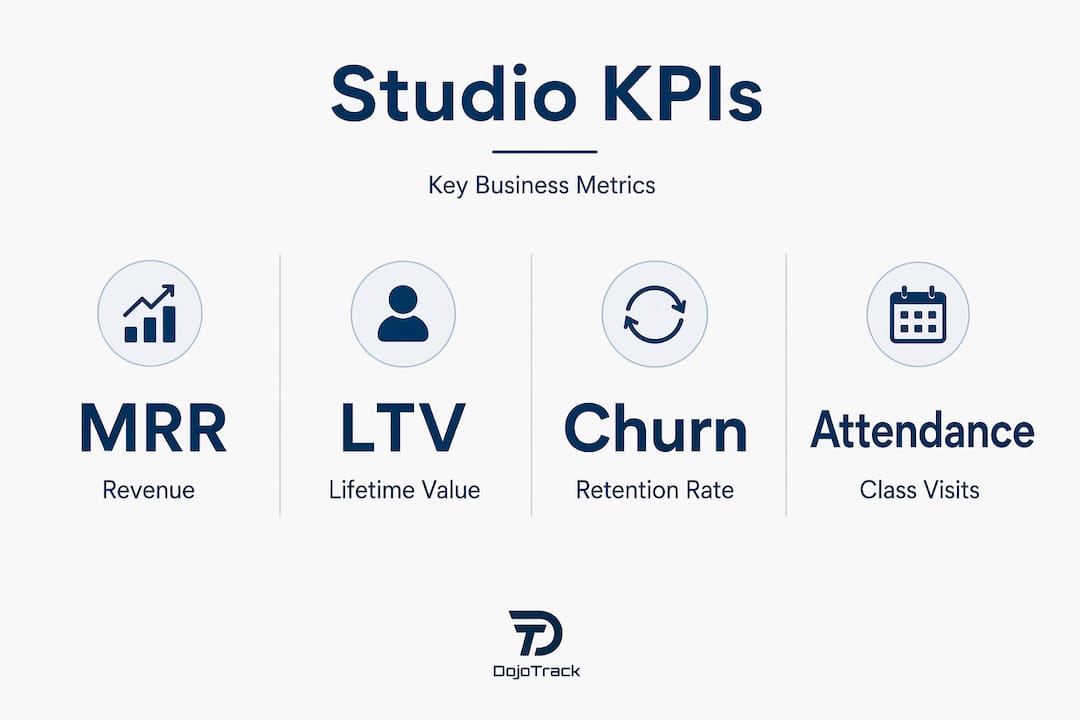
| KPI | What it measures | Why it matters |
|---|---|---|
| Monthly recurring revenue (MRR) | Predictable monthly income from active memberships | Tells you your revenue floor and cash stability |
| Month-over-month revenue growth | Change in total revenue between periods | Signals sales momentum and program demand |
| Student churn rate | Percentage of students who leave each month | Directly impacts long-term profitability |
| Student lifetime value (LTV) | Total revenue generated per student over their enrollment | Tells you how much you can afford to spend acquiring a new student |
| Cash runway to breakeven | How long your current cash supports operations | Critical for newer studios planning toward sustainability |
| Attendance rate | Average class attendance divided by enrolled students | Reveals disengagement before it becomes a cancellation |
Studios should track MRR, revenue growth, and margins on at least a monthly cadence. Weekly reviews work well for attendance and churn signals. The goal is to spot a problem early enough to respond, not to document it after the damage is done.
Lifetime value gets overlooked more than any other metric, which is a costly mistake. If a student who trains for three years pays $150 per month, their LTV is $5,400. Knowing that number tells you that spending $200 on a referral incentive to acquire that student is a sound investment, not an expense. You can use DojoTrack’s LTV calculator tool to work this out for your own studio.
Understanding unit economics and cash runway also matters more than most school owners realize. Breakeven planning, especially for studios in their first two to four years, depends on knowing exactly what each new enrolled student contributes to covering fixed costs. Without that number, growth decisions become guesses.
Pro Tip: Set a recurring 30-minute weekly review meeting with yourself or your manager to go through attendance, billing flags, and churn signals. Studios that review data consistently make faster corrections and retain more students.
How BI drives efficiency and student retention
The most direct application of martial arts analytics is reducing the time you spend on administrative work while improving the outcomes that matter. BI automates data aggregation, which means you stop pulling reports from three different places and start seeing everything in one view.
Here’s where that plays out in practical studio operations:
- Scheduling optimization: If your Tuesday 6pm class consistently runs at 90% capacity and your Thursday 6pm sits at 40%, that’s a scheduling and marketing signal. BI surfaces it without you having to count heads manually.
- Targeted member outreach: When a student’s attendance drops from four classes per week to one, an AI-powered system can flag that student and trigger an automated text or email before they cancel. That kind of proactive retention action is only possible if you’re tracking attendance data in real time.
- Program adjustments: If enrollment in your kids’ beginner program is down 20% quarter over quarter, that’s a product signal. Maybe the time slot is wrong, maybe competition in your area has shifted, or maybe your introductory offer isn’t converting. BI tells you the “what” so you can investigate the “why.”
- Billing recovery: Faster identification of failed payments means fewer students who drift away because of an unresolved billing issue they never told you about.
Better decisions from real data reduce the time you spend reacting and increase the time you spend on strategy. That’s the core promise of martial arts data analysis applied to an actual school. Less time drowning in spreadsheets means more time on the mat.
Choosing the right BI tools for your school

When selecting BI software, the comparison between general-purpose platforms and martial-arts-specific solutions is not close.
| Feature | General BI platforms | Martial arts-specific software |
|---|---|---|
| Setup complexity | High, requires configuration | Low, built for your workflows |
| Martial arts KPI tracking | Manual setup required | Pre-built for attendance, belts, churn |
| Billing integration | Requires third-party connections | Native recurring billing included |
| Student engagement tracking | Generic | Tracks belt progression, class participation |
| Automation capabilities | Limited without custom setup | Automated alerts, SMS, lead follow-up |
| Learning curve | Steep for non-technical users | Designed for studio owners, not data analysts |
General BI tools like standalone analytics platforms can technically display any data you feed them. The problem is that you have to define every metric, build every report, and connect every data source yourself. For a studio owner who is also the head instructor and the front desk manager, that setup time is time you simply don’t have.
Martial-arts-specific platforms come with the KPIs, automations, and reporting structures already built. You can see a comparison of specialized vs. generic apps to understand where those differences show up in daily use.
When implementing any BI tool, follow this sequence. Start with data migration: get your existing student records, billing history, and attendance logs into the new system cleanly. Then train whoever will review reports regularly. Without clear ownership of who acts on the data, the tool sits unused. Finally, build a rhythm around KPI review so that the reports you’re generating actually trigger decisions.
Common pitfalls in martial arts BI adoption
Getting BI wrong is often not a technology problem. It’s a process problem. These are the traps studios most commonly fall into:
- Tracking too many metrics at once: When everything is a priority, nothing is. Start with five to seven KPIs and build from there.
- Inconsistent data entry: If your front desk enters student check-ins manually on some days and skips it on others, your attendance data is unreliable. BI is only as good as the data behind it.
- Treating dashboards as reports rather than triggers: A dashboard that shows churn is rising has no value unless someone acts on it within 48 hours. BI adoption requires process change around who reviews data and what follow-up actions happen automatically.
- No ownership: If everyone is responsible for reviewing the data, no one is. Assign a specific person to own KPI review each week.
- Ignoring leading indicators: Declining attendance is a leading indicator of cancellation. Missed payments are a leading indicator of churn. If you only track lagging indicators like total revenue, you’ll always be responding too late.
Pro Tip: Audit your data entry habits before investing in a BI platform. If your current software has gaps or inconsistencies, clean data is the first problem to solve. Understanding martial arts KPIs starts with reliable inputs, not better reports.
My honest take on business intelligence for martial arts studios
I’ve worked with enough school owners to say this plainly: most of them already have the data they need. The problem is they can’t see it, or when they can, nothing happens because of it.
What I’ve learned is that the studios getting the most out of BI aren’t the ones with the most sophisticated dashboards. They’re the ones who made a commitment to review specific numbers every week and act on what those numbers tell them. That consistency is the difference. A studio that checks attendance trends every Monday and follows up with disengaged students before Thursday will outperform a studio with a more advanced system that nobody opens.
The other misconception I see constantly is that BI is for large, multi-location schools. That’s not true. A single-location studio with 80 students benefits enormously from knowing which students are at risk of leaving and why. The smaller the school, the more each student’s revenue matters, and the more damage a retention problem can do before you notice it.
My advice: don’t wait until you’re managing three locations to start caring about AI-powered retention tools. Start with the basics now. Track MRR, attendance, and churn. Build the habit of reviewing them weekly. Then expand from there. The compounding effect of better decisions over 12 months is significant, and it starts with just showing up to the data consistently.
— DojoTrack
How DojoTrack brings BI to your martial arts school
DojoTrack is built specifically for how martial arts studios actually operate. The platform collects data automatically across every part of your school, including attendance, billing, lead activity, and student progression, and surfaces it in real-time dashboards built around the KPIs that matter most to you.
The AI-powered retention system identifies students at risk of dropping out before they cancel, so your team can act fast. Automated SMS follow-ups, lead scoring, and billing alerts reduce the manual work that keeps too many school owners away from the mat. If you’re currently using another platform, DojoTrack’s easy data migration service makes switching straightforward without losing your student history.
Explore everything the platform does on the DojoTrack features page, or start using the LTV calculator to see what your current students are actually worth to your school over time.
FAQ
What is martial arts business intelligence?
Martial arts business intelligence is the process of collecting, analyzing, and visualizing studio data to support better operational and financial decisions. It covers KPIs like attendance, churn, revenue, and student lifetime value.
What KPIs should a martial arts studio track?
The most important KPIs include monthly recurring revenue, student churn rate, attendance rate, student lifetime value, and cash runway. Tracking these on a weekly and monthly basis gives you the clearest picture of studio health.
How does BI improve student retention?
BI systems track attendance and engagement patterns to flag students who may be at risk of leaving. That early warning gives instructors and managers time to reach out and re-engage students before they cancel.
Do small martial arts schools need business intelligence?
Yes. A single-location studio with fewer than 100 students benefits from BI because each student’s revenue has a significant impact on overall profitability. Knowing which students are disengaged early is more valuable at a smaller scale, not less.
What’s the difference between a BI tool and regular studio software?
Standard studio software records data. BI tools analyze that data and surface patterns that help you make decisions. The best martial arts platforms combine both in one place, so you’re not exporting data into a separate analytics tool.
Recommended
- AI Powered Martial Arts Software | DojoTrack
- Best Martial Arts Studio Software for Small Schools: Features, Benefits, and AI Advantages | DojoTrack
- How AI and Automation Are Changing the Game for Martial Arts Studio Owners | DojoTrack
- Martial Arts Management Software vs Generic Fitness Apps | DojoTrack