
TL;DR:
- MMA is a regulated sport combining striking and grappling from multiple disciplines like boxing and BJJ. The introduction of unified rules and official oversight transformed it from a no-rules spectacle to a mainstream, competitive sport.
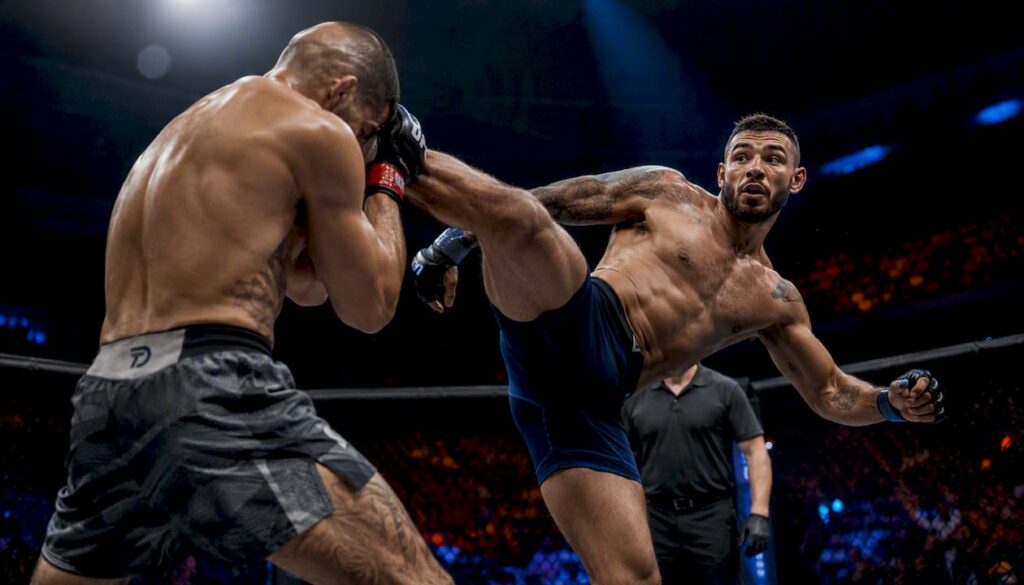
Mixed martial arts (MMA) is a regulated full-contact combat sport that combines striking and grappling techniques from multiple disciplines, applied both standing and on the ground. According to Wikipedia, MMA allows a wide variety of fighting techniques from a mixture of other combat sports to be used in competition. The UFC’s introduction to MMA identifies four core disciplines that feed the sport:
- Boxing — punching combinations, head movement, and footwork
- Wrestling — takedowns, positional control, and dictating where the fight happens
- Muay Thai/kickboxing — kicks, knees, elbows, and clinch work
- Brazilian Jiu-Jitsu (BJJ) — guard, sweeps, chokes, and joint locks on the ground
Matches take place in a cage (most commonly an octagon) or a boxing-style ring. A fight ends by knockout (KO), technical knockout (TKO), submission, or judges’ decision. Modern professional competition is governed by the Unified Rules of MMA and overseen by state athletic commissions, which set safety standards and sanction events across the United States.
Table of Contents
- How mixed martial arts sports evolved from ancient combat to regulated competition
- What each core discipline actually contributes to a fight
- How MMA matches are governed and scored
- The major promotions and how the pro landscape is organized
- What MMA training actually looks like day to day
- How fighter archetypes shape match dynamics
- Safety, regulation, and what protects fighters in U.S. competition
- How to find the right MMA gym and what to expect at your first class
- Why MMA’s evolution from spectacle to technical sport changed everything
- MMA rewards the honest student, not the comfortable one
- Key Takeaways
- FAQ
How mixed martial arts sports evolved from ancient combat to regulated competition
MMA’s roots run deeper than the UFC’s 1993 debut. Ancient Greece had pankration, a striking-and-grappling event contested at the Olympic Games as early as 648 BCE. Brazil developed vale tudo (“anything goes”) contests in the 1920s, where fighters from different disciplines tested their styles against one another with minimal rules. Japan’s Shoot wrestling scene in the 1970s added another strand, blending professional wrestling with legitimate submission grappling.
The Gracie family brought this hybrid approach to the United States. When Rorion Gracie co-founded the UFC in 1993, the early events were explicitly designed to answer one question: which martial art is most effective? There were no rounds, no weight classes, and almost no rules. The spectacle drew attention, but it also drew political backlash. Senator John McCain famously called early MMA “human cockfighting,” and several U.S. states banned the events outright.
“The shift from no-holds-barred to the Unified Rules was decisive: formal rulesets enabled athletic commissions to sanction events and opened MMA to mainstream audiences and commercial investment.”
The New Jersey State Athletic Control Board adopted the Unified Rules of MMA in 2000, and Nevada followed shortly after. The rules introduced five-minute rounds, a standardized foul list (no eye gouging, groin strikes, or strikes to the back of the head), referee authority to stop contests, and a 10-point must scoring system. That regulatory framework is what allowed athletic commissions nationwide to sanction events, which in turn opened the door to mainstream television deals, corporate sponsorships, and the global growth that followed.

What each core discipline actually contributes to a fight
Understanding MMA at a tactical level means knowing what each discipline is for, not just that it exists. The table below maps the seven most common disciplines to their role, typical techniques, the phase of a fight where they appear, and the training emphasis at most gyms.
| Discipline | Role in MMA | Common techniques | Fight phase | Training emphasis |
|---|---|---|---|---|
| Boxing | Striking accuracy and defense | Jab, cross, hook, uppercut, head movement | Stand-up | Pad work, shadowboxing, sparring |
| Muay Thai / Kickboxing | Clinch control and multi-limb striking | Roundhouse kick, teep, knee, elbow, plum clinch | Stand-up, clinch | Bag work, partner drilling, sparring |
| Wrestling | Takedowns, cage control, top position | Double leg, single leg, sprawl, body lock | Takedown, ground-and-pound | Drilling, live wrestling, conditioning |
| Brazilian Jiu-Jitsu | Submissions and ground survival | Guard, triangle choke, armbar, rear naked choke, sweep | Ground | Positional sparring, drilling |
| Judo | Throws and grip fighting | Osoto-gari, seoi-nage, grip breaks | Clinch, takedown | Randori, grip drilling |
| Sambo | Leg locks and throws | Heel hook, kneebar, hip throw | Takedown, ground | Drilling, competition sparring |
| Karate | Linear striking and distance control | Front kick, side kick, straight punch, oblique kick | Stand-up | Kata adaptation, point-sparring drills |
Britannica notes that karate, judo, and sambo each contribute specific techniques even when adapted for the MMA context. Karate provides linear striking and distance management; judo and sambo supply throws, grips, and leg attacks. The Wikipedia entry on karate highlights practitioners like Lyoto Machida (Shotokan), Georges St-Pierre (Kyokushin), and Stephen Thompson (American Tetsushin Ryu Kempo Karate) as examples of fighters who built MMA careers on a karate foundation.
A few practical notes on how fighters combine these disciplines:
- Hybridization is the norm. Most competitive fighters do not fight “as a boxer” or “as a wrestler.” They train transitions: how to close distance from boxing range into a clinch, how to chain a failed takedown into a submission attempt.
- The clinch is where styles collide. Muay Thai and judo both operate in the clinch, but with different objectives. A Muay Thai fighter wants knees and elbows; a judoka wants a grip for a throw. Recognizing that conflict is what makes MMA tactically interesting.
- Wrestling is the great equalizer. Wikipedia identifies wrestling as foundational for takedowns, positional control, and conditioning. A fighter who can choose whether the fight stays standing or goes to the ground holds a structural advantage regardless of their striking ability.
How MMA matches are governed and scored
The Unified Rules, first adopted in New Jersey in 2000, are the standard ruleset for professional MMA in the United States. Britannica confirms that the Unified Rules established standardized fouls, round structure, and referee responsibilities, which enabled athletic commissions to sanction events.
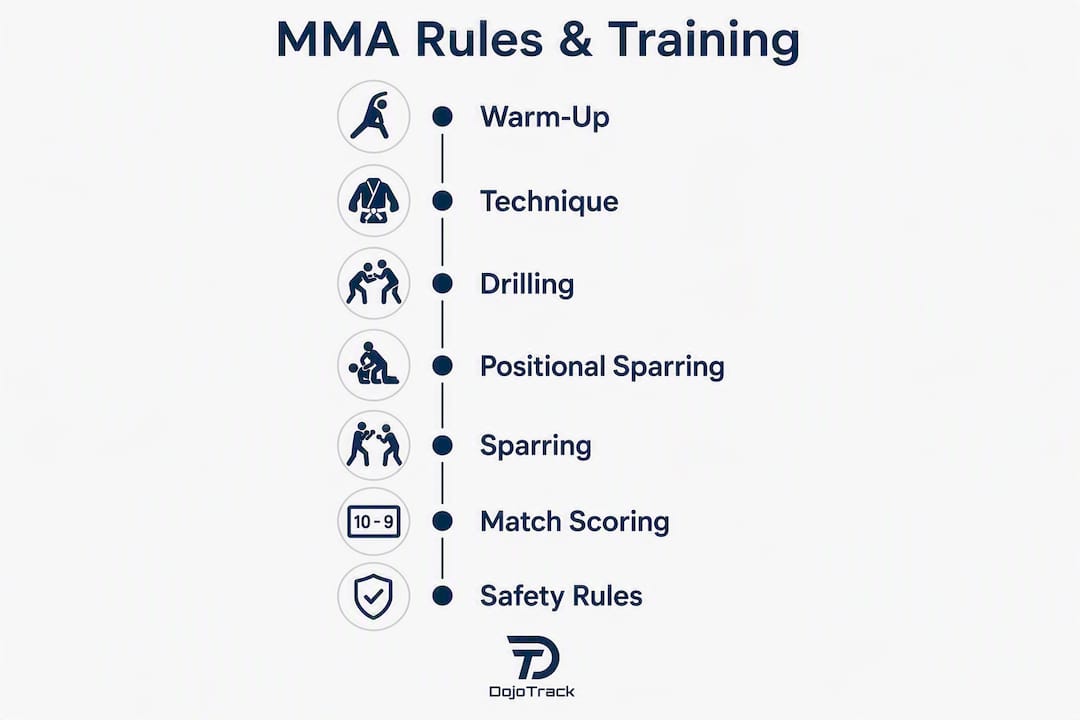
Match structure: Professional non-title bouts run three rounds of five minutes each. Championship bouts run five rounds. Amateur rules often use shorter rounds (two minutes) and may restrict certain techniques, such as elbows to the head.
Methods of victory follow a clear hierarchy, as the UFC outlines:
| Method | What triggers it |
|---|---|
| Knockout (KO) | Fighter rendered unconscious by a legal strike |
| Technical Knockout (TKO) | Referee stops the fight; fighter cannot intelligently defend |
| Submission | Fighter taps out, verbally submits, or goes unconscious from a choke |
| Judges’ Decision | Unanimous, split, or majority decision after all rounds |
| Disqualification | Fighter commits repeated or flagrant fouls |
| No Contest | Fight stopped due to accidental foul or external circumstances |
Scoring: Judges score each round using the 10-point must system. The round winner receives 10 points; the loser typically receives 9 (or 8 for a knockdown or dominant round). Judges evaluate effective striking, effective grappling, aggression, and cage/ring control, in that priority order.
Common fouls include eye gouging, groin strikes, strikes to the back of the head, headbutts, and small-joint manipulation. Referees can deduct points for fouls or stop the contest entirely.
Weight classes in major professional promotions run from strawweight (up to 115 lbs) through heavyweight (206–265 lbs), with most organizations recognizing eight to ten divisions for men and four to six for women.
Pro Tip: When watching a close fight, track effective grappling separately from effective striking. Many casual viewers score rounds purely on punches landed and miss the control time a wrestler accumulates on top, which judges weigh heavily.
The major promotions and how the pro landscape is organized
MMA the sport and MMA the business are two different things, and the distinction matters. A promotion is a commercial event organizer that signs fighters, books venues, and sells broadcast rights. A sanctioning body sets rules. An athletic commission is a government agency that licenses fighters, approves officials, and enforces safety standards. All three exist simultaneously, and they do not always overlap.
The International Mixed Martial Arts Federation (IMMAF) serves as the global governing body for the sport, setting standards for safety, education, and fair competition. IMMAF reports an estimated 449 million followers worldwide, reflecting how far MMA has traveled from its early no-rules spectacle.
The three promotions with the broadest reach:
- UFC (Ultimate Fighting Championship): The largest MMA promotion in the world by revenue, broadcast reach, and fighter recognition. UFC events air globally and the organization has been central to establishing MMA’s mainstream credibility since the early 1990s.
- Bellator MMA: A major U.S.-based promotion that has historically competed for top-tier free-agent talent and runs events across North America and Europe. Bellator operates under the Unified Rules and has produced multiple world-class champions.
- ONE Championship: Singapore-based and dominant across Southeast Asia, ONE Championship uses a modified ruleset that includes a hydration test instead of traditional weight cuts, and it also promotes Muay Thai and kickboxing events alongside MMA.
“UFC is a global promotion and brand central to modern MMA; other promotions operate regionally or in different markets.”
— Britannica
Below the major promotions sits a large ecosystem of regional promotions (Cage Fury Fighting Championships, Titan FC, LFA) that serve as developmental circuits. Fighters typically accumulate an amateur record through local events sanctioned by state athletic commissions, then turn professional with regional promotions before earning a contract with a major organization. Athletic commissions at the state level (the Nevada Athletic Commission, the California State Athletic Commission, and others) license fighters, require pre-fight medicals, and assign referees and judges independently of the promotions.
What MMA training actually looks like day to day
A typical MMA gym class runs 60–90 minutes and follows a predictable arc: warm-up, technique instruction, drilling, positional or situational sparring, and conditioning work at the end. The technique portion might focus on a single entry (a jab-to-double-leg combination, for example) and drill it in isolation before adding resistance.
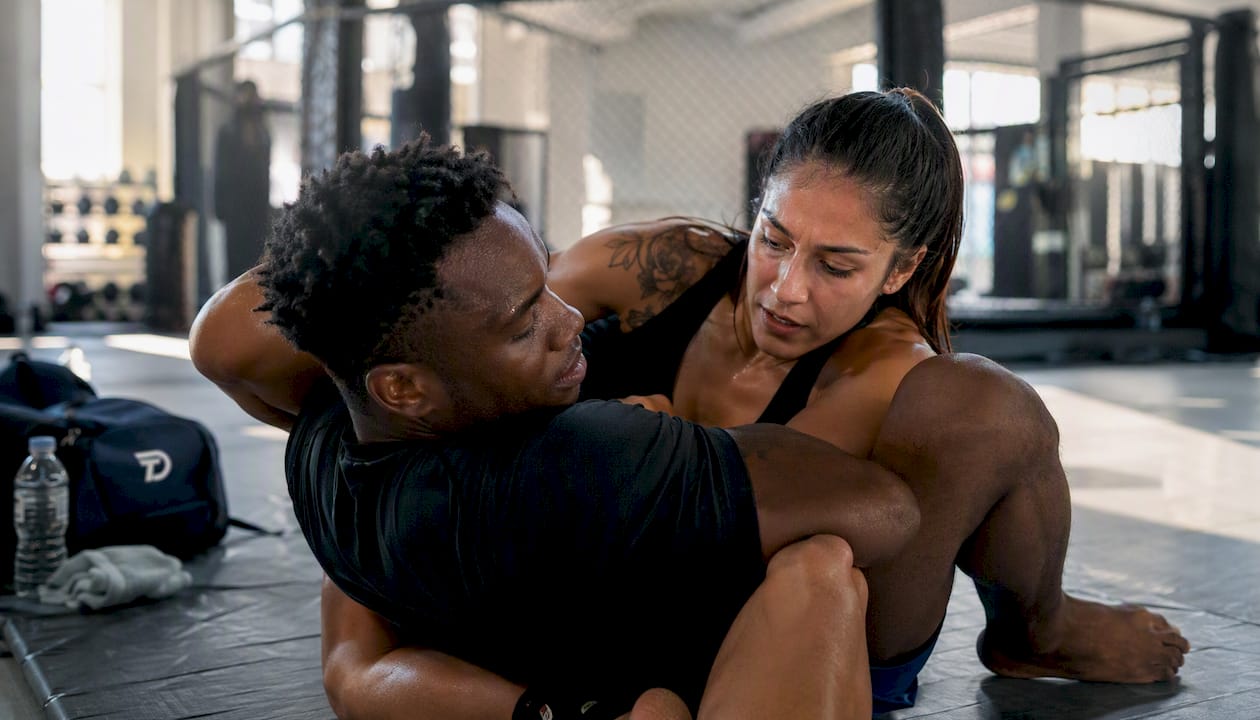
The UFC’s training overview describes MMA gyms as focused on fast, functional training: tactical sparring, conditioning, and scenario-driven drills. That orientation differs sharply from traditional dojos, where rank progression and kata practice structure the curriculum. At an MMA gym, the measure of progress is how you perform under pressure, not which belt you wear.
A sample competitive training week might look like this:
- Monday/Wednesday/Friday: Technical striking (boxing or Muay Thai), 60 min; wrestling/grappling, 45 min
- Tuesday/Thursday: Strength and conditioning, 60 min; BJJ positional sparring, 45 min
- Saturday: Full MMA sparring, 60–90 min
- Sunday: Active recovery or rest
Fight camp changes everything. In the six to eight weeks before a scheduled bout, volume increases, sparring becomes more fight-specific, and a weight-management protocol begins. Coaches introduce opponent-specific game plans, and strength work shifts toward maintenance rather than development.
Pro Tip: If you run an MMA gym, class scheduling is one of your biggest retention levers. Students who attend three or more times per week are far less likely to cancel than those who come once. Tracking attendance patterns with a tool like Dojotrack’s membership tracking lets you spot at-risk students before they disappear.
How fighter archetypes shape match dynamics
Every MMA fighter leans on a primary skill set, even when they train across disciplines. Recognizing these archetypes helps you understand why certain matchups play out the way they do.
- The striker builds a game plan around keeping the fight standing. Fighters with a Muay Thai or boxing base use footwork, distance management, and volume to accumulate damage. Their vulnerability is the takedown, which is why sprawl-and-brawl defense (a strong sprawl to stop shots) is a non-negotiable skill for any striker competing at a high level.
- The wrestler/grappler wants to take the fight to the mat and control position. Wrestlers from a folkstyle or freestyle background often have exceptional conditioning and pressure, grinding opponents down over three rounds. Their challenge is developing enough striking to threaten opponents at range and prevent them from simply backing away.
- The submission specialist may not dominate position the way a wrestler does, but they are dangerous the moment a fight hits the ground. BJJ-based fighters look for transitions, sweeps, and the moment an opponent makes a positional mistake. The rear naked choke and the armbar remain the two most common submission finishes in professional MMA.
- The balanced/hybrid fighter has no obvious hole in their game. These fighters are the hardest to prepare for because they can credibly threaten in every phase. Building that balance takes years of cross-training and is the goal most serious competitors work toward.
“The toughest transition for many traditional martial artists entering MMA is not the techniques themselves but mastering distance management and the transitions between standing and ground phases — the clinch and the ‘gap’ where many traditional techniques are less effective without adaptation.”
— Britannica
When you watch a matchup, the first question to ask is: who controls where the fight happens? A striker who can keep a wrestler at the end of a jab is winning the positioning battle. A wrestler who closes that distance and gets a body lock is winning it back. That tug-of-war is the tactical spine of most MMA contests.
Safety, regulation, and what protects fighters in U.S. competition
MMA carries real injury risk. Research published in PMC/NCBI documents injury patterns in combat sports, with head and neck injuries among the most common in striking-based competition. Lacerations, hand injuries, and musculoskeletal strains round out the typical injury profile.
The regulatory framework in the United States is designed to limit those risks. State athletic commissions require:
- Pre-fight medicals (bloodwork, neurological screening, eye exams)
- A licensed ringside physician present at every event
- Mandatory suspension periods after a KO or TKO (typically 30–90 days, depending on the severity)
- Drug testing through the U.S. Anti-Doping Agency (USADA) for UFC-contracted fighters, and through commission-administered testing for other promotions
“MMA operates as a practical testing ground for martial effectiveness, which pushes gyms and coaches to integrate techniques proven to work in high-level competition rather than rely solely on tradition.”
— UFC Introduction to MMA
The IMMAF sets international safety standards for amateur competition, including mandatory headgear, shin guards, and a more restrictive foul list than the professional Unified Rules. Amateur athletes in the U.S. compete under state commission oversight, which varies in rigor by state.
For gym owners and coaches, injury prevention starts before anyone steps on the mat. Proper warm-up protocols, controlled sparring environments, and clear rules about contact levels in training are the practical tools that reduce acute injury risk. Facility standards matter too: standardized flooring, cage upkeep, and hygiene protocols are real ongoing costs that professional MMA’s growth made non-negotiable.
Pro Tip: Set explicit sparring rules for every class, not just advanced sessions. Defining contact levels (light, medium, competition) in writing and posting them in your gym removes ambiguity and protects both students and your liability exposure.
How to find the right MMA gym and what to expect at your first class
Finding a good gym matters more than finding a famous one. Here is a practical checklist and a step-by-step picture of what your first visit should look like.
What to look for in a gym:
- Coaching credentials. Ask whether coaches have competitive experience or recognized certifications. A head coach with a verifiable competitive background is a strong signal.
- Class structure. Look for a gym that separates beginner classes from advanced sparring sessions. You should not be thrown into live sparring on day one.
- Sparring culture. Watch a class before you sign up. Are experienced students respectful of newer ones? Is contact controlled? A gym where ego drives sparring is a gym where beginners get hurt.
- Hygiene standards. Mats should be cleaned daily. Skin infections (ringworm, staph) are a real risk in grappling-heavy environments. Ask how often mats are sanitized.
- Trial classes. Most reputable gyms offer one or two free trial classes. If a gym pushes you to sign a long-term contract before you have trained once, that is a red flag.
- Class variety. A well-rounded MMA gym offers dedicated striking classes, grappling/BJJ classes, and integrated MMA sessions. Conditioning classes are a bonus.
What to expect at your first class:
- Arrive 10–15 minutes early to introduce yourself to the instructor and fill out a waiver.
- The class opens with a group warm-up: jogging, dynamic stretching, and movement drills.
- The instructor demonstrates a technique or combination. You drill it with a partner at low intensity.
- Positional sparring (not full sparring) may follow, with clear rules about contact level.
- The class closes with conditioning work and a cool-down.
Membership costs at MMA gyms in the United States typically run $100–$200 per month for unlimited classes, though rates vary significantly by city and facility quality. Use a price comparison tool to benchmark local options before committing.
Questions to ask during your trial visit:
- What is the instructor-to-student ratio in beginner classes?
- How long before beginners are allowed to spar?
- Is there a separate curriculum for students who want fitness versus those who want to compete?
Pro Tip: Bring a water bottle, athletic shorts, a rash guard or fitted t-shirt, and an open mind. Most gyms have loaner gloves for trial classes, but buying your own pair ($30–$60 for a basic set) signals commitment and is more hygienic.
Why MMA’s evolution from spectacle to technical sport changed everything
The transformation from no-holds-barred spectacle to regulated competition was not just a political compromise. It was the condition that made MMA technically interesting. When rounds, fouls, and referee stoppages were introduced, fighters could no longer rely on a single dominant skill. A submission specialist who could not survive on the feet for five minutes was exposed. A striker who had no answer for a takedown lost to wrestlers consistently. The rules created pressure to adapt, and that pressure drove the cross-training revolution.
Britannica’s analysis confirms that the Unified Rules established the framework that enabled mainstream acceptance. But the deeper effect was on training culture. Gyms that once taught a single art began hiring coaches from multiple disciplines. Fighters began building genuine competency across striking, wrestling, and grappling rather than patching holes with superficial cross-training.
“Modern MMA gyms structure classes around scenario-based drills and tactical sparring rather than long-form kata or rank-based curricula; this change has operational implications for class scheduling, membership retention, and instructor staffing.”
— UFC Introduction to MMA
For gym owners, this evolution created real operational complexity. You need multiple qualified coaches, not one. You need mat space that accommodates both striking and grappling. You need a class schedule that serves beginners, recreational students, and competitors simultaneously without those groups undermining each other’s experience. Managing that complexity manually, with spreadsheets and paper sign-in sheets, is where most small MMA gyms lose time they could spend on the mat. A unified software platform built for martial arts schools handles scheduling, attendance, billing, and retention in one place, so the operational side of running a gym does not consume the coaching side.
MMA rewards the honest student, not the comfortable one
Most coverage of MMA focuses on the spectacle: the knockouts, the champions, the pay-per-view numbers. What gets less attention is the philosophical shift the sport represents for anyone who trains martial arts seriously.
Traditional martial arts built their authority on lineage and rank. A black belt in a traditional system signals years of investment in a specific curriculum. That has real value, and the discipline it builds is genuine. But MMA introduced a different standard: does it work under pressure, against a resisting opponent who is trying to stop you? That question has no comfortable answer. It demands honest training, honest feedback, and the willingness to be bad at something before you get good at it.
The conventional advice for beginners is to “find a gym with a good community.” That is true, but incomplete. The more important variable is whether the gym trains honestly. A gym with a friendly atmosphere but no live drilling, no positional sparring, and no culture of constructive feedback will make you feel good without making you better. The gyms that produce capable fighters and confident recreational students share one trait: they prioritize honest resistance over comfortable repetition.
For gym owners, that same principle applies to operations. The gyms that grow are not the ones with the most elaborate websites. They are the ones that track what actually matters: who showed up, who is at risk of leaving, which leads converted, and which classes are underperforming. Dojotrack was built specifically for that kind of honest operational clarity, giving MMA gym owners the data they need to make decisions that keep students training and businesses healthy.
Key Takeaways
MMA is a regulated full-contact sport governed by the Unified Rules, combining striking and grappling from disciplines including boxing, wrestling, Muay Thai, and Brazilian Jiu-Jitsu across stand-up, clinch, and ground phases.
| Point | Details |
|---|---|
| Four core disciplines | Boxing, wrestling, Muay Thai, and BJJ form the foundation of modern MMA training and competition. |
| Unified Rules govern pro competition | Rounds, fouls, referee authority, and the 10-point must system were standardized to enable athletic commission oversight. |
| Global followers | IMMAF estimates MMA’s worldwide fanbase is large, reflecting the sport’s commercial and cultural reach. |
| Three major promotions | UFC, Bellator, and ONE Championship lead the professional landscape, each with distinct scale and regional focus. |
| Gym selection drives outcomes | Coaching credentials, sparring culture, and hygiene standards matter more than a gym’s name or marketing. |
FAQ
Is mixed martial arts a real regulated sport?
Yes. MMA is sanctioned by state athletic commissions across the United States under the Unified Rules of MMA, which establish rounds, fouls, referee authority, and medical requirements for licensed events.
What are the main types of martial arts used in MMA?
The four most common are boxing, wrestling, Muay Thai, and Brazilian Jiu-Jitsu. Judo, sambo, and karate also contribute specific techniques, particularly throws, leg locks, and linear striking.
How do judges score an MMA fight?
Judges use a 10-point must system, scoring each round on effective striking, effective grappling, aggression, and cage/ring control, in that priority order. The round winner receives 10 points; the loser typically receives 9.
Is MMA one of the most popular sports in the world?
MMA has grown into one of the fastest-growing sports globally. The International Mixed Martial Arts Federation (IMMAF) estimates approximately 449 million followers worldwide.
What is the best martial art to start with for MMA?
Wrestling or BJJ gives beginners the strongest foundation because grappling fundamentals transfer directly to controlling where a fight happens. Most coaches recommend adding a striking discipline (boxing or Muay Thai) within the first year of training.