

TL;DR:
- Dojotrack is the leading software choice for U.S. BJJ academies, offering native belt tracking, AI retention alerts, and a free core tier. For smaller programs or niche needs, options range from specialized BJJ platforms to comprehensive gym management solutions, with migration support critical during transition. Selecting the right system requires testing demo features like belt histories and attendance-linked alerts to ensure effective retention and progression tracking.
For most BJJ academies, Dojotrack is the strongest choice: it combines native belt tracking, AI-driven retention alerts, and a free core tier with data migration support, all purpose-built for martial arts schools in the United States.
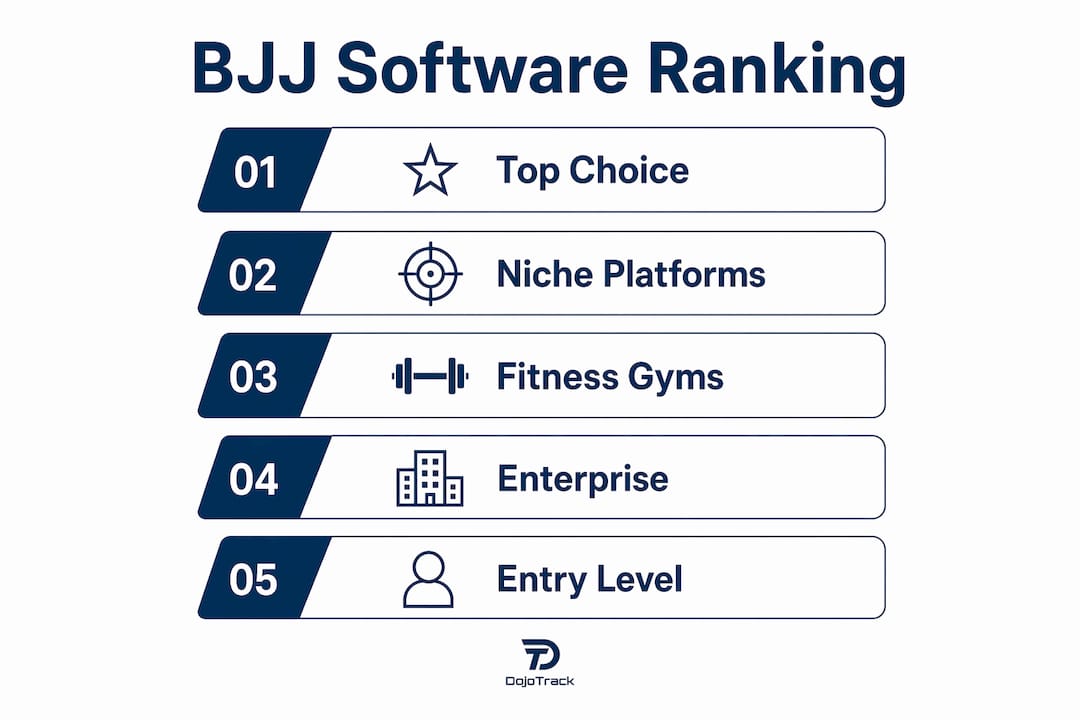
If your situation calls for something different, here is a quick shortlist:
- Dojotrack — best overall for BJJ academies that want AI retention, automated belt progression, and a free starting point
- BJJ-optimized niche platforms (e.g., BJJLINK, Martialytics) — best for small schools that want deep belt/technique workflows and are less concerned with broader gym management
- All-in-one fitness platforms (e.g., Mindbody, Zen Planner, ABC Glofox) — best for multi-program gyms that need strong scheduling and billing but can live without BJJ-specific belt tracking
- Enterprise/multi-location platforms (e.g., Wodify, Xplor Recreation) — best for growing academies managing multiple sites and needing centralized reporting
Your fastest next step: book demos with your top two or three picks, run the belt-tracking and failed-payment simulations described in this guide, and use migration support to move your data without downtime.
Table of Contents
- What is the best software for BJJ academies right now?
- Platform profiles: who each option is really built for
- Which features actually matter for a BJJ academy?
- How do you choose the right software for your BJJ academy?
- Common mistakes BJJ owners make when choosing software
- Why AI-driven retention and a digital curriculum matter for BJJ schools
- What is the final verdict on BJJ academy software?
- Key Takeaways
- The real lesson from software rollouts at BJJ schools
- Dojotrack is ready to run for your BJJ academy
- Useful sources and further reading
- FAQ
What is the best software for BJJ academies right now?
| Platform | Best For | Pricing & Free Tier | Belt Tracking Depth | Retention / AI |
|---|---|---|---|---|
| Dojotrack | Most BJJ academies (all sizes) | Free core tier; paid tiers unlock AI + app | Native, automated belt promotions | AI at-risk alerts + SMS automation |
| Gymdesk | Small-to-mid BJJ schools | Paid plans; free trial available | Moderate belt/rank tracking | Basic automation |
| Zen Planner | Established martial arts schools | Paid plans; free trial | Rank tracking included | Moderate automation |
| Mindbody | Multi-program fitness/yoga/BJJ | Paid plans; no free tier | Limited belt-specific features | Marketing automation |
| PushPress | CrossFit/MMA hybrid gyms | Free tier + paid plans | Basic rank fields | Basic retention tools |
| BJJLINK | BJJ-only small schools | Low-cost; free trial | Deep belt/stripe tracking | Community-focused, limited AI |
| Kombat Evolve | Martial arts schools (general) | Paid plans | Moderate belt tracking | Moderate automation |
| Wodify | Mid-to-large multi-program gyms | Paid plans | Basic rank fields | Moderate retention tools |
| MAAT | Martial arts schools | Paid plans | Belt tracking included | Basic |
| Kicksite | Small martial arts schools | Paid plans; free trial | Belt/rank tracking | Basic automation |
| Xplor Recreation | Multi-location / enterprise | Enterprise pricing | Limited BJJ-specific | Reporting-focused |
| Arbox | Boutique fitness / BJJ | Paid plans | Basic rank fields | Moderate automation |
| ABC Glofox | Mid-to-large gyms | Paid plans | Limited belt-specific | Marketing automation |
| Pike13 | Service-based fitness studios | Paid plans | Basic rank fields | Basic |
| WellnessLiving | Multi-discipline studios | Paid plans; free trial | Moderate rank tracking | Moderate automation |
| Spark Membership | Martial arts schools | Paid plans | Belt tracking included | Basic automation |
| Martialytics | BJJ/martial arts schools | Low-cost paid plans | Deep belt/stripe tracking | Basic |
| RhinoFit | Budget-conscious gyms | Low-cost paid plans | Basic rank fields | Minimal |
| Chalk It Pro | BJJ-focused schools | Paid plans | Belt tracking included | Basic |
Demo and migration support availability varies by vendor. Dojotrack publishes a dedicated data migration page with guided services for academies moving off spreadsheets or legacy systems.
Platform profiles: who each option is really built for
Dojotrack
Dojotrack is an AI-powered martial arts studio management platform founded in Utah by martial arts veteran Jared Reed. It covers the full operational stack: student CRM, attendance tracking with sign-in kiosks, automated belt promotions, Stripe-powered recurring billing, family discounts, digital waivers, event registration, staff management, and a student mobile app. The free core tier gives you membership management, attendance, scheduling, and digital waivers at no cost. Paid tiers unlock AI retention alerts, SMS automation, advanced analytics, and the student app. Migration services are available for schools moving off spreadsheets or older platforms.
Pros:
- Native belt tracking tied directly to attendance data and AI at-risk alerts
- Free core tier lowers the barrier to entry; paid tiers scale with your school
- Purpose-built for martial arts, not adapted from a generic gym template
Cons:
- Currently available only for U.S.-based academies
- Advanced AI and mobile app features require a paid subscription
BJJ-optimized niche platforms (BJJLINK, Martialytics, Chalk It Pro)
These platforms go deep on the BJJ-specific side: belt and stripe tracking, technique tagging, and community curriculum libraries. BJJLINK, for example, is built around the BJJ community with progression tracking and class scheduling. Martialytics focuses on martial arts school management with detailed belt workflows. Chalk It Pro targets BJJ schools with belt tracking and scheduling tools.
Pros:
- Highly specialized belt and progression features
- Lower price points for small schools
Cons:
- Narrower feature sets outside of belt/curriculum workflows
- Migration support and AI retention tools are limited or absent
All-in-one fitness/gym platforms (Mindbody, Zen Planner, ABC Glofox, Arbox, WellnessLiving, Pike13)
These platforms serve many fitness verticals and bring strong scheduling, payment processing, and marketing automation. Zen Planner has a martial arts mode with rank tracking. Mindbody is widely used across yoga, fitness, and martial arts studios. ABC Glofox and Arbox target boutique gyms with polished member apps. WellnessLiving and Pike13 cover multi-discipline studios with moderate automation.
Pros:
- Mature scheduling and billing tools
- Broad third-party integrations
Cons:
- Belt tracking is often an add-on or workaround, not a native workflow
- Less suited to BJJ-specific curriculum and progression needs
Enterprise/multi-location platforms (Wodify, Xplor Recreation)
Wodify started in CrossFit and has expanded to MMA and martial arts. Xplor Recreation targets large recreation centers and multi-location operators. Both offer centralized reporting and advanced user roles.
Pros:
- Built for scale: multiple locations, staff hierarchies, and consolidated dashboards
- Strong reporting and analytics
Cons:
- Higher cost and longer onboarding timelines
- BJJ-specific belt workflows are not a primary focus
Mid-market martial arts platforms (Gymdesk, Kicksite, Spark Membership, Kombat Evolve, MAAT)
Gymdesk is a clean, well-regarded platform for martial arts schools with rank tracking and a digital curriculum feature that practitioners report improves student retention. Kicksite focuses on martial arts with belt/rank tracking and basic automation. Spark Membership and Kombat Evolve are built for martial arts schools with belt tracking and moderate automation. MAAT covers belt tracking and scheduling for martial arts schools.
Pros:
- Martial arts focus with belt tracking included
- Reasonable pricing for small-to-mid schools
Cons:
- AI retention features are limited compared to Dojotrack
- Migration support varies; confirm before committing
Entry-level scheduling and POS tools (PushPress, RhinoFit)
PushPress offers a free tier with basic scheduling and billing, popular in CrossFit and MMA gyms. RhinoFit is a budget option with basic rank fields and minimal retention tools.
Pros:
- Low or no upfront cost
- Simple to set up for very small schools
Cons:
- Belt tracking is rudimentary or absent
- No meaningful retention automation
Pro Tip: Before ruling out a platform because it lacks a BJJ-specific label, ask the vendor to show you a live student profile with belt history attached to attendance records. If they cannot demo that in under two minutes, the feature is not production-ready.
Which features actually matter for a BJJ academy?
The table below maps each key dimension to what “good” looks like for a BJJ school and which platform categories deliver it.
| Feature Axis | What “Good” Looks Like for BJJ | Dojotrack | BJJ Niche Platforms | All-in-One Fitness | Enterprise Platforms | Entry-Level Tools |
|---|---|---|---|---|---|---|
| Belt & progression tracking | Native belt/stripe fields tied to attendance; automated promotion workflows | ✓ Native + automated | ✓ Deep | Partial | Partial | Minimal |
| Attendance & kiosks | Sign-in kiosk, mobile check-in, coach override; data feeds retention dashboard | ✓ Kiosk + mobile | Varies | ✓ Strong | ✓ Strong | Basic |
| Scheduling & multi-program | Multiple class types (gi, no-gi, kids, comp team); calendar integrations | ✓ Included | Moderate | ✓ Strong | ✓ Strong | Basic |
| Billing & family memberships | Recurring billing, family discounts, failed-payment retries, Stripe integration | ✓ Stripe-native | Varies | ✓ Strong | ✓ Strong | Basic |
| Mobile app & member UX | Student app with belt progress, schedule, push notifications, in-app purchases | ✓ Dedicated app | Varies | ✓ Strong | ✓ Strong | Minimal |
| Digital curriculum / technique library | Structured technique library linked to belt level; visible progress milestones | ✓ Included | ✓ Deep | Partial | Partial | None |
| Retention & AI automation | AI at-risk alerts, SMS/email workflows, churn-prediction thresholds | ✓ AI-native | Minimal | Moderate | Moderate | None |
| Integrations | Stripe, QuickBooks, Google Calendar, marketing tools | ✓ Stripe + more | Limited | ✓ Broad | ✓ Broad | Limited |
| Onboarding / migration | Guided data migration, staff training, dedicated support | ✓ Migration page | Varies | Varies | ✓ Strong | Minimal |
| Support quality | Live chat, email, onboarding calls, documented SLAs | ✓ Documented | Varies | Varies | ✓ Strong | Email only |
Belt and progression tracking
For a BJJ academy, belt tracking is not a cosmetic feature. It is the operational record that ties a student’s training history to their rank. The best implementations attach belt and stripe fields directly to the student profile, log the date of each promotion, and trigger automated workflows (congratulatory messages, updated member portal badges, coach notifications). Platforms that store rank as a free-text field or a dropdown with no attendance linkage are not doing real belt tracking. During a demo, ask the vendor to pull up a student profile, show the full belt history with dates, and demonstrate what happens automatically when a promotion is recorded.

Attendance and churn detection
Attendance data is the earliest reliable churn signal available to a BJJ school owner. A student dropping from three classes per week to one is far more likely to cancel within 60 days than a student maintaining frequency. Modern platforms like Dojotrack use that pattern to trigger automated retention workflows before the student ghosts. Platforms without attendance-linked dashboards leave you reacting to cancellations rather than preventing them.
Statistic callout: Research from Jitsmagazine confirms that attendance-linked retention dashboards convert vague churn intuition into measurable interventions, specifically by flagging students who drop training frequency before they cancel.
Digital curriculum and visible progress
A structured technique library linked to belt level does two things: it gives students a reason to show up consistently, and it gives coaches a teaching framework. Practitioners report that visible progress toward stripes and belts reduces dropout by keeping students engaged between sessions. Gymdesk’s curriculum guide documents this effect in detail. When evaluating vendors, ask them to show you how a student sees their curriculum progress in the member app, not just how the coach manages it in the back end.
Billing, family memberships, and payment recovery
Urban BJJ gyms earning $12,000–$22,500 per month cannot afford a billing system that fails silently on declined cards. The platform you choose should handle Stripe-powered recurring billing, family plan discounts, and automated failed-payment retries with dunning sequences. Ask vendors to simulate a failed payment during your demo and show you exactly how the system notifies the member, retries the charge, and flags the account for staff follow-up.

Pro Tip: Test how the platform reconciles Stripe payments against bank deposits. Platforms that show a Stripe dashboard but do not reconcile against your bank statement create accounting headaches. Ask for a QuickBooks or accounting export during the demo.
How do you choose the right software for your BJJ academy?
Start with your non-negotiables, then use demos to stress-test the specifics.
Selection criteria (prioritized)
- Native belt and progression tracking — rank fields tied to attendance, not a workaround
- AI or automated retention tools — at-risk alerts, SMS/email workflows, churn thresholds
- Pricing transparency — published pricing or a clear quote; no hidden per-transaction fees
- Migration and onboarding support — guided data transfer from your current system
- Mobile app for members — belt progress, schedule, push notifications
- Family billing and recurring payments — Stripe integration, family discounts, failed-payment retries
- Integrations — QuickBooks, Google Calendar, marketing tools
- Support quality — live chat or phone, documented response times
Demo questions to run with every vendor
- Show me a live student profile with full belt history and the attendance records attached to it.
- Simulate a failed payment: how does the system notify the member, retry the charge, and alert staff?
- Run an at-risk alert: which students would your system flag today, and what threshold triggers the alert?
- Export a belt history report for all active students.
- Walk me through your data migration process: what format do you accept, how long does it take, and who manages it?
- Show me the member-facing mobile app: how does a student see their belt progress and upcoming classes?
- What does your onboarding timeline look like from contract signing to full operation?
Red flags to watch for
- No native belt tracking — rank stored as a note or free-text field is not a belt tracking system; it will not scale
- Opaque pricing — “contact us for pricing” with no ballpark range makes ROI planning impossible; use a lifetime value calculator to set your budget ceiling
- No migration support — vendors who expect you to re-enter all student data manually add weeks of friction and risk data loss
- No attendance analytics — without attendance data feeding a retention dashboard, you are managing churn reactively
- Vague AI claims — ask for the specific threshold that triggers an at-risk alert and the false-positive rate; “AI-powered” without specifics is marketing copy
Buying timeline and implementation milestones
A realistic implementation runs four to six weeks from contract to full operation:
- Week 1: Free trial or demo access; run all demo questions above
- Weeks 2–3: Data migration (student records, belt history, billing data)
- Week 3: Staff training on admin workflows and coach check-in tools
- Week 4: Soft launch with one program; monitor attendance data and billing
- Weeks 5–6: Full rollout; activate retention automation and student mobile app
Common mistakes BJJ owners make when choosing software
Most of these mistakes cost time and money that could have been avoided with a 30-minute demo checklist.
- Choosing on price alone. The cheapest platform often lacks belt tracking and retention automation. Calculate the value of retaining one additional student per month against the cost difference between tiers before deciding.
- Ignoring instructor and coach workflows. If your coaches find the check-in process clunky, they will skip it. Attendance data disappears, and your retention dashboard becomes useless. Test the coach-facing interface, not just the admin panel.
- Skipping the migration dry run. Ask every vendor to run a test import of a sample CSV before you sign. Vendors who cannot do this cleanly will cause data loss or weeks of manual cleanup.
- Not testing belt workflows before going live. Many platforms list “belt tracking” as a feature but implement it as a dropdown with no automation. Run a full belt promotion simulation during the demo.
- Underestimating integration needs. If you use QuickBooks for accounting and Google Calendar for scheduling, confirm those integrations work natively before committing. Workarounds via Zapier add cost and fragility.
- Poor staff training at launch. Launching without a structured training session for front-desk staff and coaches leads to inconsistent data entry. Block two to three hours for a live walkthrough before your go-live date.
- Activating all features at once. Rolling out billing, curriculum, retention automation, and the member app simultaneously overwhelms staff and students. Start with core operations, then layer in advanced features over 30–60 days.
Pro Tip: Build a one-page “demo scorecard” before your vendor calls: list your five non-negotiables and score each vendor 1–3 on each. It removes the post-demo memory bias that makes the last demo you took always feel like the best one.
Why AI-driven retention and a digital curriculum matter for BJJ schools
The case for AI retention tools is straightforward: attendance drops predict cancellations, and manual tracking cannot catch them fast enough. A student who trained four days a week in January and is now showing up once a week in March is almost certainly on their way out. Without a system that flags that pattern automatically, you find out when they cancel, not when you could still do something about it.
Statistic callout: Urban BJJ gyms typically earn $12,000–$22,500 per month. Losing even two or three students per month to preventable churn represents a meaningful share of that total.
How AI retention actually works in practice
Consider a student who has been training three times a week for eight months. In week 33, they drop to once a week. Without automation, that pattern goes unnoticed until they send a cancellation email. With an AI retention system, the platform flags the student as at-risk after a configurable threshold (say, two consecutive weeks below their baseline frequency), triggers an automated SMS check-in from the coach, and logs the outreach in the student’s CRM record. The coach has a conversation. The student, who was struggling with a schedule change, adjusts their membership tier instead of canceling. That is the difference between reactive billing and proactive retention.
When evaluating vendors on AI features, ask these specific questions:
- What is the exact attendance threshold that triggers an at-risk alert?
- How many false positives does the system generate per month (students flagged who were just on vacation)?
- Can a coach or admin override or dismiss an alert without affecting the underlying data?
- Does the system log automated outreach in the student’s CRM record?
The digital curriculum retention link
A curated technique library tied to belt level gives students a visible progress path between promotions. Students who can see what they need to learn to reach their next stripe are more likely to attend consistently. During a vendor demo, ask the student-facing view to be shown, not just the coach-facing curriculum editor. If a student cannot see their own progress in the mobile app, the curriculum feature is not doing retention work.
| Retention Tool | What It Does | What to Test in Demo |
|---|---|---|
| Attendance-linked at-risk alerts | Flags students below frequency threshold | Set a threshold; confirm alert fires and logs in CRM |
| Automated SMS/email outreach | Sends coach-branded check-in message | Trigger a test message; confirm personalization fields |
| Belt progression notifications | Notifies student and coach when promotion criteria are met | Simulate a promotion; check student app notification |
| Digital curriculum visibility | Student sees technique library and stripe milestones in app | Log in as a student; navigate to curriculum progress view |
| Failed-payment recovery | Retries charge, notifies member, flags account | Simulate a declined card; trace the full dunning sequence |
What is the final verdict on BJJ academy software?
The right platform depends on your academy’s size, budget, and operational priorities. Here is a direct mapping:
- Best overall for most BJJ academies: Dojotrack. Native belt tracking tied to attendance, AI at-risk alerts, Stripe billing, a student mobile app, and a free core tier make it the most complete BJJ-specific option available in the United States. Retention and revenue tools are built in, not bolted on.
- Best for tight budgets or very small schools: Entry-level tools like PushPress (free tier) or RhinoFit cover basic scheduling and billing. Expect to outgrow them as your school scales past 50 active members.
- Best for BJJ-only schools that prioritize technique libraries: BJJ-niche platforms like BJJLINK or Martialytics go deep on belt and curriculum workflows at lower price points, though AI retention and migration support are limited.
- Best for multi-program gyms with complex scheduling: All-in-one platforms like Zen Planner, Mindbody, or ABC Glofox handle multi-discipline scheduling and marketing automation well. Belt tracking is workable but not native.
- Best for enterprise/multi-location academies: Wodify or Xplor Recreation offer the centralized reporting and role management that large operations need. Budget for longer onboarding and higher monthly costs.
To validate your decision: book demos with your top two picks, run the seven demo questions listed above, and use Dojotrack’s member lifetime value calculator to confirm whether premium automation features justify the subscription cost for your school’s revenue profile.
Key Takeaways
Dojotrack is the strongest choice for most U.S. BJJ academies because it combines native belt tracking, AI retention alerts, and a free core tier in one purpose-built platform.
| Point | Details |
|---|---|
| Verify native belt tracking | Confirm belt fields are tied to attendance records and trigger automated promotions, not just stored as a dropdown. |
| Test churn alerts with a simulated drop | Ask vendors to flag a student who dropped from three classes to one per week and show the automated outreach that fires. |
| Confirm migration support before signing | Vendors without guided data migration add weeks of manual work and risk losing historical belt and billing records. |
| Match platform to academy size | Small schools on tight budgets can start with Dojotrack’s free tier; enterprise academies need multi-location reporting tools. |
| Dojotrack as the starting point | Dojotrack’s free core tier, AI retention, and U.S.-based migration support make it the practical first demo to book. |
The real lesson from software rollouts at BJJ schools
Most academy owners I talk to made the same mistake: they picked software based on a demo that looked polished, then discovered three months in that belt tracking was a workaround and the “AI retention” was just a weekly email blast. The gap between a vendor’s marketing and their actual workflow depth is widest in two places: belt progression and churn detection.
The rollout that actually works looks like this. You start with the free tier or a trial, migrate your student data with vendor support, and spend the first two weeks doing nothing but confirming that attendance is being captured correctly. Only after attendance data is clean do you activate retention automation. Then you pilot the digital curriculum with one coach and one program for six weeks before rolling it out academy-wide. That sequence matters because each layer depends on the one below it. AI alerts are only as good as the attendance data feeding them. Curriculum engagement is only measurable if attendance is tracked.
One pilot tip worth taking seriously: assign one coach as the curriculum owner for the first six weeks. They build the technique library for their program, test the student-facing view, and report back on what students actually engage with. That feedback loop saves you from building a curriculum no one opens.
Dojotrack is ready to run for your BJJ academy
Most BJJ academy owners spend more time managing spreadsheets than they do on the mat. Dojotrack eliminates that overhead with a platform built specifically for martial arts schools: AI-powered retention alerts that catch at-risk students before they cancel, native belt tracking tied to real attendance data, a student mobile app with curriculum progress and push notifications, and Stripe-powered billing that handles family plans and failed-payment recovery automatically.
The free core tier covers membership management, attendance tracking, scheduling, and digital waivers with no upfront cost. When you are ready to add AI retention, SMS automation, and the student app, paid tiers scale with your school. For academies moving off spreadsheets or legacy systems, Dojotrack’s guided data migration service handles the transfer so you do not lose historical belt records or billing data.
Sign up for the free tier or book a demo at dojotrack.com to see belt tracking, AI retention alerts, and the student app in a live walkthrough.
Useful sources and further reading
- Why direct debit alone is not enough to run a BJJ academy — Research on attendance-linked churn signals and why integrated retention dashboards outperform billing-only approaches.
- How to Build a BJJ Curriculum That Keeps Students | Gymdesk — Practitioner guide on digital curriculum design and its effect on student retention.
- How Much Do BJJ Gym Owners Make? Real Income Data | Gymdesk — Revenue benchmarks by gym size and location; useful for ROI and pricing decisions.
- Stop Losing Students: 5 Steps to Boost Retention | Dojotrack — Practical retention workflow guide for martial arts schools.
- How to Track Student Attendance in Martial Arts Schools | Dojotrack — Explains attendance capture methods and why attendance-data integration matters for churn prevention.
- Why School Owners Need AI Business Tools in 2026 | Dojotrack — Covers practical AI applications for studios and what to ask vendors about AI features.
- Lifetime Value Calculator for Martial Arts Schools | Dojotrack — Tool to estimate member lifetime value and justify software spend.
- Easy Software Migration to Dojotrack — Migration landing page with guided services for academies moving off legacy systems.
- Establish a Student Retention System Early in Your Dojo | Dojotrack — Step-by-step guide to building a retention system from day one.
FAQ
What does BJJ academy software actually need to do?
At minimum, it needs native belt and stripe tracking tied to attendance records, recurring billing with family plan support, and a retention dashboard that flags students who drop training frequency. Scheduling, a member-facing mobile app, and a digital curriculum are the next tier of features that separate good platforms from great ones.
How much does BJJ gym management software cost?
Pricing ranges from free (Dojotrack’s core tier, PushPress’s free plan) to several hundred dollars per month for enterprise platforms. Most mid-market martial arts platforms fall in the $50 per month range depending on student count and features. Urban BJJ gyms typically find that investing in a platform that prevents cancellations pays for itself.
How long does it take to implement new gym software?
A realistic timeline is four to six weeks from contract signing to full operation: one to two weeks for data migration, one week for staff training, and one to two weeks of soft-launch monitoring before full rollout. Vendors with guided migration support, like Dojotrack, compress the migration phase significantly.
Does belt tracking software work for kids’ BJJ programs too?
Yes. The best platforms handle separate belt progressions for kids and adults, including the intermediate stripe system common in youth programs. During a demo, ask the vendor to show a kids’ program profile with stripe milestones distinct from the adult belt ladder.
How much does a BJJ school make per month?
Revenue varies widely by location and size. Urban gyms in a roughly 1,500 square foot space typically earn $12,000–$22,500 per month, suburban gyms earn $3,000–$7,500, and rural gyms earn $1,500–$4,500 per month.