
The simplest enforceable rule for most dojos: a 12-hour cancellation cutoff for group classes, credit forfeiture for members on class packs, and a flat no-show fee for drop-ins. None of it holds up without one thing: a timestamped acknowledgment collected at booking and enforced automatically. Everything else below is the fine print that makes that rule stick.
TL;DR:
- Implementing a timestamped agreement at booking significantly reduces disputes by providing clear proof of cancellation policies.
- Shortening the cancellation window to 12 hours for group classes minimizes lost capacity and discourages late cancellations.
- Applying a flat fee or credit forfeiture based on the student’s type prevents double punishment and maintains fairness across memberships.
- Automation in studio management software ensures consistent enforcement, from reminders to fee charges, minimizing staff errors.
- Regularly reviewing policy effectiveness over 30 to 60 days helps identify whether the issue lies with fees, communication, or student behavior.
Table of Contents
- Late Cancel Vs No-Show: What Your Martial Arts Cancellation Policy Must Define
- How Should You Set Your Cancellation Notice Window?
- What Does a Consistent Enforcement Workflow Look Like?
- Where Should Members See Your Policy Before They Book?
- What Should Your Studio Software Handle Automatically?
- Templates You Can Copy Into Your Booking Flow Today
- How Long Should You Trial a New Cancellation Policy?
- Why Consistent Enforcement Beats Bigger Fees
- How DojoTrack Handles Your Late Cancel Policy For You
- Sources
- FAQ
Late Cancel Vs No-Show: What Your Martial Arts Cancellation Policy Must Define
A “late cancel” happens when a student cancels a booked class after your published cutoff, usually the same day. A “no-show” happens when a student never cancels at all and simply doesn’t appear on the mat. Both eat a training spot, but staff often treat them the same way when they shouldn’t, since a no-show carries zero warning and typically deserves the stricter remedy.
Concrete examples make this real for your team:
- A student books the 6:00 PM Brazilian Jiu Jitsu class, cancels at 5:15 PM. If your cutoff is 12 hours, that’s a late cancel.
- A student books a private lesson and never cancels or shows up. That’s a no-show, and it usually costs you a coach’s paid hour, not just a mat spot.
- A student registers for a weekend seminar and cancels the morning of. Workshops often deserve their own rule since seats are capped and prepaid instructors are already committed.
Before you write a word of policy, decide who it covers. Unlimited members, punch-card holders, trial students, and drop-in guests don’t behave the same way, and a fair studio cancellation policy should say so explicitly rather than assume one rule fits everyone. Punch-card and class-pack students have the most at stake, since a forfeited credit is real money; unlimited members feel it less, so a flat fee often fits them better.
The fix that prevents almost every dispute later: build a single source of truth. Require a checkbox at booking, link it to the actual policy text, and store the timestamp and policy version with the reservation. A timestamped record of a member’s agreement is the strongest defense you have when someone disputes a charge, and it turns a “he said, she said” argument into a two-second lookup.
How Should You Set Your Cancellation Notice Window?
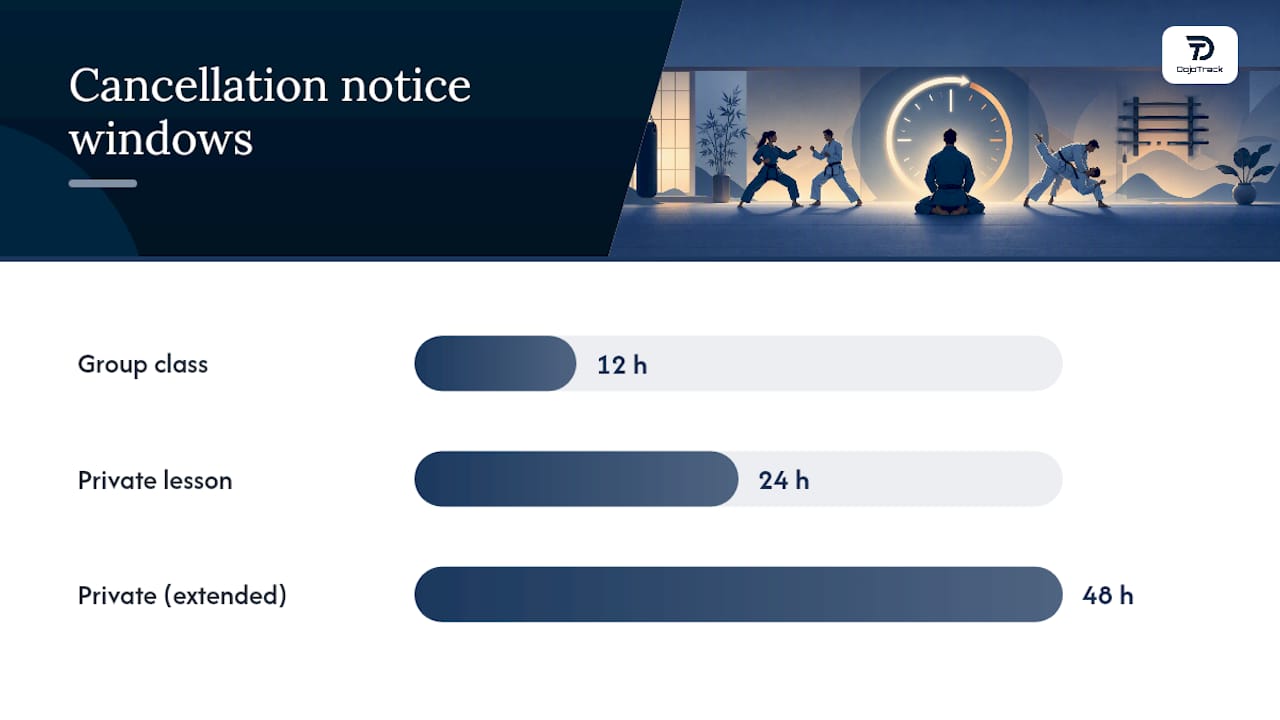
Most studios that publish a clear cutoff, commonly a 24-hour window where earlier cancellations return full credit, see fewer disputes than studios with vague or unwritten rules. Martial arts classes run on tighter margins than yoga or spin, though. A missed jiu jitsu spot can’t be resold the way a drop-in fitness class can, so many dojos shorten the window to 12 hours for group classes and extend it to 24 or even 48 hours for privates, since coaches block that time exclusively for one student.
Three remedies cover almost every situation:
- Credit forfeiture: the student loses the class credit they would have used. Best for unlimited and pack members where cash changing hands feels punitive.
- Flat fee: a fixed charge, commonly in the $10 to $25 range depending on class size and how premium the session is. Best for no-shows, where a warning never happened.
- Drop-in rate charge: the student pays what a walk-in guest would pay for that class. Best for trial students or guests who have no credits to forfeit in the first place.
Pro Tip: Match the remedy to what the student actually has to lose. Charging a pack holder a flat fee on top of a forfeited credit feels like double punishment, and it’s the fastest way to generate an angry phone call.
Present fees as protecting training spots for everyone else, not as a punishment aimed at one person. That framing alone cuts a lot of the resentment before it starts.
What Does a Consistent Enforcement Workflow Look Like?
A policy only works if the same rule fires the same way every time, regardless of which staff member is on the front desk that day. Manual enforcement fails constantly, not because owners don’t care, but because a busy front desk forgets, or a favorite student gets a pass a stranger wouldn’t.
- Booking timestamp: the reservation records the exact time it was made and the exact cutoff that applies to it.
- Reminders: an automated message goes out ahead of class, giving the student one more chance to cancel inside the window.
- Check at class close: attendance closes out and the system flags anyone who booked but didn’t check in.
- Apply the rule: credit forfeiture or fee triggers automatically based on the policy tied to that booking.
- Notify the member: a message explains what happened and what was charged, in plain language.
- Log everything: charge amount, attendance status, and the exact policy version in effect all get stored together.
Keeping a card on file with clear authorization language at signup (“your card may be charged for late cancellations or no-shows per our published policy”) heads off most chargeback attempts before they start. Build a short standard operating procedure for exceptions too: medical emergencies, instructor-canceled classes, and software errors should route to a manager for a documented waiver, never a front-desk judgment call made on the fly. Track repeat offenders separately, since a first-time no-show and a fifth one in a month deserve different responses.
That audit trail, charge, attendance status, and policy version together, is what turns “the system charged me by mistake” into a five-second resolution instead of a 20-minute argument.
Where Should Members See Your Policy Before They Book?
Members can’t follow a rule they never saw. Surface your cancellation policy at signup, again inside the booking widget, again on the confirmation message, again in the class reminder, and once more on the receipt if a fee applies. Repetition here isn’t overkill. It’s the difference between a student who forgets and a student who claims they never knew.
A booking checkbox can be this short: “I understand cancellations inside 12 hours forfeit my class credit, and no-shows are charged a moderate fee.” Three numbers, one sentence, done. Confirmation messages should echo the same three numbers: cutoff time, credit or fee amount, and the class time itself.
Timing matters as much as wording:
- Send a reminder 24 hours and again 2 hours before class, giving a clear last chance to cancel free.
- Send a short “we missed you today” recovery text within 30 minutes of the missed class, which also opens the door to rebooking a fresh spot.
Keep every message short, factual, and free of guilt trips. A student who feels lectured is a student who starts avoiding your gym instead of just avoiding one class.
What Should Your Studio Software Handle Automatically?
Manual tracking is the reason most late cancel policies collapse within a month. Software should carry the operational weight so your staff isn’t the enforcement mechanism, which is exactly why studio management platforms built around this problem treat the cancellation window and acknowledgment as core features, not add-ons.
Look for a platform that handles:
- Cutoff display at the moment of booking, with a required acknowledgment checkbox saved alongside a timestamp.
- Automated fee enforcement, including card capture, retry logic on failed charges, and the accounting entry created without staff typing anything in.
- Dynamic waitlist movement that fills a canceled spot instantly, which recovers class capacity even after a late cancel.
- Reporting that breaks out late-cancels, no-shows, waived fees, and repeat offenders so you can see patterns instead of guessing.
| What you need | Why it matters | DojoTrack feature area |
|---|---|---|
| Cutoff shown at booking | Prevents “I didn’t know” disputes | Attendance tracking |
| Auto fee and card retry | Removes manual billing work | Automated billing |
| Instant waitlist fill | Recovers lost capacity fast | Waitlist management |
| Offender reporting | Flags who needs coaching, not just fees | Analytics and reports |
Templates You Can Copy Into Your Booking Flow Today
Short policy language performs better than long paragraphs, mostly because members actually read it when it’s three numbers instead of three paragraphs.
- Booking checkbox: “I agree that canceling within 12 hours of class forfeits my credit, and no-shows incur a moderate flat fee.”
- Front-desk script (10 seconds): “Looks like that class was a late cancel, so the credit was used per our policy. Want me to help you rebook this week?”
- Manager escalation line: “Let me pull up the timestamp and policy version on that booking and get back to you in a few minutes.”
- Recovery SMS (30 minutes after class): “We missed you at class today! Want help grabbing a spot later this week?”
- Chronic-offender follow-up: “Noticed a few missed classes lately. Everything okay? Let’s find a schedule that actually works for you.”
How Long Should You Trial a New Cancellation Policy?
Run any new policy for 30 to 60 days before declaring it finished. Track five numbers: late-cancel rate, no-show rate, fee revenue recovered, how fast waitlist spots refill, and what share of incidents come from repeat offenders rather than one-off mistakes.
If your no-show rate barely moves, the fee is probably too low, or students haven’t actually seen the policy. If refill rate stays weak, your waitlist notifications need shortening. If repeat offenders account for most incidents, that’s a coaching problem, not a pricing problem. Adjust one variable at a time, whether that’s the cutoff window, the fee amount, or reminder timing, so you can tell what actually moved the number. Attendance data over a full trial period tells you far more than a gut reaction after one bad week.
Why Consistent Enforcement Beats Bigger Fees
The instinct when a policy isn’t working is to raise the fee. That’s usually the wrong lever. A $15 fee applied every single time, without exception, changes behavior faster than a $30 fee applied inconsistently, because inconsistency is what actually breeds resentment and disputes.
Chronic no-shows are rarely about money at all. They’re a signal that a student is drifting, and a personal check-in often recovers that student where a fourth penalty just pushes them out the door for good.
— DojoTrack
How DojoTrack Handles Your Late Cancel Policy For You
A robust enforcement layer in studio software is what most studios need, rather than another app to manually babysit. The platform captures the timestamped booking acknowledgment automatically, applies your fee or credit forfeiture rule the moment a cutoff passes, moves the waitlist to fill the open spot, and logs the full audit trail, charge, attendance status, and policy version, so disputes take minutes instead of guesswork. Attendance tracking, automated billing, and reporting all live in one dashboard instead of three disconnected tools.
Studios can start on the free core plan to get attendance tracking, scheduling, and digital waivers running immediately, then unlock automated fee enforcement and reporting once ready. Check DojoTrack’s feature list to see exactly what maps to your policy, and get started at DojoTrack today.
Sources
- How to Reduce No-Shows at Your Studio: 12 Strategies That Work
- How to Manage Late Cancellations and No-Show Fees
- Managing disputed charges
- No Show Charge: A Gym Owner’s How-To Guide
FAQ
What’s the Difference Between a Late Cancel and a No-Show?
A late cancel means the student canceled after your published cutoff, usually inside 12 to 24 hours of class. A no-show means the student never canceled at all and simply didn’t attend, which is why it typically carries the stricter fee.
How Long Should a Martial Arts Cancellation Window Be?
Most group classes work well with a 12 hour window, while private lessons often warrant 24 to 48 hours since a coach blocks that time exclusively. The right window depends on how hard that class type is to backfill.
How Much Should a No-Show Fee Be?
Many studios land in the $10 to $25 range depending on class size and how premium the session is. Flat fees work best when paired with credit forfeiture kept separate for pack holders.
Does DojoTrack Automate Late Cancel Fees?
Yes. DojoTrack captures the timestamped acknowledgment at booking, applies fee or credit forfeiture rules automatically at the cutoff, and logs the full record for disputes. Current pricing for automation features starts on the Launch plan at $95 per month, with a free core tier available for basic attendance and scheduling.
How Do I Handle Repeat Offenders Fairly?
Flag students with a pattern, often three or more missed classes in 30 days, for a personal check-in rather than an automatic escalation. A short conversation about scheduling usually solves more than another fee ever will.