

TL;DR:
- Implementing a structured student retention system with regular check-ins, data tracking, and personalized recognition significantly reduces early dropout rates. Using automated alerts and community engagement strategies allows instructors to identify and re-engage at-risk students promptly. Building this system from day one fosters long-term commitment and enhances overall dojo growth.
A student retention system is a structured set of processes, tools, and communication touchpoints designed to prevent early dropout and build long-term student commitment. For martial arts studio owners, the stakes are high. Systematic check-ins at weeks 2, 4, and 8 reduce early student turnover by 40–60%. That single finding should reshape how you think about your first 90 days with every new student. This guide breaks down the tools, frameworks, and communication strategies you need to establish student retention system early and keep your dojo growing.
What tools and data should you use to establish student retention system early?
The foundation of any early retention initiative is knowing what to track and having the right tools to track it. Without data, you are guessing. With the right data, you are making decisions.
The most important metrics to monitor in the first 90 days are:
- Attendance frequency: How often is the student showing up each week?
- Milestone completions: Are they progressing through belt curriculum on schedule?
- Engagement behaviors: Are they interacting with instructors, attending events, or using your student app?
- Communication response rates: Are they opening emails, replying to texts, or ignoring outreach?
These are what retention science calls “value-attainment behaviors.” Tracking simple behaviors like attendance and task completion predicts retention better than complex models. That means you do not need a sophisticated algorithm to start. You need consistent data collection on the basics.
Comparing common retention tools for martial arts schools

| Tool type | What it tracks | Best for |
|---|---|---|
| Attendance tracking software | Class check-ins, frequency, absences | Spotting drop-off patterns early |
| CRM platform (e.g., Dojotrack) | Student profiles, communication history, milestones | Centralizing all student data |
| Mobile student app | Belt progress, schedule views, push notifications | Keeping students engaged outside class |
| Automated alert systems | Absence thresholds, missed milestones | Triggering timely instructor follow-up |
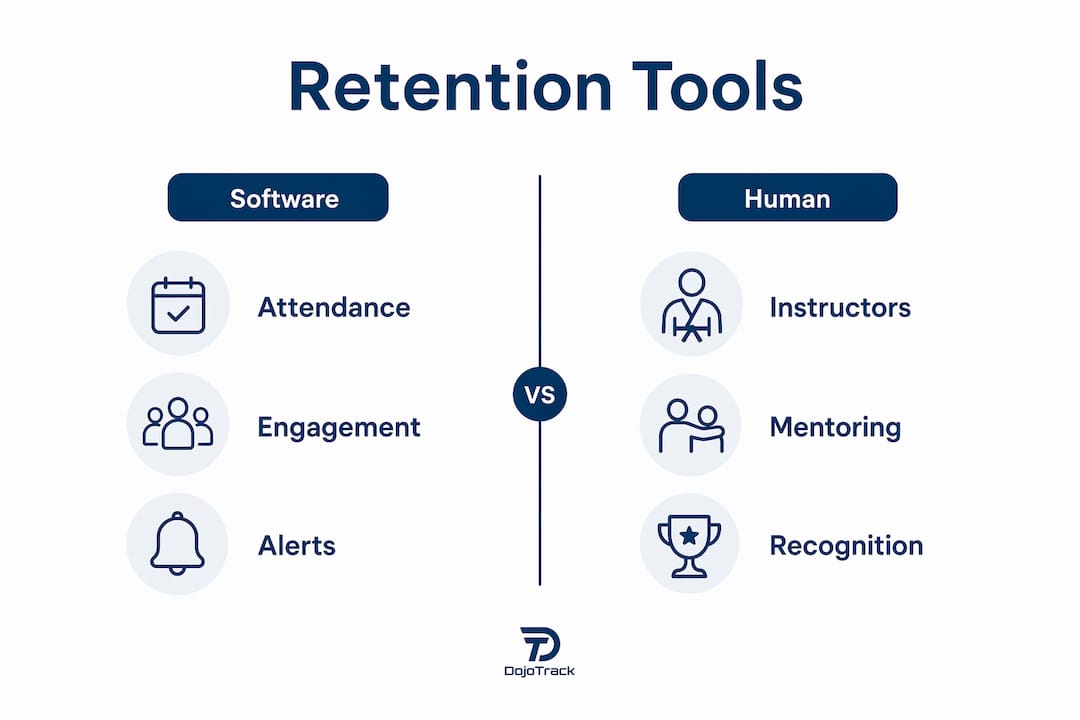
Dojotrack combines all four of these functions in one platform built specifically for martial arts schools. That matters because disconnected tools create gaps. A student can miss three classes without anyone noticing if your attendance data and your communication system do not talk to each other.
Staff roles matter just as much as software. Assign one instructor or staff member as the primary point of contact for new students in their first 30 days. That person owns the check-ins, tracks the data, and flags concerns. Professional development paired with integrated digital tools correlates with a 23-percentage-point increase in retention. Investing in your instructors’ ability to use retention tools is not optional. It is part of the system. For a deeper look at building that staff structure, the Dojotrack staff management guide covers instructor roles and accountability in detail.
How to implement a 90-day check-in framework that actually works
The first 90 days are when most students decide whether to stay or leave. A structured check-in framework turns that window into an opportunity instead of a risk.
Here is a proven sequence you can start using immediately:
-
Week 2 check-in: This is your first real touchpoint after orientation. Keep it brief and personal. Ask how the student is feeling about class, whether the schedule works for them, and if they have any questions. A two-minute conversation or a personal text message is enough. The goal is to signal that you notice them.
-
Week 4 check-in: By week four, patterns are forming. Review their attendance data before this conversation. If they have missed more than one class, address it directly but warmly. Acknowledge any progress they have made, even small wins like learning a new technique or improving their stance. Personalized feedback and wellness check-ins build the instructor-student bond that drives long-term persistence.
-
Week 8 check-in: This is your most critical touchpoint. Research shows the 40–60% reduction in early turnover comes from completing all three check-ins, not just the first one. By week eight, students who are going to disengage have usually shown warning signs. This check-in is your last clear opportunity to intervene before dropout becomes likely.
Between formal check-ins, use peer mentoring to reinforce community. Pair new students with an intermediate-level student who can answer questions, invite them to open mat sessions, and make them feel like part of the group. Community belonging is a retention driver that no software can fully replace.
Pro Tip: Use Dojotrack’s mobile app or a simple notes field in your CRM to log every check-in immediately after it happens. A 30-second note like “Week 4 check-in complete, mentioned schedule conflict on Thursdays” gives you context for the next conversation and prevents anything from slipping through.
Starting retention efforts immediately with low-effort touchpoints prevents invisible disengagement. The students who quietly stop showing up rarely announce it. They just disappear. Structured check-ins make that disappearance much harder.
How do early warning systems identify at-risk students before they quit?
An early warning system (EWS) is a set of predefined behavioral triggers that alert instructors when a student shows signs of disengagement. In higher education, EWS tools boost retention rates by 4–7% by identifying at-risk students up to 12 weeks before dropout. The same logic applies directly to your dojo.
The behavioral markers that most reliably signal disengagement in martial arts students include:
- Two or more consecutive absences without a communicated reason
- Missed belt testing or promotion milestones relative to their cohort
- No response to two or more communication attempts via text or email
- Declining class frequency over a three-week trend, even without full absences
When any of these triggers fire, the system should automatically notify the assigned instructor. That notification is not the intervention. It is the prompt for a human conversation. The instructor then reaches out personally, not with a generic message, but with a reference to something specific about that student’s progress or goals.
Dojotrack’s AI-driven retention system does exactly this. It monitors attendance data in real time and flags students who cross absence thresholds, so your instructors spend their time on conversations rather than spreadsheet reviews. The platform also tracks milestone completions, giving you a second layer of early warning beyond attendance alone.
The intervention itself does not need to be elaborate. A personal phone call, a handwritten note, or an invitation to a special class event can be enough to re-engage a student who is drifting. The key is speed. Every week you wait after the first warning sign is a week the student spends mentally moving on.
What role does personalized recognition play in keeping new students enrolled?
Recognition is one of the highest-leverage tools you have in the first 30 days. Students who receive specific recognition early are 3 times more likely to remain enrolled past 90 days. That is not a soft metric. It is a measurable behavioral outcome.
Effective recognition in a martial arts school looks like this:
- Calling out a student by name in class for a technique they improved
- Sending a personal message after their first belt stripe or promotion
- Acknowledging attendance milestones, such as completing their 10th class
- Introducing new students to the broader school community at a group event
The second critical human factor is predictable communication. Consistent, predictable messaging reduces student anxiety and raises engagement. New students often feel uncertain about whether they are progressing correctly, whether they fit in, and what comes next. A simple “What to Expect This Month” message sent at the start of each month answers those questions before anxiety builds.
Pro Tip: Build a communication calendar for new students covering their first 90 days. Map out exactly when they receive a welcome message, a week-two check-in text, a month-one progress note, and a month-two goal-setting prompt. Standardizing the schedule means nothing gets skipped, and students experience your school as organized and attentive.
Avoid communication overload. More messages do not mean more retention. Standardized, clear communication reduces new member anxiety. Two to three meaningful touchpoints per month outperform daily generic messages every time. Quality and specificity matter far more than volume.
Extended onboarding that treats belonging as a measurable outcome improves retention by up to 15 percentage points. That means your onboarding should not end after the first class. It should run through the first 90 days, with recognition and communication built into every phase.
Key takeaways
The most effective way to improve student retention in a martial arts school is to build a structured system of check-ins, data alerts, and personalized recognition that starts on day one, not after problems appear.
| Point | Details |
|---|---|
| Start check-ins immediately | Week 2, 4, and 8 check-ins reduce early turnover by 40–60% when completed consistently. |
| Track simple behavioral data | Attendance frequency and milestone completions predict dropout risk better than complex models. |
| Use early warning alerts | Automated absence alerts give instructors time to intervene before a student mentally checks out. |
| Recognize students early and specifically | Students who receive personal recognition in the first 30 days are 3x more likely to stay past 90 days. |
| Standardize your communication | A predictable monthly communication roadmap reduces new student anxiety and improves persistence. |
Why most dojos get retention wrong from the start
Here is what we have seen repeatedly: studio owners treat retention as a rescue operation instead of a system. A student misses two weeks, the owner panics, sends a discount offer, and hopes for the best. That approach fails because it is reactive. By the time you notice the problem, the student has already decided to leave.
The studios that retain students at high rates do something different. They build the system before they need it. They assign check-in responsibilities before a student ever walks through the door. They set up attendance alerts before anyone misses a class. They write their 90-day communication calendar before the first new enrollment of the month.
The other mistake we see constantly is skipping the social integration step. Instructors focus on technique instruction and assume students will naturally bond with the community. They do not. New students feel like outsiders for longer than you think. Peer mentoring, group events, and deliberate introductions are not extras. They are part of the retention system.
You do not need perfect software to start. You need a simple, repeatable process that your instructors actually follow. Start with a check-in schedule and one behavioral trigger, such as two consecutive absences. Build from there. Complexity added to a working foundation is progress. Complexity added to no foundation is just noise.
The studios that get this right are not necessarily the ones with the most resources. They are the ones that decided retention was a system worth building on day one.
— DojoTrack
How Dojotrack helps you build retention from day one
Dojotrack gives martial arts studio owners the tools to put everything in this guide on autopilot. The platform tracks attendance in real time, triggers alerts when students miss class, and logs check-in notes so nothing falls through the cracks. Its AI-driven retention system identifies at-risk students before they quit, and the student mobile app keeps members engaged between classes through belt progress tracking and push notifications. If you want to see what retaining students longer is actually worth to your school financially, the Lifetime Value Calculator gives you a clear number. Ready to build a system that works? Explore Dojotrack’s full platform and see how it fits your dojo.
FAQ
How early should you start a student retention system?
Start on day one. Low-effort touchpoints within the first two weeks prevent the invisible disengagement that leads to early dropout.
What is the most important check-in in the first 90 days?
The week 8 check-in is the most critical. It is the last clear intervention point before early dropout risk peaks, and completing all three check-ins drives a 40–60% reduction in turnover.
How does an early warning system work in a martial arts school?
An early warning system monitors behavioral triggers like consecutive absences or missed milestones and alerts instructors to act. Dojotrack automates this process so instructors focus on conversations, not data review.
Does recognition really affect whether students stay enrolled?
Yes. Students who receive specific, personal recognition in their first 30 days are 3 times more likely to remain enrolled past 90 days, making early recognition one of the highest-return retention tactics available.
How many communication touchpoints should new students receive each month?
Two to three meaningful, personalized touchpoints per month outperform high-volume generic messaging. Standardizing a monthly communication roadmap reduces anxiety and keeps students engaged without overwhelming them.