

TL;DR:
- Manual attendance tracking in martial arts schools leads to errors, time loss, and unnoticed student dropout signals. Implementing automated, martial arts-specific software with proper staff training and data analysis significantly improves retention and operational efficiency. Regular review and action on attendance data help schools predict churn, optimize classes, and grow sustainably.
If you’re still marking attendance on a clipboard or hunting through spreadsheets to figure out why enrollment dropped last month, you already know the problem: manual systems to track student attendance in martial arts schools cost you time, accuracy, and money. The data you’re not collecting, or collecting inconsistently, is directly connected to students slipping away unnoticed. Getting this right doesn’t require a degree in data science. It requires the right setup, the right tools, and a clear process from day one.
Table of Contents
- Key takeaways
- What you need before tracking attendance
- Step-by-step: how to track attendance in martial arts classes
- Common mistakes and how to fix them
- Using attendance data to improve retention and class management
- My take on what most schools get wrong
- See how DojoTrack handles this for you
- FAQ
Key takeaways
| Point | Details |
|---|---|
| Manual tracking creates real risks | Errors and time loss from paper-based systems lead to missed retention signals and revenue gaps. |
| Prep work determines your results | Understanding your class structure and training your staff before setup prevents costly problems later. |
| Automation cuts admin time dramatically | Automated attendance tracking reduces manual workload and improves student engagement. |
| Attendance data drives retention strategy | Linking check-in data to belt progression and churn trends helps keep monthly dropout rates below 5%. |
| Tech alone is not enough | Schools that succeed combine attendance software with personal outreach to keep students engaged. |
What you need before tracking attendance
Before you pick software or set up a check-in kiosk, take stock of what you’re working with. Jumping into any attendance management system without this groundwork is one of the most common reasons schools end up with messy data six months later.
Know your class structure first. How many classes run per week? Do you have separate programs for kids, teens, and adults? Do beginners and advanced students share time slots? Every layer of your schedule affects how student profiles need to be organized in any attendance tracking system you choose.
Here’s what you’ll want to gather before you begin:
- A complete list of your current active students, including program type and belt rank
- Your weekly class schedule with instructor assignments
- Any existing attendance records you want to migrate or reference
- Family accounts, since many martial arts students are minors whose parents need account access
- Basic data privacy awareness, especially if you’re storing information on minors (review your state’s data handling requirements)
Staff training matters more than you think. If your front desk or instructors don’t consistently use the system, your data falls apart. Cloud-based management software only improves profitability when people actually use it. Block out dedicated time to walk your team through the process before launch, not after.
Pro Tip: Run a two-week parallel period where you track attendance both ways simultaneously. It gives your staff a low-pressure learning window and lets you catch setup errors before the old system disappears.
Step-by-step: how to track attendance in martial arts classes
Once your prep work is done, setting up a working attendance system comes down to five clear steps. Follow them in order, and you’ll have a reliable process that scales as your school grows.
-
Choose software built for martial arts. Generic scheduling apps won’t give you the integrations you need. Look for a student attendance system designed specifically for dojos, one that connects attendance to billing, belt progression, and retention reporting. The more data lives in one place, the more useful each piece becomes.
-
Build out your digital student profiles. Each student record should include their program, belt rank, membership type, emergency contact, and linked family accounts if applicable. This is the foundation. Weak profiles mean weak reporting later.
-
Pick your check-in method. You have several good options depending on your facility size and student age range:
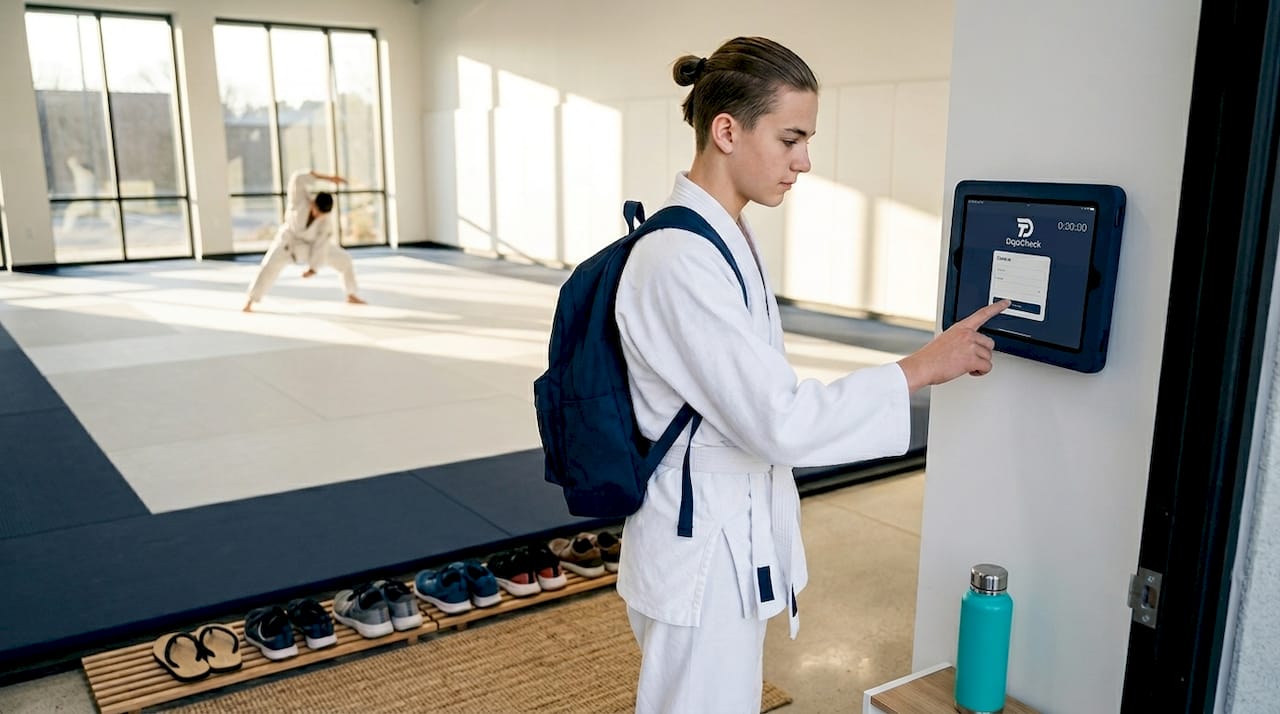
- Self check-in kiosks placed near the mat entrance (best for larger schools)
- Instructor-entered attendance from a tablet or phone during class
- Barcode or QR code scans from student ID cards or a mobile app
- Parent check-in through a family portal for youth programs
-
Set up automated absence notifications. When a student misses two or three consecutive classes, your system should flag it and trigger an outreach message automatically. This is where attendance tracking for martial arts goes from record-keeping to actual retention work. Waiting until a student cancels to reach out is always too late.
-
Connect attendance to belt progression and billing. A student who stops showing up is usually a student about to quit. Linking attendance to progression metrics helps you predict churn before it happens, and gives instructors a reason to have a real conversation with that student at the next class.
Pro Tip: Place your check-in kiosk or QR code sign-in directly at the mat entrance, not at the front desk. Students are far more likely to check in when it’s part of the natural flow of entering class.
Common mistakes and how to fix them
Even schools that commit to a digital system run into problems. Most of the mistakes below are avoidable with small adjustments, but they’re worth knowing before they cost you.
-
Inconsistent check-in habits. When students sometimes check in and sometimes don’t, your data becomes unreliable. Low engagement with check-in processes is one of the top reasons attendance systems underperform. Fix it by making check-in a visible, expected part of every class, reinforced by your instructors.
-
Duplicate or mismatched student records. If a parent creates an account online and a staff member also creates one manually, you now have split attendance history. Audit your records quarterly and set a clear rule: one profile per student, always.
-
Treating attendance as a check-the-box task. Many schools collect the data but never look at it strategically. Attendance tells you which classes are thriving, which time slots are dying, and which students are drifting. Ignoring those signals is leaving real decisions unmade.
-
Ignoring family account complexity. If one parent has three kids enrolled, all three need to be accurately tracked under a linked account. Mixed-up family records create billing errors and attendance gaps.
-
Delayed troubleshooting. If your system shows a sudden spike in absences, don’t wait until end-of-month reporting to investigate. Regular KPI monitoring, done weekly, catches problems while they’re still small.
The through-line in all of these mistakes is the same: the system only works as well as the habits built around it. Technology sets the floor, but your team’s consistency determines the ceiling.
Using attendance data to improve retention and class management
Collected attendance data is only valuable when you act on it. Here’s how smart school owners turn numbers into decisions.
| Attendance insight | What it tells you | Action to take |
|---|---|---|
| Declining attendance in a specific time slot | Low demand or scheduling conflict | Consolidate or reschedule the class |
| Students missing 3+ classes in a row | High churn risk | Trigger personal outreach immediately |
| Rapid attendance growth in one program | Demand exceeding capacity | Plan class expansion or hire an instructor |
| Attendance plateau across all classes | Enrollment ceiling approaching | Launch a referral campaign or new program |
| High attendance but slow belt progression | Students may feel disengaged | Review curriculum pacing with instructors |
Keeping monthly churn below 5% is a recognized benchmark for stable martial arts schools, and attendance patterns are your earliest warning system. If you see three students from the same Tuesday evening class drop off in the same two-week window, that’s a pattern worth investigating, not a coincidence.
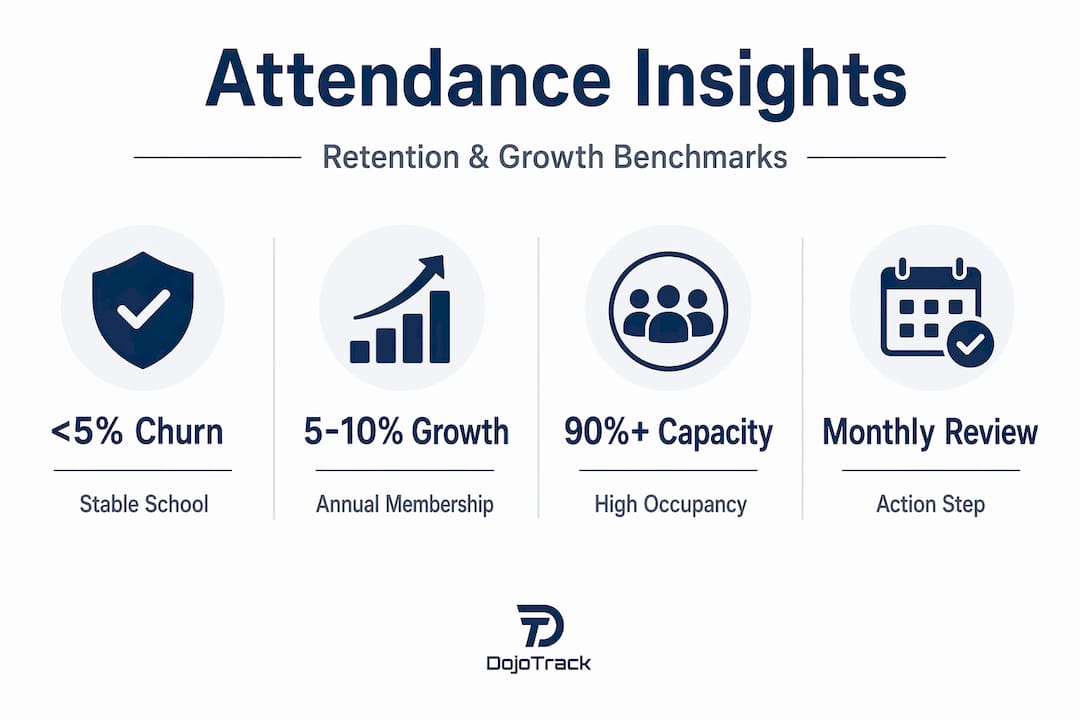
Facility occupancy rates also matter here. When your classes consistently run at or above capacity, that’s not just a good problem to have. It’s a signal that you need to act quickly by adding a class section or bringing on another instructor, or you risk burning out your current students and your staff. Schools that link attendance to instructor utilization make staffing decisions based on real data rather than gut feelings.
Tracking karate school monthly enrollment trends alongside daily attendance gives you a fuller picture. A class might look fine week to week but show a slow four-month decline when you zoom out. That kind of trend only becomes visible when you’re tracking consistently and reviewing the data at multiple intervals.
Pro Tip: Set a monthly calendar reminder to review your attendance trends across all programs. A 30-minute review each month will show you patterns that weekly spot-checks miss entirely.
My take on what most schools get wrong
I’ve seen hundreds of martial arts schools set up attendance tracking, feel relieved for a few weeks, and then slip back into the same retention problems they started with. The tool wasn’t the issue. The mindset was.
Most school owners think of attendance as administrative data. I think of it as a financial health indicator. When I look at a school’s attendance report, I’m not reading a log of who showed up. I’m reading a forecast of next month’s revenue. A student who misses two weeks isn’t an absence record. That student is a billing cancellation that hasn’t happened yet.
The schools that get the most out of tracking attendance in their martial arts programs are the ones who build a response system around the data, not just a recording system. Automated flags are only useful if someone follows up. Occupancy reports only matter if you’re willing to act on them before a problem becomes a crisis.
Here’s the uncomfortable truth: some schools still struggle with retention even after implementing great software. That usually comes down to the personal touch getting lost. Automation handles the monitoring. Your instructors handle the relationship. Neither replaces the other. The schools that win combine both without letting technology become a reason to stop having real conversations with students.
Attendance data is one of the most reliable tools you have. Use it like one.
— DojoTrack
See how DojoTrack handles this for you
DojoTrack was built specifically for this problem. The platform gives you AI-powered attendance tracking with self check-in kiosks, automated absence alerts, and student profiles that connect directly to belt progression and billing. There’s no manual data entry, no spreadsheets to reconcile, and no guesswork about which students are at risk.
Every DojoTrack feature is designed for martial arts schools, not adapted from generic software. That means your attendance data talks to your retention system, your billing, your instructor schedule, and your monthly enrollment reports from day one. If you’re currently running your school on disconnected tools or paper logs, DojoTrack also offers a simple data migration path to get your existing records moved over cleanly. You shouldn’t have to start from scratch to get started right.
FAQ
What is the best way to track attendance in a martial arts school?
The most reliable method is digital attendance tracking through martial arts management software, using self check-in kiosks or QR code scans at the mat entrance. This approach reduces errors, creates automatic records, and links attendance to billing and belt progression.
How often should I review attendance data for my dojo?
Check attendance at both a weekly and monthly level. Weekly reviews catch at-risk students early, while monthly trend analysis reveals enrollment patterns and class performance issues that short windows miss.
What monthly churn rate should martial arts schools target?
Schools should aim to keep monthly student churn below 5%, with annual membership growth between 5% and 10%. Consistent attendance tracking is one of the most direct ways to catch churn signals before students cancel.
Can attendance data help me decide when to hire another instructor?
Yes. When your facility occupancy rate consistently runs high and class sizes are at capacity, attendance data gives you the concrete evidence needed to justify adding staff or expanding your schedule.
Does tracking attendance affect student retention directly?
Tracking attendance alone does not retain students, but acting on the data does. Automated absence alerts combined with personal instructor follow-up significantly reduce the window between a student disengaging and actually quitting.
Recommended
- 5 Tips to Get the Most from Your Martial Arts CRM | DojoTrack
- What is DojoTrack? The All-in-One Martial Arts CRM for the Modern Martial Arts School – DojoTrack
- Lifetime Value Calculator for Martial Arts Schools | DojoTrack
- Stop Losing Students: 5 Steps How to Boost Retention and Revenue (Easy Guide for Martial Arts Schools) | DojoTrack