

TL;DR:
- A student progress tracking system offers a comprehensive view of a student’s growth, beyond simple belt tests. It enables early identification of learning gaps, personalized instruction, and improved retention by analyzing attendance, participation, and skill mastery. Modern, AI-powered tools automate data collection and alerts, allowing schools to proactively support students and enhance long-term success.
Most martial arts instructors assume a belt test tells them everything they need to know about a student. It doesn’t. Belt tests are snapshots, not stories. A student progress tracking system gives you the full picture: where every student started, how they’re growing week to week, and who’s quietly falling behind before they quit. If you’ve ever lost a student and wondered why you didn’t see it coming, this article will show you exactly what systematic tracking looks like, why it matters for retention, and how modern tools make it practical even for busy school owners.
Table of Contents
- Key takeaways
- What is a student progress tracking system
- Benefits of tracking progress in your martial arts school
- How modern tools make progress tracking practical
- How to implement a tracking system in your school
- Common challenges and how to handle them
- My honest take on what tracking actually changed
- See how DojoTrack handles progress tracking for you
- FAQ
Key takeaways
| Point | Details |
|---|---|
| Beyond belt tests | A tracking system monitors ongoing growth, not just milestone assessments. |
| Retention through data | Early identification of struggling students lets you intervene before they drop out. |
| Multi-metric monitoring | Effective tracking combines attendance, participation, and skill mastery for a full student view. |
| AI accelerates results | AI-powered tools can predict at-risk students early, giving instructors time to act. |
| Implementation matters | Success depends on staff buy-in, student engagement, and consistent data follow-through. |
What is a student progress tracking system
A student progress tracking system is a systematic, ongoing process of collecting and analyzing performance data to measure a learner’s growth toward specific goals. It is not about grades or pass/fail results. It is about watching someone develop over time, with enough data to make smart decisions along the way.
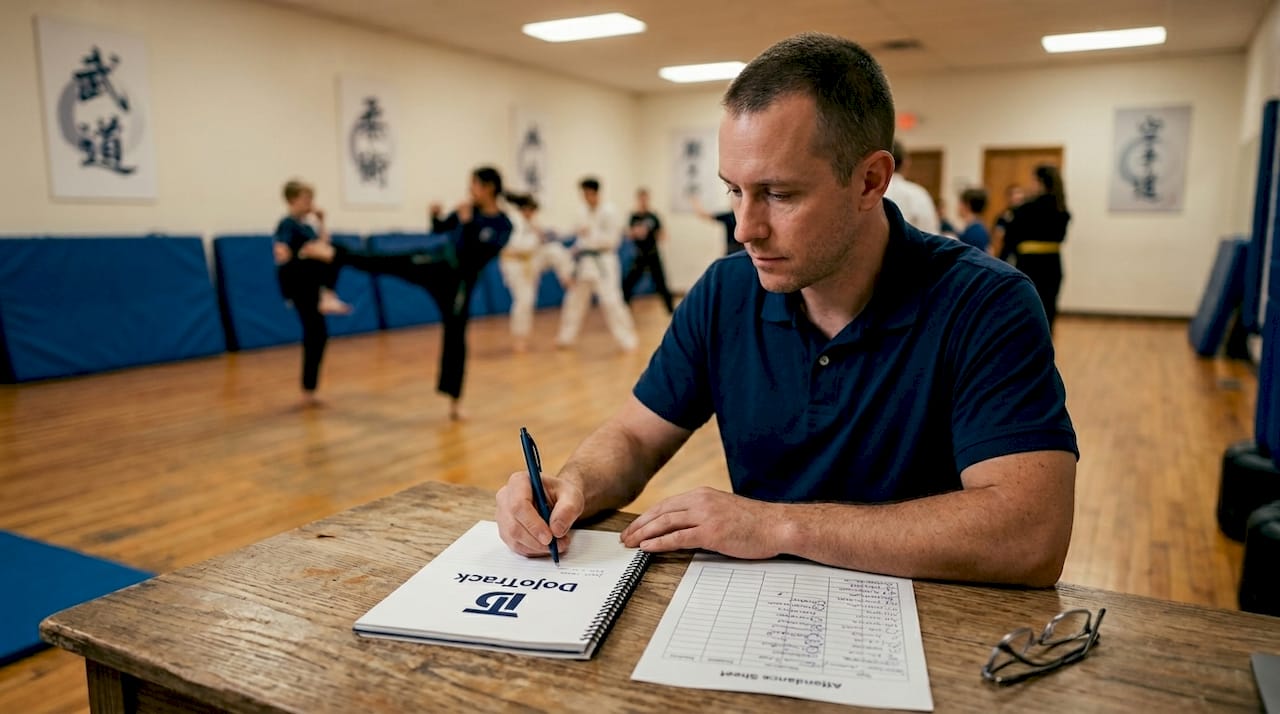
In a martial arts school, this means more than checking whether a student shows up for their belt test. It means recording what they can and cannot do right now, setting a target for where they should be, and checking in regularly to see how they’re moving toward that target. Assessments in well-designed systems happen weekly, biweekly, or monthly so that instructors catch trends early.
The core components of any solid system include:
- Goal setting: Defining clear, specific learning outcomes for each student or class level
- Frequent formative assessments: Short, low-stakes checks on technique, form, or knowledge that happen regularly during training
- Summative assessments: Higher-stakes evaluations like belt tests or grading events that measure cumulative mastery
- Data recording: Logging results through trackers, unit-by-unit charts, objective inventories, or digital dashboards
- Analysis and action: Reviewing the data and adjusting your instruction, not just filing the numbers
The distinction between formative and summative assessment is worth understanding clearly. Formative assessment happens during the learning process. A quick observation of a student’s sparring stance or a check of their kata form mid-class is formative. A belt test is summative. Most schools run plenty of summative assessments and almost no formative ones. A progress tracking system changes that ratio.
Benefits of tracking progress in your martial arts school
The real value of student performance monitoring shows up where it matters most: keeping students enrolled and improving their experience.
-
Early identification of learning gaps. When you track progress consistently, you spot the student who stopped improving three months ago, well before they stop showing up. Effective monitoring tools are sensitive to small growth increments, giving you the information you need to decide whether to continue, adjust, or intensify your approach with that student.
-
Data-driven instruction. Instead of teaching the same curriculum to every student the same way, you use real data to tailor your approach. The student who needs extra repetition on their guard position gets it. The one who’s ready to advance gets challenged faster. This is what separates a good instructor from a great one.
-
Boosted student motivation. When students can see their own progress in concrete terms, not just “Sensei said I’m doing well,” they stay motivated longer. Framing tracking tools as a way for students to own their learning journey increases engagement and peer support rather than competition.
-
Consistent attendance monitoring. Tracking student learning outcomes means tracking more than technique. Combining attendance, participation, and skill data gives you a 360-degree view of every student, making it far easier to spot who’s disengaging before they formally quit.
-
Better administrative decisions. Which classes are producing the most progress? Which curriculum sequences are creating bottlenecks? With solid data, you can answer both questions and adjust your school’s program accordingly.
Pro Tip: Don’t wait for retention problems to appear before you start tracking. Build your system when things are going well so you have a baseline to compare against when challenges arise.
A practical example: D.C. public schools used data-driven interventions to bring chronic absenteeism down from over 46% in 2022 to under 40% by 2025. The same principle applies to your dojo. When you act on data early, you keep more students engaged.
How modern tools make progress tracking practical
Tracking progress manually is possible, but it creates enough friction that most schools abandon it within a few months. Digital tools remove that friction.
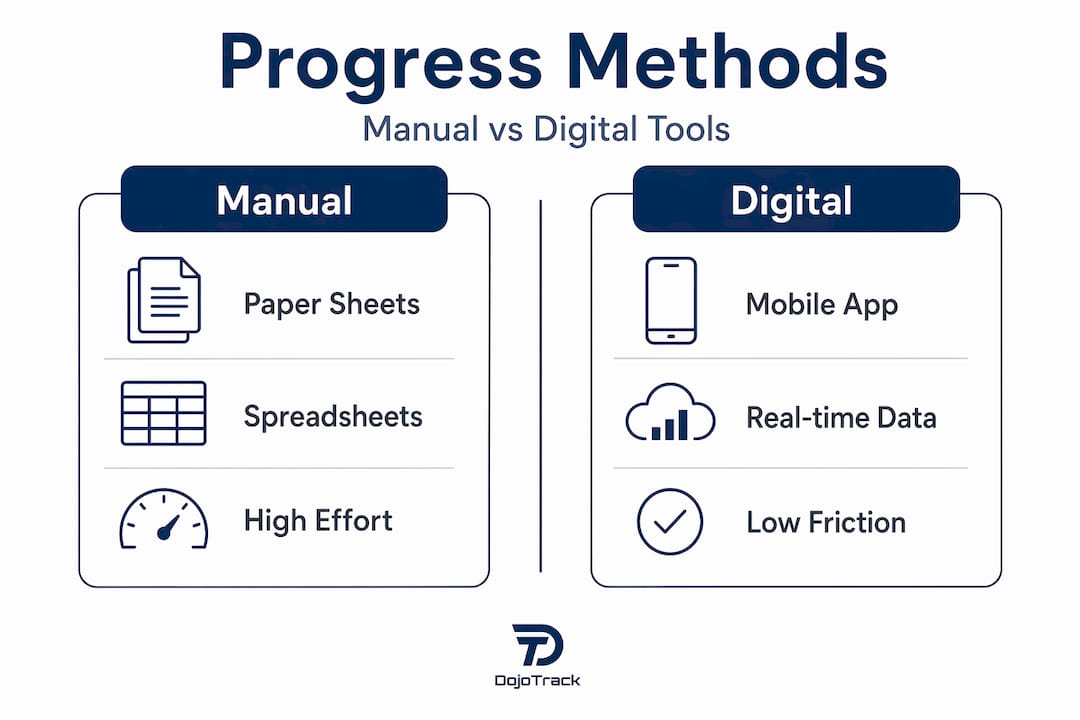
Here’s how modern academic progress tracking tools compare across key capabilities:
| Feature | Manual/Spreadsheet | Generic school software | Martial arts-specific platform |
|---|---|---|---|
| Real-time data updates | No | Sometimes | Yes |
| Belt/curriculum tracking | No | No | Yes |
| AI-driven retention alerts | No | No | Yes |
| Attendance integration | Manual | Partial | Fully integrated |
| Student mobile app access | No | Rarely | Yes |
| QR/barcode check-in | No | Sometimes | Yes |
Purpose-built student achievement tracking software designed for the martial arts industry handles the things that generic tools miss entirely. QR scanning at the door logs attendance the moment a student walks in. That attendance data connects directly to their progress profile, so you see in one place that a student has been attending half their usual classes and their technique assessments have dropped off simultaneously. That combination is a retention warning.
The most advanced effective student monitoring systems now use AI and machine learning to go a step further. Hybrid AI models can reach accuracy rates up to 98.8% in identifying students at risk of dropping out, giving instructors time to reach out before the student mentally checks out. For a martial arts school owner, that kind of early warning is worth more than any marketing spend on new student acquisition.
Pro Tip: Look for a platform that integrates attendance, belt curriculum progress, and communication in one place. If your tracking data lives in three different apps, it won’t get used consistently.
Digital tools also give students access to their own progress through a mobile app. When a student can pull up their phone between classes and see which curriculum requirements they’ve completed and what comes next, they feel invested. That investment shows up in retention numbers.
How to implement a tracking system in your school
Getting this right takes more than buying software. Here’s a practical sequence that works for real martial arts schools.
-
Audit your current situation. What are you tracking right now? Most schools track attendance and belt tests. Write down what’s working and where you’re guessing. This baseline tells you where the gaps are.
-
Define your tracking goals. Decide what “progress” means at each rank level in your curriculum. What specific skills should a white belt demonstrate after 30 days? After 90? Write those down as measurable outcomes, not vague descriptions.
-
Choose a system that fits your school’s culture. A martial arts-specific platform will always fit better than generic fitness software because it’s built around belt progression, class structures, and the attendance patterns unique to martial arts schools.
-
Train your staff before launch. Your tracking system is only as good as the data going in. Walk your instructors through how to record assessments, what the data means, and how they’ll use it to adjust their teaching. If they see it as extra paperwork, they’ll skip it. If they see it as a teaching tool, they’ll use it.
-
Engage your students in the process. Share progress data with students and their families. Use the mobile app, printed summaries, or in-class reviews to show students how they’re improving. Progress monitoring shifts from a bureaucratic task to a teaching advantage the moment students can see their own data.
-
Review and refine regularly. Set a monthly date to review school-wide trends. Which students are thriving? Which ones haven’t progressed in their assessments for 60 days? Use that data to drive conversations and adjust your curriculum delivery.
Common challenges and how to handle them
Even the best-designed tracking system runs into resistance. Here’s what to expect and how to work through it.
-
“This will take too much time.” Manual tracking does. Digital tools, especially those with QR check-in and automated reports, cut data entry time dramatically. Digital tools reduce administrative burden so instructors spend more time with students and less time on paperwork.
-
“Students will feel judged.” This is a real concern if tracking is framed the wrong way. Framing progress tools around growth and mastery rather than ranking students against each other prevents this entirely. Show students how far they’ve come, not how far they lag behind classmates.
-
“We don’t have the budget for software.” Calculate what one lost student costs you over a year. Then ask whether a system that helps you retain even two or three more students annually covers its own cost. The math almost always works out.
-
Data privacy. Collect only what you need. Store it securely on a platform with proper access controls. Be transparent with families about what you track and why.
Pro Tip: Introduce tracking as a student benefit, not an administrative requirement. Tell students it’s how you personalize their training. That framing changes the entire conversation.
My honest take on what tracking actually changed
When I started looking at how martial arts schools manage student data, the most common story I heard went like this: the instructor knew something was off with a student but couldn’t point to specific evidence. They’d rely on gut instinct. Sometimes they were right. Often, the student quit before anyone acted.
What I’ve seen from schools that implement real tracking systems is a fundamentally different dynamic. The instructor doesn’t have to rely on memory or intuition. The data tells them which student missed four of the last six classes and hasn’t passed a curriculum checkpoint in two months. That’s not a hunch. That’s a call to make.
What strikes me most is how tracking shifts the instructor’s role. Instead of reacting when a student decides to leave, you’re having a proactive conversation weeks earlier. You’re not chasing cancellations. You’re preventing them. The student feels seen and cared for. The instructor feels in control of their school’s health.
My view is that the schools resisting progress tracking are usually not resisting the concept. They’re resisting the extra work they assume it creates. A purpose-built platform eliminates that concern entirely. The data collects itself. The insights surface automatically. The time you save goes back to the mat, where it belongs.
— DojoTrack
See how DojoTrack handles progress tracking for you
DojoTrack was built specifically for martial arts schools by someone who ran one. Every feature connects directly to the challenges this article covers: tracking belt curriculum progress, monitoring attendance trends, identifying at-risk students before they quit, and giving students a mobile app to stay engaged with their own development.
The platform’s AI-powered retention system watches your student data continuously and flags students showing early dropout signals, so you can reach out at exactly the right moment. There’s no manual report-pulling or spreadsheet maintenance involved. If you want to see the full feature set or get a sense of how the platform fits a school like yours, explore DojoTrack’s martial arts software and see what’s possible when your tracking system runs itself.
FAQ
What is a student progress tracking system in simple terms?
A student progress tracking system is an organized method for collecting and reviewing data on how students are learning and improving over time. Unlike grades alone, it uses regular assessments across multiple areas to give a full picture of each student’s growth.
How does progress tracking improve student retention in martial arts schools?
Consistent tracking identifies students who are disengaging early, through declining attendance or stalled skill progress, giving instructors time to intervene. Schools that act on this data retain more students than those relying solely on belt tests or informal observation.
What should a good student progress tracking system include?
A solid system includes goal setting, regular formative assessments, attendance monitoring, data recording tools, and a process for using that data to adjust instruction. Ideally, it also gives students access to their own progress to increase motivation.
Can AI really predict which students are at risk of quitting?
Yes. Advanced AI models analyzing attendance, participation, and performance data have reached accuracy rates near 98.8% in identifying at-risk students. For martial arts schools, this means earlier outreach and meaningfully better retention outcomes.
Is progress tracking too time-consuming for small martial arts schools?
Not with the right tools. Purpose-built platforms automate data collection through QR check-ins, mobile apps, and integrated dashboards, making it practical even for a school with one or two instructors. The time saved on manual tracking typically outweighs the setup investment within the first month.