

TL;DR:
- Attendance data is a vital performance tool that enables martial arts instructors to predict student progress and prevent dropout. Automated systems save time, provide real-time insights, and allow proactive outreach based on attendance patterns, thereby improving retention rates. Connecting attendance data with other management tools enhances decision-making, fostering stronger student engagement and long-term success.
Attendance data is the single most reliable early-warning signal martial arts instructors have for predicting which students will progress, plateau, or quit. Most school owners think of attendance records as an administrative chore. They are actually a performance management tool. When you know who showed up, how often, and at what point in their training, you can intervene before a student disappears rather than after. This article breaks down exactly why instructors need attendance data, what it reveals about student engagement, and how modern tools like Dojotrack turn raw sign-in logs into decisions that protect your retention rate and your revenue.
Why instructors need attendance data to drive student success
Attendance data, in the context of martial arts instruction, refers to the systematic recording and analysis of student class participation patterns over time. It goes well beyond a sign-in sheet. When tracked consistently, it becomes a predictor of belt advancement, motivation levels, and dropout risk.

The connection between attendance and skill development is direct. A student who misses two to four weeks of training loses continuity on technique sequences, falls behind peers at the same rank, and often loses confidence. Research from the UK government confirms that missing 2-4 weeks of instruction reduces the probability of achieving core subject success by 50%. In a martial arts context, that translates to a student who is no longer belt-test ready on schedule, which creates frustration and accelerates the decision to quit.
Chronic absenteeism compounds the problem. When students miss class repeatedly without any outreach from the school, they interpret the silence as indifference. AI-driven systems have demonstrated that early-warning alerts can reduce chronic absenteeism by 47% by categorizing risk levels and triggering targeted interventions. That same logic applies directly to your dojo. A student flagged after three missed classes is still reachable. A student flagged after three months is usually already gone.
Here is what attendance data specifically reveals for martial arts instructors:
- Skill progression gaps: Students with irregular attendance fall behind rank-appropriate benchmarks, signaling a need for catch-up sessions or modified curriculum.
- Motivation trends: A sudden drop in attendance frequency often precedes a formal cancellation by four to six weeks, giving you a window to act.
- Demographic patterns: Attendance data can reveal that adult students in a specific time slot disengage at a higher rate than youth students, pointing to scheduling or curriculum issues.
- Belt transition stress: Many students reduce attendance right before a promotion test due to anxiety. Data makes this pattern visible so you can address it proactively.
Pro Tip: Set a personal rule to review attendance reports every Monday morning. Students who missed two or more classes the prior week should receive a personal text or call before Wednesday. That three-day window is when re-engagement is most effective.
What operational efficiencies can martial arts schools gain from attendance data?
Manual attendance tracking is one of the most expensive habits a martial arts school can maintain. Not in direct cost, but in time. Automating attendance tracking saves over 80 hours annually per instructor previously lost to manual roll calls. That is two full work weeks you could spend on the mat, on curriculum development, or on growing your student base.
The operational case for automation goes beyond time savings. Automated systems accelerate intervention by 30 to 40% compared to manual processes. When a student misses class, a digital system flags it immediately. A paper log flags it when someone eventually reviews it, which may be days later. That delay is the difference between a timely, personal conversation and a generic message that arrives too late to matter.
The table below shows the practical difference between manual and automated attendance management in a martial arts school context:
| Task | Manual process | Automated process |
|---|---|---|
| Daily roll call | 5-10 minutes per class | Instant via kiosk or app check-in |
| Absence detection | Reviewed weekly or ad hoc | Real-time alert after missed class |
| Parent/guardian notification | Manual phone call or email | Automated SMS or push notification |
| Retention risk identification | Subjective instructor memory | Data-driven risk score per student |
| Monthly reporting | Hours of spreadsheet work | One-click dashboard export |
The integration angle matters too. When attendance data connects to your CRM and scheduling tools, you get a full picture of each student’s engagement. You can see that a student who used to attend three times per week has dropped to once, cross-reference that with their billing status, and prioritize outreach accordingly. That kind of data-driven decision making is only possible when your systems talk to each other.
Pro Tip: If you are currently using a paper sign-in sheet or a generic spreadsheet, calculate how many minutes per class you spend on roll call, then multiply by your total weekly classes and 52 weeks. Most school owners are shocked by the number. That figure is your automation ROI in time alone.
How can attendance data help identify and address student disengagement?
Disengagement rarely announces itself. Students do not usually tell you they are thinking about quitting. They just start showing up less. Attendance data makes the invisible visible, and the earlier you see the pattern, the more options you have to respond.
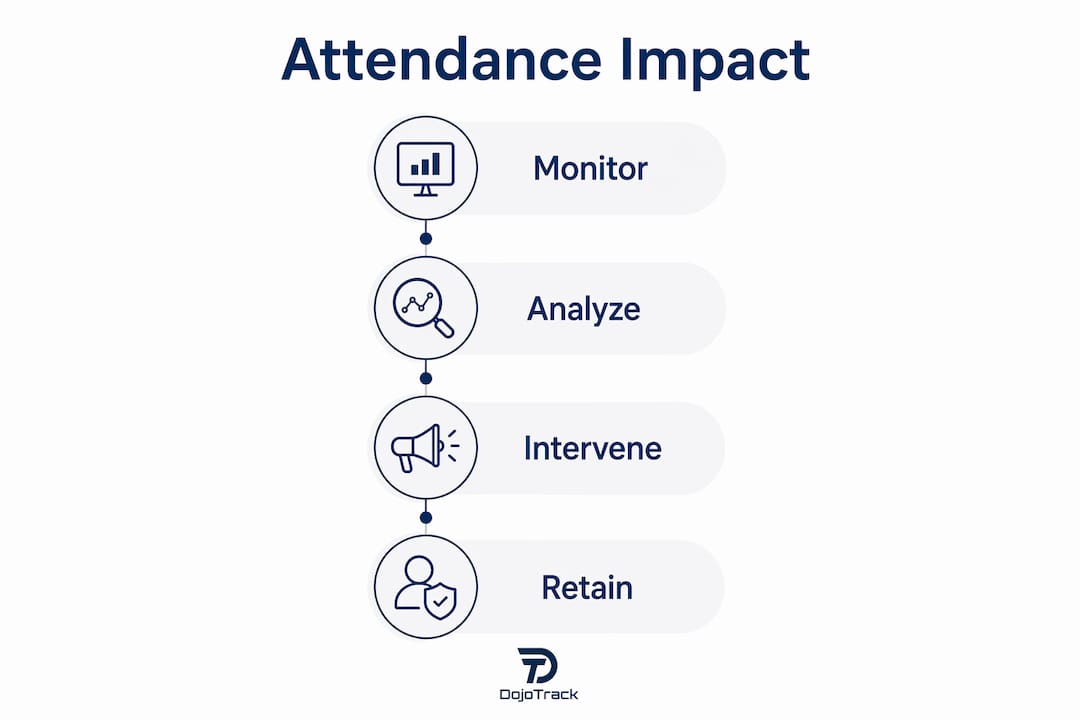
The most effective intervention framework works in four steps:
- Set a trigger threshold. Research confirms that alerts after 3 consecutive absences produce the most productive and personal outreach conversations. Three absences is enough to signal a pattern without being an overreaction to a single busy week.
- Identify attendance clusters. Attendance patterns reveal clusters at specific ranks or time slots where engagement drops. If your orange belt students consistently reduce attendance before their green belt test, that is a curriculum or confidence issue you can solve with targeted support.
- Use an asset-based approach. Rather than contacting a family to report absences, frame the conversation around the student’s progress and goals. Asset-based approaches to attendance conversations with families produce better long-term engagement than punitive or compliance-focused messaging.
- Close the loop with data. After outreach, track whether attendance improves. If a student returns to regular attendance after a personal call, that confirms your intervention model works. If they do not, escalate to a more personalized conversation about barriers, schedule conflicts, or motivation.
Sharing attendance trends openly with parents and guardians also shifts the dynamic. Transparency with caregivers transforms attendance from a school compliance issue into a shared priority, which directly improves outcomes. A parent who sees their child’s attendance chart in a monthly report becomes a partner in keeping that student engaged, not just a billing contact.
For a deeper look at how attendance data connects to student retention strategies, the patterns you uncover will directly inform how you structure your outreach calendar.
What features should instructors look for in modern attendance tracking tools?
Not all attendance tools are built for martial arts schools. Generic check-in apps capture a timestamp and nothing else. Purpose-built platforms connect that timestamp to a student profile, a rank history, a billing record, and a retention risk score. That connection is where the value of attendance metrics actually lives.
When evaluating tools, prioritize these capabilities:
- Automated data capture: Sign-in kiosks, QR code check-ins, or mobile app logins that record attendance without instructor involvement during class time.
- Real-time dashboards: Visibility into who is in class today, who has not attended in the past two weeks, and which students are trending toward disengagement.
- Parent communication modules: Automated notifications sent to parents when a student misses class, removing the burden of manual outreach from your staff.
- CRM integration: Attendance records that feed directly into student profiles, so your front desk and instructors always have the same up-to-date picture of each member.
- Retention risk scoring: AI-powered flags that identify students whose attendance patterns match historical dropout behavior, giving you a prioritized list of who to contact first.
The broader picture matters here too. 63% of educational institutions still struggle with real-time attendance analytics, and 58% rely on manual tracking that creates delays. Martial arts schools that adopt automated systems gain a measurable competitive advantage in retention, simply because they act on information faster than schools that are still reviewing paper logs. Understanding how to track student attendance in a martial arts setting gives you a practical starting point for choosing the right system.
Key takeaways
Attendance data is the most direct tool martial arts instructors have for protecting student retention, improving teaching outcomes, and reclaiming time lost to administrative work.
| Point | Details |
|---|---|
| Attendance predicts dropout | Students who miss 2-4 weeks show a 50% drop in success probability, making early tracking critical. |
| Automation saves 80+ hours yearly | Replacing manual roll calls with digital check-ins frees significant instructor time for teaching. |
| Three absences is the trigger point | Alerts after three consecutive missed classes produce the most effective and timely re-engagement conversations. |
| Transparency builds retention | Sharing attendance data with parents turns them into partners, improving long-term student commitment. |
| Integration multiplies value | Attendance data connected to CRM and billing tools enables faster, smarter retention decisions. |
Attendance data changed how we think about running a school
Most school owners we talk to started tracking attendance because they felt like they were supposed to. A sign-in sheet felt professional. It checked a box. What they did not expect was what the data would actually tell them once they started paying attention to it.
The mindset shift from compliance to engagement is not subtle. When you stop asking “did this student sign in?” and start asking “what does this student’s pattern tell me about their commitment level?”, your entire approach to mentorship changes. You stop reacting to cancellations and start preventing them. You stop guessing which students need attention and start knowing.
We have seen schools that moved from manual tracking to a platform like Dojotrack report not just time savings, but a genuine change in how instructors relate to their students. When the data surfaces a student who has quietly been pulling back, and an instructor reaches out before that student ever says a word about quitting, that moment builds loyalty that no promotion or discount can replicate. Attendance data does not replace the human relationship at the center of martial arts training. It gives that relationship the information it needs to stay strong.
— Dojotrack
See how Dojotrack handles attendance tracking for your school
Dojotrack’s AI-powered platform was built specifically for martial arts schools, and attendance tracking is one of its core strengths. The system captures check-ins automatically through sign-in kiosks and the student mobile app, feeds that data into each student’s profile in real time, and triggers alerts when attendance patterns signal disengagement risk. Parent notifications go out automatically, so your staff is not spending class time on phone calls. If you are currently running on a different platform or a manual system, switching to Dojotrack is designed to be straightforward, with full data migration support so nothing gets lost in the transition.
FAQ
Why does attendance data matter for martial arts instructors?
Attendance data gives instructors an early signal of student disengagement before a student formally cancels. It connects directly to skill progression, belt advancement readiness, and long-term retention outcomes.
How many absences should trigger an instructor outreach?
Three consecutive absences is the proven threshold. Research shows that targeted outreach after three missed classes produces more productive conversations than waiting longer or sending generic messages.
What is the difference between manual and automated attendance tracking?
Manual tracking captures a name on a list. Automated tracking connects each check-in to a student profile, flags absences in real time, and integrates with CRM and billing tools to give a complete picture of student engagement.
Can attendance data help reduce student dropout rates?
Yes. Schools using AI-driven attendance systems have reduced chronic absenteeism by as much as 47% by identifying at-risk students early and triggering personalized interventions before disengagement becomes a cancellation.
What should a martial arts school look for in an attendance tracking tool?
Look for automated check-in options, real-time dashboards, parent notification features, CRM integration, and AI-powered retention risk scoring. Generic check-in apps without these connections deliver data without the insights that actually protect your student base.
Recommended
- How to Track Student Attendance in Martial Arts Schools
- Stop Losing Students: 5 Steps How to Boost Retention and Revenue (Easy Guide for Martial Arts Schools) | DojoTrack
- 5 Reasons Why Your Student Retention Isn’t Working (And How to Fix It) – DojoTrack
- Lifetime Value Calculator for Martial Arts Schools | DojoTrack