

Running a martial arts school should be about teaching, mentoring, and building a community. But if you’re like most school owners, a huge chunk of your week disappears into billing follow-ups, attendance logs, scheduling conflicts, and chasing down paperwork. Many school owners spend 10 to 15 hours weekly on manual administrative tasks that software could handle automatically. That’s where a martial arts school operations system comes in. This guide breaks down exactly what it is, what it does, and why getting one in place may be the single most important business decision you make this year.
Table of Contents
- Defining the martial arts school operations system
- Core components and features of martial arts operations systems
- Integrating workflows: combining data, attendance, billing, and communication
- Comparing martial arts operations systems with generic fitness software
- Implementing a martial arts school operations system effectively
- Why structured operations systems trump ad hoc execution in martial arts schools
- Streamline your dojo operations with AI-powered martial arts software
- Frequently asked questions
Key Takeaways
| Point | Details |
|---|---|
| Automate admin tasks | Operations systems automate billing, attendance, scheduling, and communication to save you 10-15 hours weekly. |
| Specialized martial arts features | Choose software designed for martial arts schools with belt tracking and tournament management. |
| Connected workflows | Integrating data, attendance, billing, and communication creates smooth operations and better student retention. |
| Structured systems improve growth | Codified operations lead to consistent class delivery, member experience, and faster revenue growth. |
| Effective implementation | Follow a clear setup process and test core functions before launch for smooth operation from day one. |
Defining the martial arts school operations system
A martial arts school operations system is a centralized software platform that manages the core business functions of your school in one place. Think of it as the engine running behind the scenes while you focus on the mat. Instead of juggling spreadsheets, paper sign-in sheets, and disconnected billing tools, everything lives in a single system that talks to itself.
Martial arts software includes features like automated attendance, billing, class scheduling, belt progression tracking, and student communication. That list alone separates a true operations system from a generic calendar app or a basic payment processor.
Here is what a complete martial arts school operations system typically covers:
- Student profiles: Contact info, enrollment dates, attendance history, belt rank, and payment status all in one record
- Billing and payments: Automated recurring charges, failed payment alerts, and family discount management
- Class scheduling: Multi-class calendars, instructor assignments, and substitute management
- Belt and rank progression: Automated tracking of curriculum milestones and promotion eligibility
- Communication workflows: Automated SMS and email reminders for classes, missed sessions, and upcoming tests
- Lead management: Trial booking, follow-up sequences, and enrollment conversion tracking
- Reporting and analytics: Attendance trends, revenue summaries, and student retention data
What makes this different from generic fitness apps is the martial arts-specific layer. Belt ranks, stripe tracking, tournament registration, and grading events are not afterthoughts. They are built into the core of the system. If you want a deeper look at what to prioritize when evaluating platforms, the martial arts school software buyer’s guide covers the essentials worth checking off before you commit.
Core components and features of martial arts operations systems
Understanding what the system includes is one thing. Understanding how each component actually saves you time is another. Let’s go feature by feature.
Automated attendance tracking is where most schools feel the biggest immediate relief. Instead of manually marking who showed up, students check in via a kiosk or QR code scan. Operations systems include kiosk and QR code sign-in, automated reminders, split class scheduling, make-ups, and instructor substitutions. Your front desk stops being a bottleneck.
Automated billing is the feature that protects your cash flow. When a card fails, the system retries the charge and sends the student a payment reminder automatically. No more awkward phone calls. No more chasing down parents in the parking lot.
Here are the core features that make up a well-built operations system:
- Kiosk or QR check-in: Students sign in without staff involvement, freeing your team for higher-value work
- Recurring billing with Stripe integration: Charges run on schedule, failures are handled automatically, and your revenue becomes predictable
- Flexible class scheduling: Supports split classes, make-up sessions, and instructor substitutions without manual rescheduling
- Self-service student portals: Students and parents can view schedules, track progress, and update payment info without calling the front desk
- Automated messaging: Class reminders, missed-class follow-ups, and belt test notifications go out without anyone hitting send
The dojo management software features that matter most are the ones that eliminate repetitive manual tasks. Every hour you save on admin is an hour you can spend coaching, recruiting, or building your school’s reputation in the community.
Pro Tip: Set up your automated messaging sequences before you go live. A well-timed “We missed you in class” text sent 24 hours after an absence can recover students who would otherwise quietly disappear. Pair that with tips from your martial arts CRM to get the most out of your communication tools from day one.

Integrating workflows: combining data, attendance, billing, and communication
Here is where operations systems go from useful to genuinely powerful. The real value is not in any single feature. It is in how the features connect to each other and trigger actions automatically.
Operational systems work best when student data, events, billing, and attendance are connected in one workflow to trigger automated communications and track milestones. When those pieces are siloed, you lose visibility and students fall through the cracks.
Here is how an integrated workflow actually plays out in a real school:
- A student misses class. The attendance system logs the absence and automatically sends a follow-up text the next day.
- A payment fails. The billing system flags the account, pauses access if configured, and sends the student a payment link.
- A student hits a belt milestone. The system recognizes the progression and sends a congratulations message, then notifies the instructor to schedule a grading.
- A new lead books a trial. The CRM logs the inquiry, scores the lead, and triggers a follow-up SMS sequence to convert them into a paying student.
- A student’s attendance drops. The AI-driven retention system flags them as at-risk so you can reach out personally before they quit.
Each of these actions happens without anyone on your staff lifting a finger. That is the difference between running a school reactively and running one proactively. If boosting student retention is a priority for you, integrated workflows are your most reliable tool for keeping students engaged long-term.
Pro Tip: Map out your student journey from first inquiry to black belt before configuring your system. Knowing the key milestones, trial class, first belt, six-month mark, one-year anniversary, lets you build automation triggers that celebrate progress and reinforce loyalty at exactly the right moments.
Comparing martial arts operations systems with generic fitness software
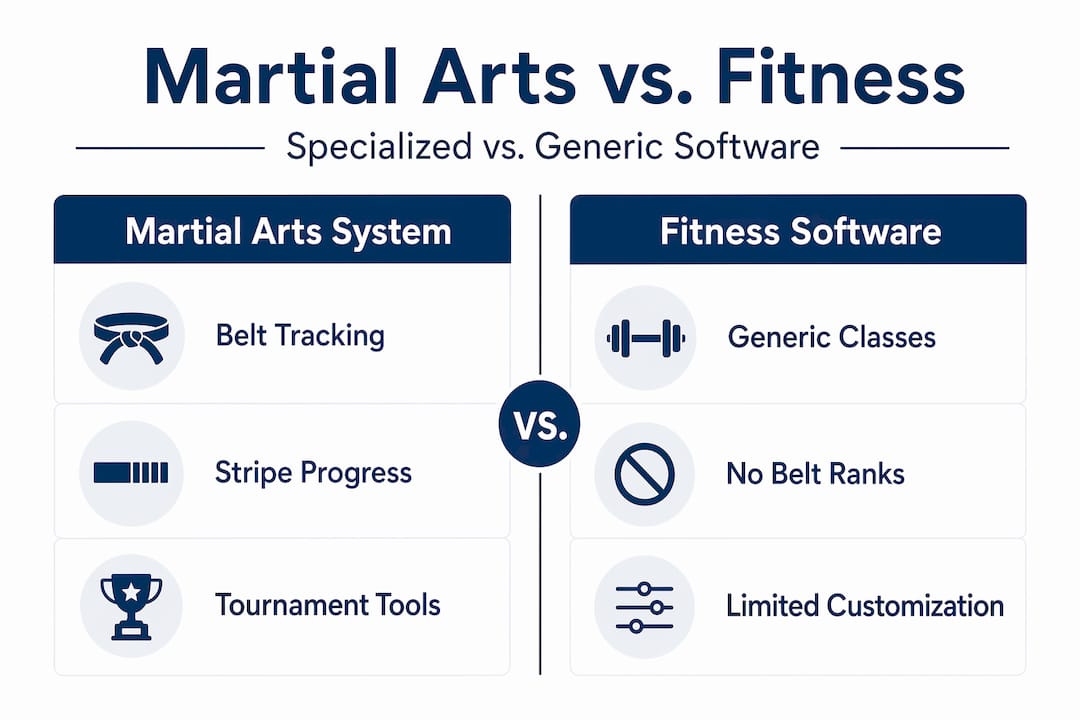
A lot of school owners start with generic fitness or gym management software because it looks familiar or costs less upfront. The problem shows up fast. Generic fitness software lacks martial arts-specific features like belt progression and grading management, which are critical to running a dojo effectively.
Here is a direct comparison of what you get with each type of platform:
| Feature | Martial arts-specific system | Generic fitness software |
|---|---|---|
| Belt and rank progression tracking | Built-in, automated | Not available |
| Curriculum milestone recognition | Automated alerts and messaging | Manual or unavailable |
| Tournament and belt test registration | Dedicated event management | Basic event tools only |
| Martial arts attendance patterns | Tracked by class type and rank | Generic class check-in only |
| Family memberships and discounts | Built-in logic | Requires manual workarounds |
| Instructor and staff role management | Dojo-specific permissions | Generic staff roles |
| Student mobile app with curriculum | Purpose-built for martial arts | Generic member app |
| Payment structures for martial arts | Memberships, drop-ins, testing fees | Basic subscription billing |
The gap is not just about features. It is about fit. Generic software forces you to work around its limitations. A purpose-built system works the way your school already works. When you are evaluating options, the best martial arts software features to prioritize are the ones that eliminate your biggest daily friction points.
Implementing a martial arts school operations system effectively
Getting a system in place is not complicated, but the order of steps matters. Rushing the setup creates gaps that cost you time later. Here is a practical sequence to follow:
- Import your existing student data first. Before anything else, get your student profiles into the system. Names, contact info, belt ranks, membership types, and billing details all need to be accurate from day one.
- Configure your classes, memberships, and billing cycles. Set up your class schedule, pricing tiers, and recurring billing rules before you go live. This is the foundation everything else runs on.
- Connect your payment processor. Stripe integration is the standard for most platforms. Successful implementation includes connecting payment processing and verifying that recurring charges, failed payment retries, and refund workflows all function correctly.
- Test your automation sequences. Run through every automated message, check-in scenario, and scheduling workflow before students interact with the system. A missed-class follow-up that fires at the wrong time or to the wrong person creates confusion.
- Train your staff and monitor early metrics. Your front desk and instructors need to know the new workflows before launch. Then watch your first two weeks of data closely: attendance rates, billing success rates, and lead response times will tell you quickly if anything needs adjusting.
The martial arts school automation guide goes deeper on each of these steps if you want a more detailed walkthrough. And once you are live, maximizing your martial arts CRM is the next step toward getting full value from the platform.
Pro Tip: Do a soft launch with just your staff for 48 hours before opening the system to students. You will catch configuration issues that are much easier to fix before real members are interacting with the platform.
Why structured operations systems trump ad hoc execution in martial arts schools
Here is an opinion worth sitting with: most martial arts schools do not have a marketing problem or a staffing problem. They have a systems problem. And the schools that grow consistently are not necessarily the ones with the best instructors. They are the ones with the most consistent operations.
UFC Gym’s franchise growth is a direct result of consistent, education-based operational expectations rather than ad hoc execution. That principle applies whether you run one location or ten. When your processes are codified, every student gets the same quality experience regardless of which instructor is teaching or who is working the front desk that day.
Ad hoc execution feels flexible, but it is actually fragile. When the one person who knows how billing works takes a week off, things break. When you rely on memory instead of automation to follow up with leads, prospects slip away. Structured systems remove that fragility.
The other thing most articles will not tell you: operational readiness accelerates revenue faster than any marketing campaign. A school that converts trials consistently, retains students through automated engagement, and collects payments reliably will outgrow a school with twice the social media following but chaotic back-end operations. The benefits of martial arts automation are not just about saving time. They are about building a school that can grow without breaking.
Streamline your dojo operations with AI-powered martial arts software
If you are ready to stop losing hours to admin work and start running your school with real efficiency, DojoTrack was built for exactly this. DojoTrack users save 10 to 15 hours a week on administrative work through automated attendance, billing, and scheduling. That is time back on the mat, with your students, where it belongs.
DojoTrack is an AI-powered martial arts software platform purpose-built for schools like yours. From Stripe-powered recurring billing and QR check-in kiosks to automated belt tracking and AI-driven retention alerts, every feature on the platform was designed with the specific needs of martial arts schools in mind. There is no workaround required. It just works the way your school works. Want to see what your students are worth over time? The lifetime value calculator gives you a clear picture of the revenue impact better retention can have. Start your 14-day free trial today and see the difference a purpose-built system makes.
Frequently asked questions
What tasks does a martial arts school operations system automate?
A martial arts school operations system automates attendance, payments, scheduling, student communication, and progress tracking, reducing the manual administrative work that typically consumes 10 to 15 hours per week.
How does integrating billing with attendance benefit the school?
When billing and attendance are connected, automated communications tied to billing and milestone tracking fire automatically, improving both cash flow and student retention without any manual follow-up from your staff.
Why choose martial arts-specific software over generic fitness apps?
Generic fitness software lacks martial arts-specific features like belt progression tracking and tournament management, which means you end up building expensive workarounds instead of running your school efficiently.
How long does it take to set up a martial arts operations system like DojoTrack?
DojoTrack’s setup process gets your dojo running smoothly in under an hour when you follow the essential steps, including data import, class configuration, and payment processor connection.
Can these systems help improve student retention?
Yes. By automating engagement and milestone tracking, these systems keep students connected to your school between classes and flag at-risk students before they quietly stop showing up.
Recommended
- The Ultimate Guide to Martial Arts School Automation: Everything You Need to Succeed in 2025 | DojoTrack
- Best Martial Arts Studio Software for Small Schools: Features, Benefits, and AI Advantages | DojoTrack
- What to Look for in Martial Arts School Software (2026 Buyer’s Guide) – DojoTrack
- What You’re Missing Without Martial Arts Software | DojoTrack