

TL;DR:
- AI analytics helps karate schools increase enrollment and retention by providing predictive data-driven insights. Implementing unified platforms enhances lead conversion, scheduling efficiency, and saves owners significant administrative time. Successful growth depends on consistent use of retention alerts and integrated systems that prioritize human connection.
AI analytics is defined as the use of machine learning and data processing to turn raw school data into decisions that directly drive enrollment, retention, and revenue. The role of AI analytics in karate school growth is no longer a future concept. Platforms like Dojotrack, OnMat, and others built for martial arts businesses are already delivering measurable results in 2026. The martial arts software market grew from $138.5 million in 2025 and is projected to reach $171.26 million by 2033, driven by an 11.2% CAGR tied directly to AI adoption. That growth reflects a real shift in how karate school owners manage their businesses, and the schools adopting AI tools now are pulling ahead.
What core AI analytics features drive karate school growth?
Predictive analytics is the most impactful AI feature a karate school can deploy. It uses historical attendance, billing, and engagement data to forecast which students are likely to quit before they actually do. That early warning gives you time to act, not just react.
Here are the core AI analytics features that directly affect growth and operational efficiency:
- Predictive retention alerts. AI monitors attendance patterns and flags students showing early signs of disengagement. Softening attendance patterns are the earliest reliable indicator of churn, often appearing weeks before a student cancels. A quick personal call at that moment costs you five minutes and saves a membership.
- Automated scheduling. AI scheduling tools analyze class capacity, instructor availability, and peak demand to fill classes more efficiently. Scheduling accuracy improves by 68.5% compared to manual or non-AI solutions. That means fewer half-empty classes and better use of your floor space.
- Attendance and engagement tracking. Automated check-in systems log every visit without staff involvement. The data feeds directly into retention models and flags students who are drifting before you lose them.
- Belt progression forecasting. AI tracks each student’s training frequency and skill milestones to predict when they are ready for promotion. This removes guesswork from belt testing decisions and keeps students motivated with clear progress signals.
- Dynamic capacity allocation. AI tools adjust class sizes and time slots based on real demand data, helping you avoid overbooking popular classes while filling underperforming ones.
Pro Tip: Do not activate every AI feature at once. Start with retention alerts and scheduling automation. Those two features alone will show you measurable results within 30 days and build your confidence in the data before you expand.
Using analytics in martial arts is most effective when the data flows through one unified system. Fragmented tools create fragmented decisions. A single platform that connects scheduling, attendance, billing, and retention gives you a complete picture of your school’s health at any moment.
How does AI training analysis improve student performance?
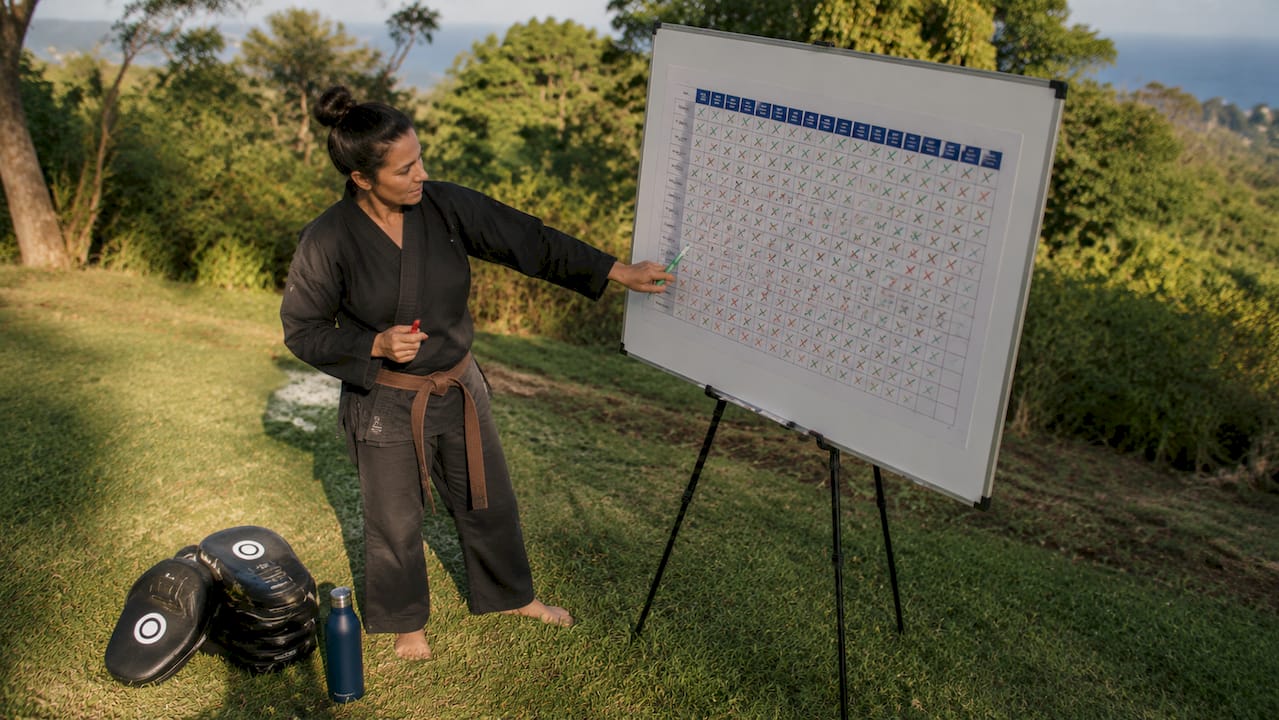
AI-assisted training analysis is the application of computer vision and data modeling to measure student technique, track physical readiness, and give instructors objective feedback they cannot generate by eye alone. This is where data analytics for karate schools moves from the back office onto the mat.
Here is how AI training analysis works in practice:
- Pose estimation for technique review. AI pose estimation tools track 33 body landmarks at 30 or more frames per second using a standard smartphone camera. They measure joint angles, movement velocity, and stance alignment with a level of precision no instructor can match in real time across a full class.
- Longitudinal progress tracking. AI systems store technique data over months, not just individual sessions. You can show a student a side-by-side comparison of their roundhouse kick from their first month versus their sixth. That kind of concrete evidence is a powerful motivator and a strong retention tool.
- Digital twin readiness modeling. Digital twin technology integrates physiological and psychological data, including fatigue markers and mental readiness scores, to give a complete picture of athlete wellbeing. Originally developed for competitive Taekwondo athletes, this approach is now filtering into school-level platforms. It supports safer training loads and reduces injury risk.
- Objective feedback delivery. AI generates data reports that instructors review before or after class. The instructor still makes the tactical call. AI measures what happened; the coach decides what it means and what to do next.
Pro Tip: Use AI technique data as a conversation starter with students, not a report card. Showing a student their own data creates buy-in. Telling them what the data means builds trust in your coaching.
The key insight from sports analytics research is that AI measures technique objectively while coaches add strategic insights like timing and fight IQ. The two work better together than either does alone. AI handles the volume of data no human can process. You handle the judgment calls that data cannot make.
What measurable growth benefits do karate schools gain from AI?
The growth benefits of AI analytics are not theoretical. Schools using unified AI platforms are reporting results that would be difficult to achieve through manual effort alone.
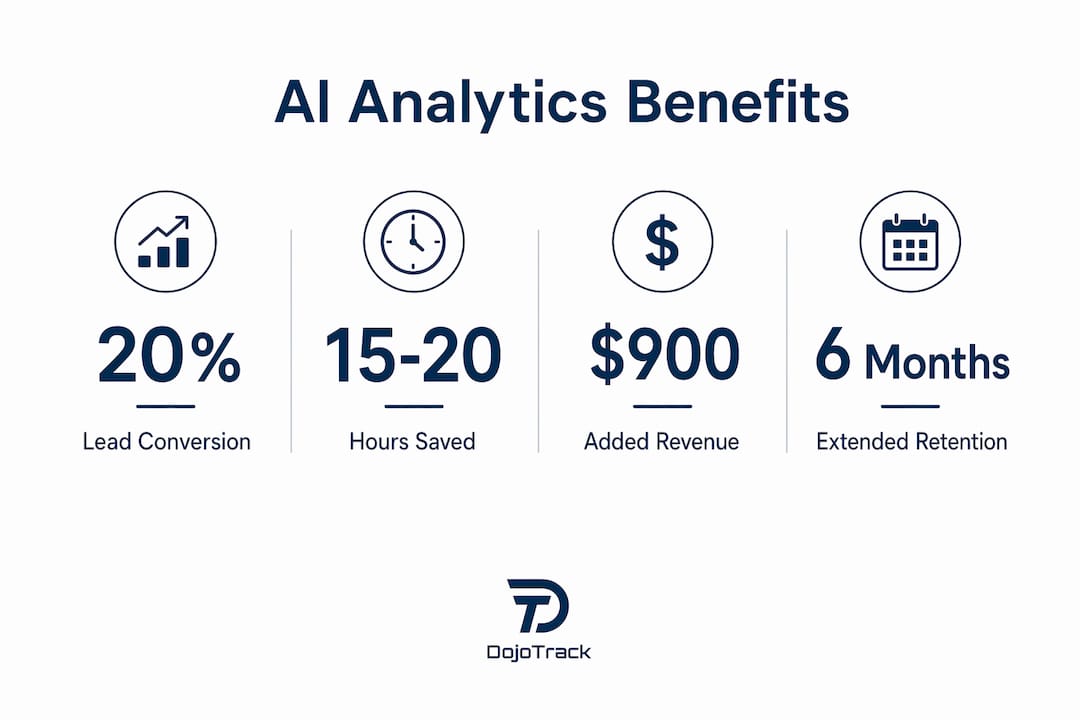
The most striking number comes from lead conversion. Schools using a unified AI command center increased lead conversion rates from 14% to 74% within 60 days of implementation. That is not a marginal improvement. It means five times more prospects becoming paying students from the same lead volume, with no increase in marketing spend.
| Metric | Before AI | After AI |
|---|---|---|
| Lead conversion rate | 14% | 74% |
| Scheduling accuracy | Baseline | +68.5% |
| Retention and progression forecasting | Baseline | +33.1% |
| Weekly admin time saved | 0 hours | 15–20 hours |
Retention and belt progression forecasting accuracy improves by 33.1% when AI predictive models replace manual observation. That improvement translates directly into fewer students dropping out and more students reaching higher belt levels, which increases their lifetime value to your school.
“The schools winning right now are not the ones with the best marketing budget. They are the ones who know exactly which students are at risk and reach out before those students ever think about quitting.” — Go2Karate, Mission Control
Automating administrative tasks saves owners 15–20 hours per week. That is two full workdays returned to you every week. Most owners reinvest that time in teaching, curriculum development, and student relationships, which are the things that actually build a school’s reputation.
The student lifetime value impact compounds over time. A student retained for an extra six months at $150 per month is $900 in revenue that would have walked out the door. Multiply that across 10 at-risk students per year and you are looking at $9,000 in recovered revenue from retention alerts alone.
How do AI analytics platforms for karate schools compare?
The AI-powered martial arts management software category has grown quickly. Not every platform delivers the same depth of analytics, and choosing the wrong tool can create more work, not less.
| Platform | AI Retention Alerts | Scheduling Automation | Belt Tracking | Billing Integration | Built for Martial Arts |
|---|---|---|---|---|---|
| Dojotrack | Yes | Yes | Yes | Stripe-powered | Yes |
| OnMat | Yes | Partial | Yes | Yes | Yes |
| Generic fitness apps | No | Basic | No | Yes | No |
The features that matter most for karate school growth are retention alerts, scheduling automation, and a unified dashboard that connects all your data. A martial arts-specific CRM outperforms generic fitness software because it is built around belt progressions, family accounts, and attendance patterns specific to martial arts schools.
Key considerations when evaluating platforms:
- Unified data. The biggest mistake school owners make is using multiple disconnected AI tools. Disconnected platforms increase workload rather than reduce it. One platform that handles scheduling, billing, retention, and reporting is always more effective than three tools that do not talk to each other.
- Retention alert specificity. Look for platforms that flag softening attendance, not just full absences. By the time a student stops showing up entirely, the retention window is often closed.
- Belt and curriculum integration. Generic software does not understand belt testing cycles. Platforms built for martial arts connect attendance data to promotion readiness automatically.
- School size fit. Dojotrack is built to scale from small single-location schools to multi-location academies, with pricing and features that match where you are now and where you are going.
The AI impact on martial arts is most visible in schools that commit to one integrated platform rather than layering tools on top of each other.
Key takeaways
AI analytics drives karate school growth by unifying retention, scheduling, and training data into one system that turns daily operations into measurable, repeatable results.
| Point | Details |
|---|---|
| Retention alerts save memberships | AI flags softening attendance weeks before students quit, giving you time to intervene. |
| Scheduling accuracy jumps 68.5% | AI scheduling fills classes more efficiently and reduces wasted capacity. |
| Lead conversion can reach 74% | Unified AI command centers have taken conversion rates from 14% to 74% in 60 days. |
| Admin time drops by 15–20 hours weekly | Automation frees owners to teach and build relationships instead of managing paperwork. |
| Unified platforms outperform tool stacks | One integrated system delivers better data and less overhead than multiple disconnected tools. |
What we have learned running schools on AI data
Here at Dojotrack, we have seen one pattern repeat itself more than any other: school owners who adopt AI analytics but spread their data across three or four tools end up more frustrated than before. They have more dashboards to check, more logins to manage, and no single source of truth. The technology that was supposed to help them becomes another administrative burden.
The owners who see real growth are the ones who commit to a single platform and actually use the retention alerts. Not every week. Every day. A student who missed two classes in a row is not a crisis yet. But if your system is not telling you about it, you will find out when they cancel.
We also want to push back on one common misconception: AI does not replace the relationship between an instructor and a student. It makes that relationship more informed. When you know a student has been attending less frequently, you can walk up to them after class and ask how things are going. That conversation is still yours to have. The AI just makes sure you have it at the right time.
The schools that grow fastest are not the ones with the most technology. They are the ones who use the right technology to protect the human connections that make martial arts worth practicing. That is the balance Dojotrack was built to support.
— Dojotrack
See how Dojotrack puts AI analytics to work for your school
Dojotrack is the AI-powered martial arts software built specifically for karate schools, MMA gyms, Taekwondo academies, and Jiu Jitsu schools across the United States. The platform connects retention alerts, automated scheduling, belt tracking, Stripe-powered billing, and a student mobile app into one unified system. You get a real-time view of your school’s performance without logging into five different tools. If you want to see what 15–20 hours of recovered time per week looks like for your specific school, use Dojotrack’s lifetime value calculator to measure the revenue impact before you commit to anything.
FAQ
What is the role of AI analytics in karate school growth?
AI analytics drives karate school growth by automating retention alerts, scheduling, and lead follow-up so owners can act on data instead of guessing. Schools using unified AI platforms have reported lead conversion rates jumping from 14% to 74% within 60 days.
How does AI improve student retention in martial arts schools?
AI monitors attendance patterns and flags students showing early signs of disengagement before they cancel. Platforms like OnMat and Dojotrack use these alerts to prompt timely outreach, which research shows significantly reduces churn.
How much time can AI analytics save a karate school owner?
Integrating AI analytics saves owners 15–20 hours per week by automating scheduling, attendance tracking, and student follow-ups. That time is typically reinvested in teaching and student development.
Can AI replace a karate instructor’s judgment?
AI measures technique and tracks data objectively, but it does not replace an instructor’s tactical knowledge, timing cues, or mentorship. The most effective approach combines AI data with instructor expertise rather than substituting one for the other.
What should karate school owners look for in an AI analytics platform?
Look for a platform that unifies retention alerts, scheduling, billing, and belt tracking in one system. Disconnected tools increase administrative work rather than reducing it, so a single integrated platform built specifically for martial arts delivers the best results.