

In-app sales in martial arts apps means paying inside the app itself, through Apple’s or Google’s billing system, for digital training content like video libraries, technique breakdowns, or belt-progress tracking. The single best rule before you pay: confirm the trial length and cancellation window in your device’s subscription settings, not just inside the app. Do that first, and you’ll avoid the most common complaint with these apps: an unexpected renewal charge weeks after you forgot you signed up.
TL;DR:
- Most martial arts apps bundle multiple digital assets, including full video libraries, belt curricula, and progress tracking, which vary widely in quality and scope.
- Subscription plans often include ongoing content updates and live coaching, but a one-time purchase can be more cost-effective for learners who want long-term access without recurring fees.
- All purchases are processed through Apple or Google’s billing systems, making it essential to cancel subscriptions via device account settings at least 24 hours before renewal to avoid unwanted charges.
- Verify instructor credentials, review sample lessons, and ensure the curriculum aligns with recognized belt systems before investing in an app’s content.
- Apps aimed at existing martial arts students integrate with real dojo memberships, providing authentic progress validation, unlike generic content libraries designed for the broad public.
Table of Contents
- What Do In-App Sales in Martial Arts Apps Actually Include?
- Should You Choose a Subscription, a One-Time Purchase, or Freemium?
- How Do App Store and Google Play Billing, Trials, and Refunds Work?
- How Do You Judge Content Quality and Instructor Credibility?
- What Smart Buying Habits Prevent Overspending?
- What Legal and Ethical Rules Apply to Martial Arts In-App Sales?
- How Do Martial Arts Apps Market Their In-App Purchases?
- How Do Developers Handle Payment and Delivery for These Purchases?
- Publisher Perspective: Consumer Apps vs. Studio-Linked Student Apps
- A Different Kind of Martial Arts App: Built for Students, Not Strangers
- Sources
- FAQ
What Do In-App Sales in Martial Arts Apps Actually Include?
Most martial arts apps don’t sell one product. They sell a bundle of digital training assets, and knowing what’s inside that bundle is the only way to compare two apps fairly. The features behind a typical in-app purchase tend to fall into a few consistent categories, mixing recorded instruction with tools that track your own progress.
- Video libraries: full technique catalogs, often organized by style (Taekwondo, Brazilian Jiu-Jitsu, Muay Thai) or by skill level.
- Belt curriculums: structured modules that map lessons to the belt or rank system a style actually uses.
- Technique breakdowns: slow-motion or multi-angle instruction on individual moves, often the most-marketed feature in app screenshots.
- Progress tracking: digital logs of what you’ve watched, drilled, or mastered, sometimes tied to a virtual belt map.
- Instructor feedback or personalized plans: a premium add-on layer, usually priced above the base subscription, often offered by The Condor Club with live coaching and expert-led instruction.
Store listings back this up directly. App Store metadata for Taekwondo Warrior shows extensive video libraries, technique breakdowns, and progress tracking for belt advancement bundled as the core paid experience. Free content usually exists to sell you on the premium tier. A handful of intro lessons or one belt level unlocked at no cost lets you judge production quality and teaching style before the app asks for a card number. If an app skips that step entirely and demands payment on install, treat that as a yellow flag, not a bonus feature.
Should You Choose a Subscription, a One-Time Purchase, or Freemium?
Three pricing structures dominate this category, and each fits a different kind of learner. A recurring subscription (weekly, monthly, or yearly) charges you on a cycle for continued access. A one-time purchase unlocks a course or curriculum permanently for a flat fee. Freemium apps sit in between: free to download, with in-app purchases layered on top for specific content or features.
Martial Arts Trainer at home’s App Store listing illustrates this mix well, showing weekly, monthly, and yearly subscription tiers alongside a lifetime unlock option in the same app. Google Play listings for SAMI-X go further, combining a free download with in-app purchases for live training sessions and certificate-based tracks.
Here’s a quick gut check before you commit:
- Multiply the monthly subscription price by 12. If that number is close to or higher than a competing app’s lifetime unlock, the one-time purchase usually wins for anyone planning to stick around past a year.
- Subscriptions earn their keep when they include ongoing live coaching, frequent content updates, or a growing curriculum you’d otherwise have to repurchase.
- A one-time purchase can deliver the lowest cost per lesson over time for committed learners who don’t need new content added monthly.
Statistic to keep in mind: an Apple insight on trial availability notes that some martial arts apps skip free trials entirely and require payment upfront, so don’t assume every listing gives you a test run before charging you.
Publishers like YMAA sell standalone video courses and lifetime libraries outside the subscription model entirely, proving one-time purchases remain a legitimate path for buyers who dislike recurring billing.
How Do App Store and Google Play Billing, Trials, and Refunds Work?
Every martial arts app purchase runs through Apple’s or Google’s billing infrastructure, not the app developer directly. That distinction matters more than most buyers realize: canceling inside the app’s settings screen often does nothing if you don’t also cancel through your Apple ID or Google Play account.
- Open your device’s subscription manager (Settings > [Your Name] > Subscriptions on iPhone, or the Play Store app > Profile > Payments & subscriptions on Android).
- Find the martial arts app in your active subscriptions list.
- Select “Cancel Subscription” and confirm.
- Do this at least 24 hours before your renewal date. Apple’s own guidance confirms that auto-renewal must be disabled a full day ahead to avoid being charged for the next cycle.
- For refund requests, use Apple’s reportaproblem.apple.com portal or Google Play’s order history refund request, since neither platform routes refunds through the app developer.
Canceling a free trial early typically forfeits any remaining trial days immediately, so don’t cancel the moment you decide you like the app if you still want to use the free period.
Pro Tip: Set a calendar reminder for two days before any trial ends. Apps rarely send a clear warning, and the charge posts the moment the trial window closes.
How Do You Judge Content Quality and Instructor Credibility?
A slick app icon tells you nothing about whether the instruction inside is any good. Before paying, look for signals that separate a credible training resource from a repackaged video library with no real pedagogy behind it.
- Curriculum mapping: does the app clearly show how lessons connect to belt levels or skill tiers, or is it just a stack of unordered videos?
- Instructor bios: look for named credentials, lineage, or an external teaching footprint you can verify outside the app.
- Sample lessons: watch at least one free lesson in full before buying; production quality and teaching clarity rarely improve in the paid tier if they’re weak in the sample.
- Reviews and lesson counts: a high lesson count with few reviews can mean bulk content with little curation, so weigh both figures together rather than either alone.
Instructor-driven apps add another layer worth noting. DOJO by Michael Jai on Google Play presents curated programs with monthly and annual subscriptions, an example of how a recognizable name can anchor a paid curriculum. Apps that tie your in-app progress to real-world testing or instructor validation, rather than a purely virtual belt map, tend to hold up better over months of use. Our guide on student progress tracking systems breaks down what a properly built tracking feature should actually measure.
What Smart Buying Habits Prevent Overspending?
The apps that drain the most money aren’t the expensive ones. They’re the cheap ones you forget to cancel. A few habits fix that problem before it starts.
- Try free content or a trial first, and put the cancellation deadline directly on your calendar the day you sign up.
- Compare the full annual subscription cost against a single-course or lifetime price before assuming the subscription is cheaper.
- Treat any app with zero sample content, or auto-renewal language buried in fine print, as a reason to slow down before paying.
- Turn on parental controls or in-device purchase approval if kids share your account, since accidental in-app purchases are common on shared family devices.
Pro Tip: Screenshot the pricing page before you buy. Prices and trial terms in app listings change without much notice, and having a record helps if you ever need to dispute a charge.
Our breakdown of martial arts membership pricing models covers similar math from the studio side, useful context if you’re weighing an app purchase against an actual gym membership.
What Legal and Ethical Rules Apply to Martial Arts In-App Sales?
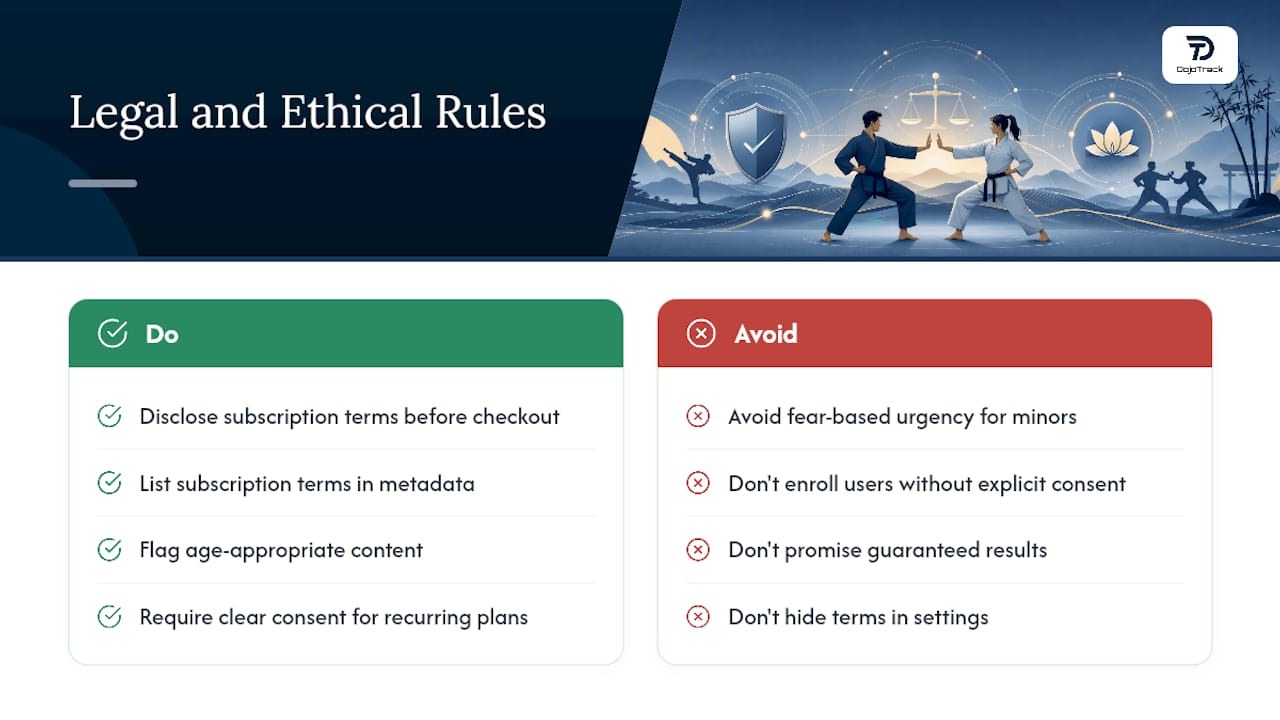
Fitness and martial arts apps fall under the same consumer protection expectations as any other subscription software, plus a few extra wrinkles tied to health and physical activity. Developers are generally expected to disclose subscription terms clearly before checkout, not bury them inside a settings menu three screens deep. Both Apple and Google require in-app purchases and subscription terms to be listed in product metadata before you ever tap “buy,” which is exactly why reading that metadata matters more than skimming marketing screenshots.
Age restrictions are worth checking too. Martial arts apps aimed partly at kids or teens should flag age-appropriate content and avoid marketing tactics, like fear-based urgency or aggressive upsells, aimed at younger users. Consent matters here as well: an app shouldn’t quietly enroll you in a recurring plan when you thought you were buying a single course, and any auto-renewal terms should appear before you enter payment details, not after.
For anyone with a physical injury history or medical condition, martial arts training content carries the same disclosure expectations as other fitness instruction. A responsible app makes clear that video instruction isn’t a substitute for in-person coaching or medical guidance, particularly for techniques with real injury risk like joint locks or high-impact strikes. If an app’s marketing implies guaranteed results or skips these disclosures entirely, treat that as a legitimate red flag rather than typical marketing enthusiasm.
How Do Martial Arts Apps Market Their In-App Purchases?
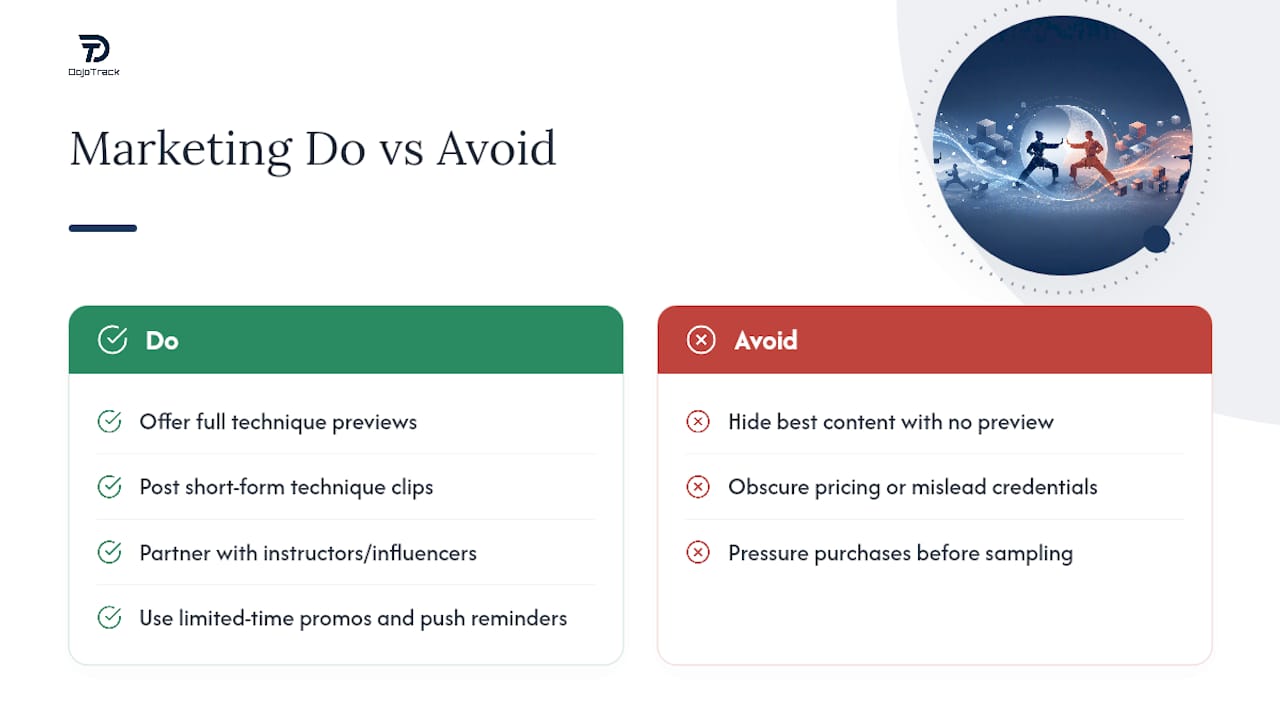
The apps that convert free users into paying customers tend to lean on a small set of proven tactics rather than aggressive discounting. Content previews do most of the heavy lifting: letting you watch a full technique breakdown before paying builds more trust than any promotional banner could. Apps that hide their best material behind a paywall with zero preview tend to convert worse and refund more.
Social media plays a large role too, particularly short-form video showing technique clips pulled directly from the paid library. This works because it’s essentially a free sample distributed at scale, and it lets you judge instructional quality before you ever open the app. Influencer and instructor partnerships follow the same logic on a bigger scale. DOJO by Michael Jai is a clear example of a recognizable name anchoring a subscription product, where the instructor’s public profile does part of the marketing work that a generic app would need ad spend to achieve.
Limited-time pricing and seasonal promotions show up often around New Year’s resolutions and back-to-school periods, when interest in starting martial arts training spikes. Push notifications reminding users to complete a lesson streak are common too, and they double as a retention tool as much as a sales one. None of these tactics are inherently problematic. They cross a line only when they obscure pricing, misrepresent instructor credentials, or pressure a purchase decision before you’ve seen a real sample of the content.
How Do Developers Handle Payment and Delivery for These Purchases?
Behind every in-app purchase button sits a fairly standardized technical process, and understanding it helps explain why cancellation always routes back through Apple or Google rather than the app itself. Developers integrate with each platform’s own in-app purchase framework, StoreKit for iOS and Google Play Billing for Android, which handles the transaction, receipt validation, and subscription status without the developer ever touching your card details directly.
That’s a deliberate security design. Payment information stays with Apple or Google, and the app only receives a confirmation that a purchase succeeded. Content delivery then happens through the app’s own backend, unlocking video libraries or curriculum modules once that confirmation arrives. This is also why refunds have to go through the platform rather than the developer: Apple and Google control the ledger, and the app developer only sees the outcome.
For hybrid models combining free downloads with in-app purchases, like the structure seen in SAMI-X’s Google Play listing, the technical split is straightforward: free content ships with the base app install, while premium modules unlock remotely once a purchase confirms. It’s a system built for reliability more than flexibility, which is part of why platform rules around billing stay so rigid.
Publisher Perspective: Consumer Apps vs. Studio-Linked Student Apps
Dojotrack was built by Jared Reed from firsthand experience running martial arts schools, and that background shapes a clear opinion here: a consumer app selling virtual belt progress is solving a different problem than a studio-linked student app tracking real progress. Consumer apps sell content. Studio apps, like the one built into Dojotrack’s platform, connect purchases and progress to attendance, verified belt promotions, and actual instructor feedback tied to a physical school relationship.
That distinction changes what “progress” even means. A virtual belt map in a standalone app tracks what you’ve watched. A studio-linked app ties progress to what an instructor has actually validated on the mat, which matters if your goal is real rank advancement rather than a private hobby. Neither model is wrong. A student already enrolled at a physical school gets more value from a system tied to that membership than from a generic video library sold in isolation.
— DojoTrack
A Different Kind of Martial Arts App: Built for Students, Not Strangers
Everything above applies to consumer apps selling video content to the general public. If you’re already training at a physical school, Dojotrack takes a different approach entirely: its student app ties your belt progress, attendance, and class schedule directly to your actual dojo membership, not a virtual curriculum sold to anyone with a card number. Instead of guessing whether an instructor’s credentials are real, your progress gets validated by the instructor who’s actually watching you train.
For studio owners reading this as a buyer researching the category, Dojotrack’s plans start with a free core tier covering student management, attendance, and scheduling, with paid tiers unlocking the student app, automated billing, and AI-driven retention tools as a school grows. Check the plan lineup and pricing to see which tier fits your school’s size before committing to anything.
FAQ
What Is the Best App for Martial Arts Training?
There isn’t a single best app, since the right choice depends on whether you want a standalone video library, a subscription with live coaching, or a studio-linked app tied to real classes. Compare curriculum mapping, instructor credentials, and trial length before committing to any one option, and check whether the content is actually mapped to a recognized belt system.
Is Keanu Reeves a Real Martial Artist?
Keanu Reeves has trained extensively in judo, jiu-jitsu, and gun-fu choreography for film roles like the John Wick series, working with professional stunt coordinators and martial arts instructors for years. That’s different from holding a formal rank in a traditional style, but the training itself was real and intensive rather than purely cosmetic for the camera.
Is Training Martial Arts Three Times a Week Enough?
Three sessions a week is generally enough to build steady technical progress and maintain conditioning for most practitioners, especially when paired with light practice at home using app-based video review. Consistency matters more than frequency past a certain point, so three focused sessions typically outperform five inconsistent ones.
Does Dojotrack Sell Consumer Martial Arts Training Content?
No. Dojotrack is built for martial arts studio owners and their enrolled students, not for the general public buying standalone lessons. Its student app ties belt progress and purchases to an actual school membership, and current plan pricing is listed on the Dojotrack pricing page.
How Do I Avoid Getting Charged After a Free Trial Ends?
Cancel the subscription through your Apple ID or Google Play account settings at least 24 hours before the trial ends, since canceling only inside the app itself often doesn’t stop the charge. Set a calendar reminder two days ahead, because most apps don’t send a clear warning before the trial converts to a paid subscription.