

Starting a martial arts school without a customer relationship management (CRM) system is like opening a dojo without a training schedule. You can survive the first few weeks, but the cracks appear fast. A CRM gives your new studio one organized home for billing, attendance, student records, and communication, so you spend your time on the mat instead of buried in paperwork.
Here’s what a CRM handles from the moment you open your doors:
- Automated recurring billing so membership fees collect themselves and missed payments trigger reminders without you making an awkward phone call
- Digital rank progression tracking that flags students eligible for belt testing based on real criteria like classes attended and time at current rank
- Centralized student profiles storing waivers, attendance history, payment records, and communication logs in one place
- Targeted messaging that reaches the right students and parents without you managing a group text thread at 10 PM
- Lead follow-up automation that contacts new prospects immediately, before their interest fades
Starting with a CRM also prevents the data migration headache that hits every dojo that waits too long. Moving student records, billing history, and attendance logs from scattered spreadsheets into a new system is time-consuming and error-prone. Building on a solid foundation from day one means you never have to.
What happens when new dojos skip a CRM
The early days of running a dojo feel manageable with a spreadsheet and a notebook. Then enrollment grows, and those manual systems start working against you.
Common pain points include:
- Lost paperwork: Physical waivers get misplaced, and finding a student’s emergency contact becomes a frustrating search through filing cabinets
- Revenue leakage: Manual billing means missed payments slip through, and uncollected fees add up to thousands of dollars over a year
- Inconsistent attendance records: Without a dedicated system, tracking who showed up and who has been absent for two weeks relies on memory
- Fragmented communication: Important announcements buried in group chats get missed, and using a personal phone for parent questions blurs the line between work and personal life
- Belt tracking guesswork: Deciding who is ready to test based on gut feeling rather than data leads to students feeling overlooked, which drives them to quit
A CRM acts as a single source of truth that eliminates these manual errors. Every student record, payment, and conversation lives in one place, accessible from any device.
How Dojotrack addresses the unique needs of a new studio

Generic fitness software handles gym check-ins. A martial arts-specific CRM handles everything a dojo actually needs, from belt promotions to family discounts to sign-in kiosks.
Dojotrack was built by Jared Reed, a martial arts veteran from Utah who experienced these operational frustrations firsthand. The platform reflects what studio owners actually need at startup, not what a generic software company guessed they might want.
Key features that matter most for new dojos:
- Stripe-powered recurring billing that stabilizes cash flow by automating membership collection and reducing missed payments
- Digital rank progression with automated criteria, so the system tells you exactly who qualifies to test based on requirements like 30 classes attended and 3 months at current rank
- AI-driven retention alerts that flag students whose attendance is dropping before they disappear entirely
- Automated SMS and email reminders that reduce no-show rates for trial classes and keep prospects engaged
- Student mobile app for tracking belt curriculum, viewing schedules, and receiving push notifications outside the dojo
| Feature Category | Operational Benefit for New Dojos |
|---|---|
| Recurring billing automation | Eliminates manual invoicing and reduces missed payments |
| Digital rank progression | Removes guesswork from belt testing eligibility |
| Attendance tracking | Identifies at-risk students before they drop out |
| Centralized student profiles | Stores waivers, history, and notes in one searchable place |
| Automated messaging | Delivers targeted announcements without personal phone use |
| Lead scoring and SMS follow-up | Speeds up prospect contact to improve conversion rates |
Dojotrack also offers a free core software layer, giving new studios access to student management, attendance tracking, scheduling, and digital waivers without upfront cost.
How a CRM protects you from burnout and supports growth
The primary source of owner burnout is the shift from teaching to business management. You opened a dojo to train students, not to chase late payments and sort through paper waivers every evening.
Automation removes the emotional drain of manual follow-up. Most sales require multiple follow-ups, and manually texting prospects who aren’t responding is exhausting. A CRM runs those workflows automatically, keeping your studio in front of leads without you lifting a finger. Contacting a lead within 5 minutes makes conversion 21 times more likely than waiting 30 minutes, and no manual system can hit that window consistently.
When billing runs itself and communication goes out on schedule, you get your evenings back. That time goes toward better instruction, stronger student relationships, and the kind of community that keeps people training for years.
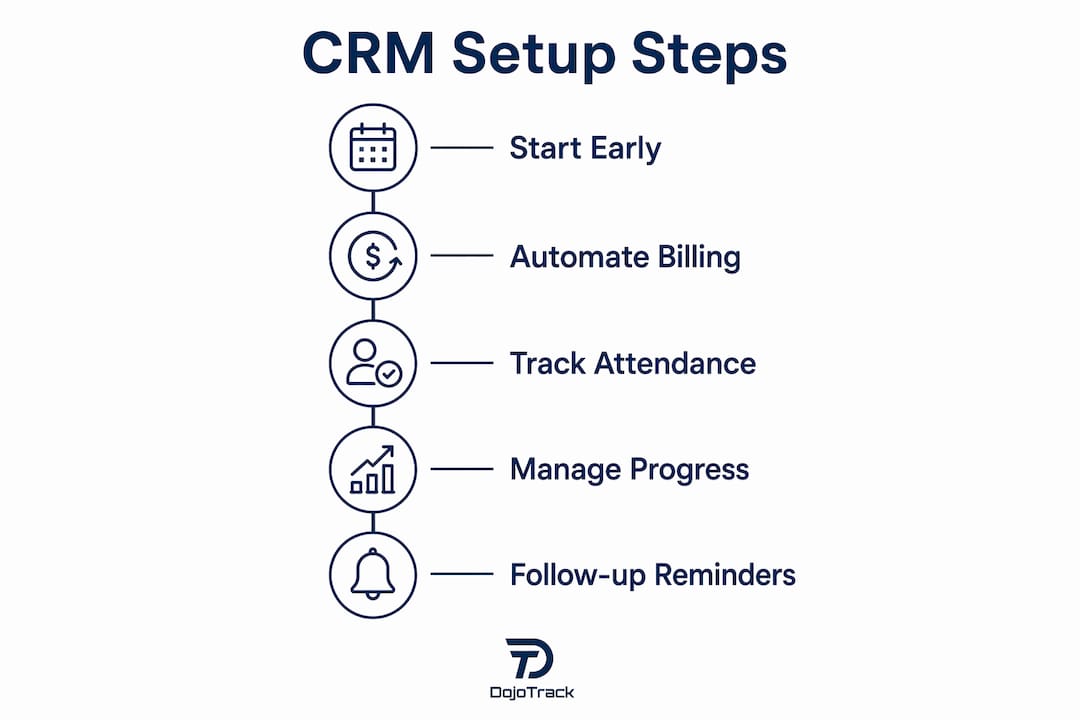
How to set up your CRM the right way from the start
- Launch your CRM before your first student enrolls. Entering data into a system from day one is far easier than migrating records after six months of growth. Start clean.
- Activate core features first. Set up billing, attendance tracking, rank progression, and messaging before exploring advanced analytics. Complexity overload kills adoption.
- Train staff by role. Front desk staff need to know check-in and payment workflows. Instructors need attendance and rank tracking. Owners need reporting. Role-specific training builds confidence faster than a single all-hands session.
- Connect your CRM to existing tools. If you’re running ads on Facebook or Google, link those lead sources directly to your CRM so every inquiry lands in one place automatically.
- Address resistance early. Staff who are used to spreadsheets may push back. Show them specifically how the CRM removes tasks they already dislike, like manual payment reminders or searching for student records.
- Plan for staged feature rollout. Add advanced automation and AI insights after your team is comfortable with the basics. Trying to use every feature at once leads to inconsistent usage.
Pro Tip: Set up automated SMS reminders for trial class bookings before you open. Reducing no-shows from your very first week protects early revenue and builds the habit of using your CRM consistently.
What early CRM adoption looks like in practice
A Taekwondo academy opening with 30 students and no CRM typically hits a wall around 80 to 100 members. At that point, the owner is managing billing manually, tracking belt eligibility in a spreadsheet, and answering parent questions on a personal phone. Growth stalls because the administrative load becomes unmanageable.
The same studio opening with Dojotrack from day one builds differently. Billing runs automatically through Stripe. The system flags students eligible for their next rank without anyone checking a spreadsheet. When a new lead submits a form, an automated SMS goes out within minutes. By the time the studio reaches 100 students, the owner is still spending most of their time teaching because the system handles the rest.
An MMA gym that starts with automated attendance tracking also gains an early warning system for retention. When a student’s attendance drops, the CRM flags it. The instructor reaches out before that student cancels, which is a conversation that almost never happens in a manual system.
How to choose the right CRM for your new dojo
Not every CRM fits a martial arts school. Generic platforms built for retail or service businesses lack belt tracking, rank progression, and attendance-based retention tools. The right system for a new dojo meets a specific set of criteria.
- Martial arts-specific features: Look for automated belt promotions, rank eligibility tracking, and attendance monitoring built into the platform, not bolted on as workarounds
- Billing automation: Recurring membership collection with automatic payment failure reminders is non-optional for cash flow stability
- Lead management: Automated SMS follow-up and lead scoring keep your prospect pipeline moving without manual effort
- Scalability: The system should handle 50 students and 500 without requiring a platform switch. Switching CRMs mid-growth is disruptive and expensive
- Ease of use: A platform your staff won’t actually use is worthless. Prioritize clean interfaces and role-appropriate workflows
- Free entry point: Starting with a free core tier, as Dojotrack offers, lets you build habits and processes before committing to paid features
Dojotrack’s CRM selection criteria guide walks through these factors in detail for studio owners evaluating their options in 2026.
Common pitfalls when introducing a CRM early and how to avoid them
Trying to use every feature at once overwhelms your team and leads to inconsistent adoption. Start with billing and attendance, then layer in automation and analytics.
Skipping staff training is the fastest way to end up with a CRM nobody uses. Even a 30-minute walkthrough tailored to each role makes a measurable difference in daily usage.
Failing to connect lead sources means prospects fall through the cracks. If your website form, Facebook ads, and walk-in inquiries don’t feed into your CRM automatically, you’re still managing leads manually.
Underestimating communication setup time is common. Building your messaging templates, automated reminders, and follow-up sequences takes a few hours upfront but saves dozens of hours every month after that.
Choosing a generic platform because it’s familiar creates problems as your dojo grows. A system without martial arts-specific features forces you to build workarounds that break down at scale.
Key Takeaways
A CRM adopted from day one gives new dojos the operational foundation to grow without administrative chaos derailing the teaching mission.
| Point | Details |
|---|---|
| Start before your first student | Entering data from day one prevents the costly migration headache of moving records later. |
| Automate billing immediately | Recurring billing automation eliminates missed payments and removes awkward collection conversations. |
| Use rank criteria, not gut feeling | Automated eligibility tracking based on clear criteria—such as 30 classes attended and 3 months at current rank—keeps promotions fair and students motivated. |
| Speed matters for lead conversion | Contacting a lead quickly after inquiry significantly improves conversion likelihood more than waiting 30 minutes. |
| CRMs reduce owner burnout | Automating follow-ups and admin tasks returns instructors’ time to teaching and student relationships. |
FAQ
Why do new dojos need a CRM from day one?
Starting with a CRM prevents data fragmentation and migration problems that become exponentially harder to fix once a dojo grows. It also builds consistent billing, attendance, and communication habits from the start.
What features should a martial arts CRM include?
A martial arts CRM should include automated recurring billing, digital rank progression tracking, attendance monitoring, lead follow-up automation, and centralized student profiles with waiver storage.
How does a CRM help with student retention?
CRMs flag students with declining attendance before they quit, enabling instructors to reach out proactively. Automated milestone recognition and consistent communication also keep students engaged long-term.
Can a new dojo afford a CRM?
Dojotrack offers a free core software tier that covers student management, attendance tracking, scheduling, and digital waivers, so new studios can start without upfront cost and unlock advanced features as they grow.
Is Dojotrack available for all martial arts styles?
Dojotrack supports martial arts schools, MMA gyms, Taekwondo academies, Jiu Jitsu schools, and other combat sports businesses across the United States.