

TL;DR:
- Effective staff management in martial arts schools involves hiring, training, and coordinating staff to ensure consistent operations and growth. Clear role definitions, standardized processes, and specialized software help create a sustainable culture that reduces burnout and improves long-term success. Utilizing AI-powered management tools streamlines daily tasks, enhances communication, and fosters a cohesive team environment.
Running a martial arts school means wearing a lot of hats, but staff management is the one most owners underestimate. If you’ve ever thought that what is staff management in a martial arts school really boils down to posting a class schedule and calling it done, you’re not alone — and that’s exactly where things start to fall apart. Effective staff management touches every part of your operation: how your instructors perform, how your front desk handles enrollment, how your culture holds together under pressure, and whether your school can grow without depending entirely on you.
Table of Contents
- What staff management means in a martial arts school
- Key roles and responsibilities in martial arts staff management
- Standardizing staff management for consistent martial arts school success
- Practical techniques for effective staff management in your martial arts school
- Choosing the right tools: Martial arts staff management software essentials
- Rethinking martial arts staff management: Beyond scheduling to culture and sustainability
- Streamline your martial arts school’s staff management with DojoTrack
- Frequently asked questions
Key Takeaways
| Point | Details |
|---|---|
| Staff management scope | Effective staff management in martial arts schools includes scheduling, training, operations, and community building. |
| Role clarity importance | Clear staff roles and communication prevent conflicts and ensure smooth school operations. |
| Standardization benefits | Standardized training and processes improve consistency, scalability, and reduce dependency on star personalities. |
| Use management tools | Adopting martial arts-specific software automates routine tasks and enhances efficiency. |
| Build sustainable culture | Long-term success depends on fostering a healthy work culture and avoiding staff burnout. |
What staff management means in a martial arts school
Staff management in a martial arts school is the system you use to hire, train, coordinate, and develop every person who keeps your school running. That includes your lead instructors, assistant coaches, front desk staff, and anyone who interacts with students or prospects. It’s not just scheduling. It’s the entire framework that determines whether your school operates consistently or constantly puts out fires.
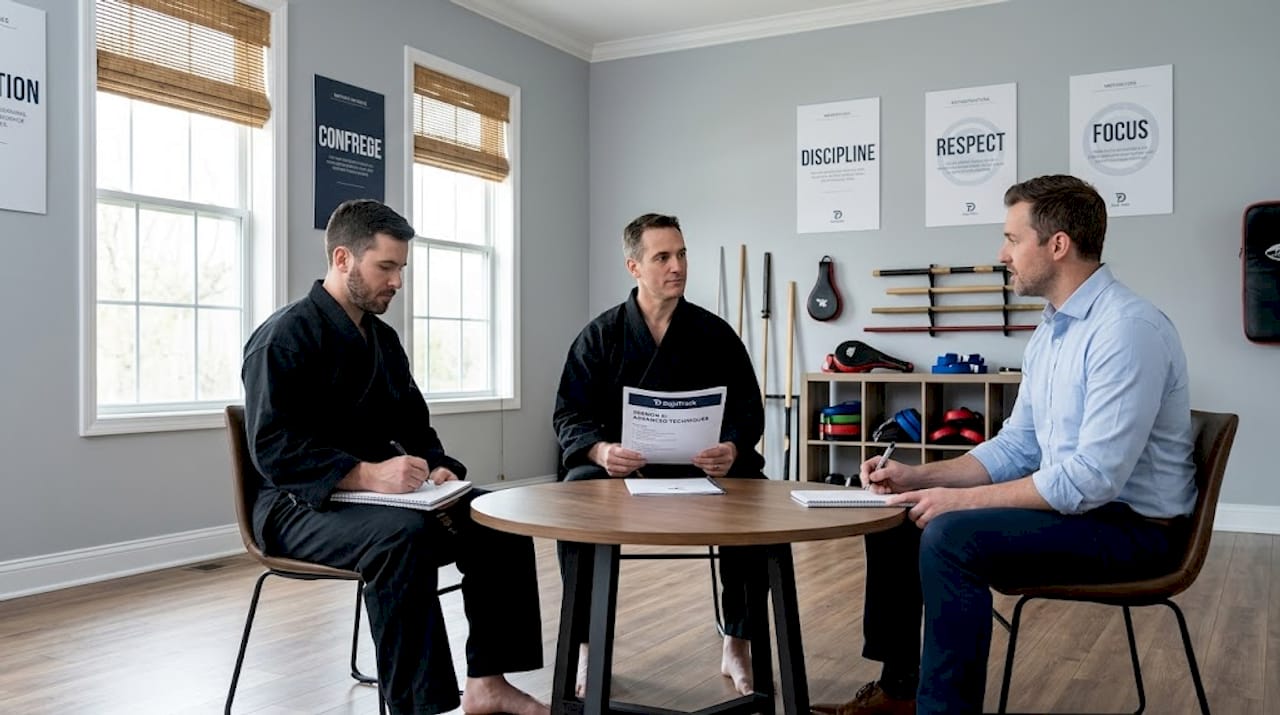
Think about what breaks down when staff management is weak. Classes get taught differently by different instructors. New students get inconsistent information at the front desk. A key instructor quits and suddenly enrollment drops because your school’s quality was tied to one person’s personality. Strong staff management reduces that kind of fragility.
Here’s what effective dojo staff management actually covers:
- Scheduling and coverage — ensuring classes are staffed reliably, substitutions are handled, and no student shows up to a locked door
- Training standards — making sure every instructor delivers curriculum consistently, regardless of their personal style
- Enrollment coordination — aligning front desk staff with your marketing and boosting student retention through proactive communication
- Culture building — setting expectations for how staff treats students, parents, and each other
- Operational accountability — tracking performance, addressing issues early, and recognizing wins
UFC Gym’s structured “Management Institute” trains franchisees on staffing, class delivery, and operational expectations to create consistency across locations. The lesson for independent school owners is the same: systems beat personalities every time.
Now that we understand what staff management entails, let’s explore the specific roles involved.
Key roles and responsibilities in martial arts staff management
One of the most common mistakes in managing staff in dojos is treating every team member as interchangeable. They’re not. Each role serves a distinct function, and when those functions overlap without clear boundaries, things fall through the cracks.
Here’s how staff roles in martial arts schools typically break down:
- Head instructor — leads curriculum delivery, sets technical standards, and models the school’s culture on and off the mat
- Assistant instructors — support head instructors, work with smaller groups, and often help manage student behavior and class flow
- Operations manager or front desk coordinator — the backbone of daily school functioning
- Program director — oversees curriculum development, belt testing schedules, and progression tracking
A Karate School Operations Manager oversees scheduling, enrollments, training programs, marketing, finances, and facility maintenance. That’s a wide scope. If you’re handling all of that yourself, you’re probably familiar with the feeling of having no time to actually teach.
Effective martial arts leadership means building a team where instructors can focus on students because operations are handled elsewhere. Here’s how to establish role clarity:
- Write specific job descriptions for every position, including expectations, reporting structure, and performance metrics
- Hold a staff orientation before each new hire teaches a class or touches enrollment data
- Define decision-making authority so staff knows what they can handle independently versus what needs your sign-off
- Create communication channels that fit each role — instructors need mat-side feedback, front desk staff need enrollment updates
- Review roles quarterly and adjust responsibilities as your school grows
Using martial arts studio software can help formalize this structure. When your scheduling, attendance, and billing all live in one place, roles become clearer because the system holds everyone accountable.
Understanding the roles leads us naturally to how schools standardize processes for quality and growth.
Standardizing staff management for consistent martial arts school success
Here’s the uncomfortable truth most school owners avoid: your school’s quality should not depend on any single person. Not even you. Standardization is how you get there.
When you build documented processes for how classes are taught, how new students are onboarded, and how staff handles conflict or emergencies, you remove the guesswork that creates inconsistency. A new assistant instructor should be able to follow your standards on day one, not figure them out over six months by watching others.
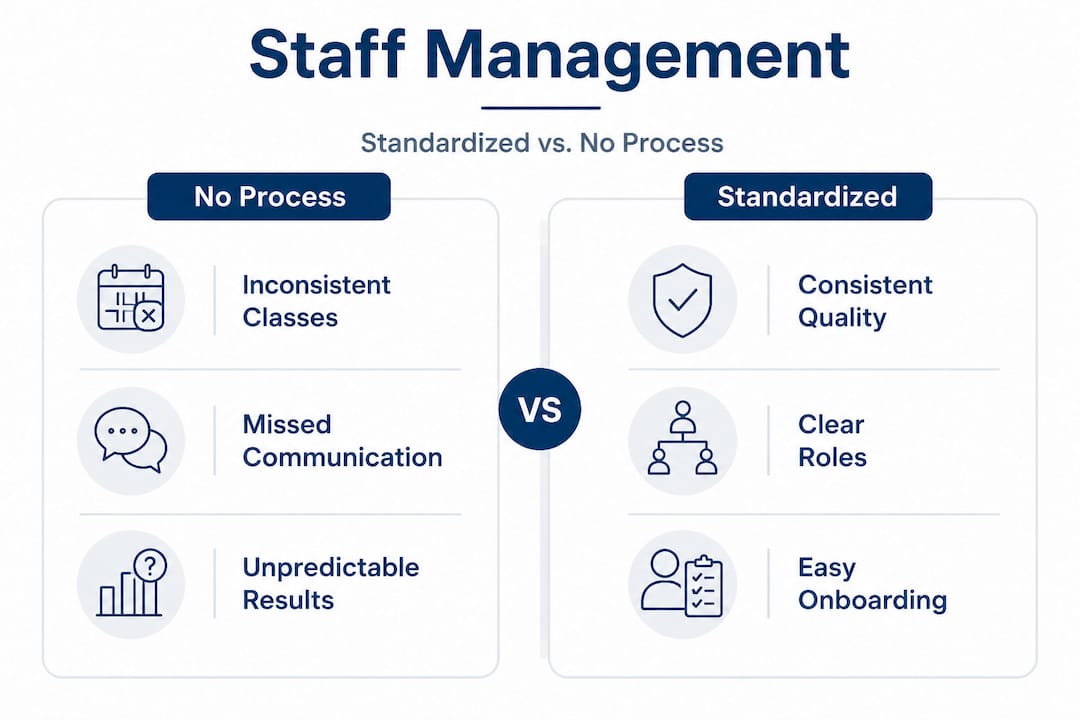
| Approach | Without standardization | With standardization |
|---|---|---|
| Class quality | Varies by instructor | Consistent across staff |
| New hire ramp-up | Weeks of trial and error | Structured onboarding |
| Student experience | Depends on who’s teaching | Predictable and reliable |
| School scalability | Limited to owner’s capacity | Replicable by any trained staff |
| Staff turnover impact | Disruptive, hard to recover | Manageable with documented processes |
UFC Gym’s proven frameworks minimize troubleshooting and maximize time spent on sales and community building. That’s not just a franchise strategy — it’s a principle any school owner can apply. Build your own “playbook” and train every staff member from it.
Pro Tip: Don’t wait until you have five instructors to document your processes. Write down how you run a trial class, handle a late payment, or substitute for a sick instructor. One documented process per week adds up to 52 by year’s end, and that’s the foundation of a scalable school.
Pairing your standards with a martial arts school automation guide can help you figure out which tasks to systematize first. And if local visibility is part of your growth plan, investing in gym SEO services alongside your internal operations work can accelerate new student acquisition.
With standardization in place, let’s discuss practical strategies to manage staff efficiently day-to-day.
Practical techniques for effective staff management in your martial arts school
Knowing what staff management is and actually running it well day-to-day are two different challenges. Let’s close that gap with techniques that work in real school environments.
The martial arts labor market demands certified, specialized instructors and professional operational frameworks to reduce turnover and burnout. This means you can’t just hire someone who can throw a good kick and hope for the best. You need a real people management system.
For scheduling and coordination:
- Use software that shows you staff availability, class capacity, and conflicts in one view
- Build substitute coverage protocols before you need them, not during a 6 a.m. emergency
- Schedule staff meetings at consistent times so communication is predictable, not reactive
For training and development:
- Onboard every new instructor with a formal training period, even experienced ones
- Use video recordings of your best class sessions as training references
- Set clear expectations around athlete development, injury prevention, and age-appropriate coaching
For communication and culture:
- Hold brief weekly check-ins to surface problems before they escalate
- Create a feedback loop where staff can raise concerns without fear of judgment
- Recognize good work publicly, address poor performance privately
Pro Tip: The most overlooked staff management tool is the exit conversation. When a staff member leaves, ask them directly what could have made their experience better. You’ll hear things students and current staff would never tell you, and that information is worth more than any survey.
Explore dojo management software features that handle scheduling and communication in one place. And if you’re not fully using your CRM to track staff-related touchpoints, these martial arts CRM tips will help you get more out of what you already have.
Choosing the right tools: Martial arts staff management software essentials
You can have excellent processes on paper and still struggle if your tools don’t match your workflow. Generic business software was not built for martial arts schools. You end up bending it to fit your needs, wasting time and missing features that would otherwise run automatically.
Here’s what to prioritize when evaluating martial arts-specific management software:
| Feature | Why it matters for staff management |
|---|---|
| Class scheduling with staff assignments | Prevents coverage gaps and double-bookings |
| Attendance tracking | Holds instructors accountable and identifies patterns |
| Integrated payroll or hour logging | Reduces manual errors and saves admin time |
| CRM with staff communication tools | Keeps enrollment and follow-up coordinated |
| AI-driven retention alerts | Flags at-risk students so staff can intervene early |
| Role-based access | Staff sees only what’s relevant to their job |
Beyond features, look for software that reflects how martial arts schools actually operate. Belt promotions, class-specific attendance, family accounts, and event registration are not standard CRM territory. Platforms built for AI and automation in the martial arts space handle these workflows natively, so your staff spends less time on workarounds.
The right software does more than save time. It creates visibility. When your head instructor can see which students missed three classes in a row, or your front desk can check a family’s billing status without interrupting you, that’s your whole team operating more professionally.
Now that you know what tools to look for, let’s explore a fresh perspective on staff management for long-term success.
Rethinking martial arts staff management: Beyond scheduling to culture and sustainability
Most articles about staff management stop at processes and software. That’s important, but it’s not the whole picture. The schools that last for decades are not just well-organized — they’re sustainable. And sustainability starts with culture, not spreadsheets.
Here’s what gets overlooked in conversations about effective martial arts leadership: staff burnout is a management failure, not a personal one. When instructors teach back-to-back classes with no buffer, get pulled into administrative tasks they weren’t hired for, and receive no development feedback, they leave. Then you lose the institutional knowledge they carried, the student relationships they built, and the culture they helped create.
Daniel Ruocco’s long-term legacy in martial arts was built on consistency, discipline, and routine rather than chasing quick competitive wins. That same philosophy applies to how you manage people. Sustainable staff management means investing in your team’s growth over time, not just filling scheduling slots.
The schools we see struggle most are the ones where the owner is also the head instructor, the front desk, and the marketing department. That’s not a staff management system. That’s one person burning out while trying to do everything. Your job as the school owner is to build a team that can deliver your vision even when you’re not in the room.
This also means aligning your operational decisions with your school’s actual values. If you teach discipline and respect on the mat, your staff meetings should reflect those same principles. If you preach student development, your instructors should receive the same kind of structured development from you. The culture you build internally is the culture your students will experience. You can track student retention strategies all you want, but retention starts with a staff team that genuinely cares — and caring is something you model and cultivate deliberately.
Streamline your martial arts school’s staff management with DojoTrack
If you’re ready to move from reactive management to a system that actually works, DojoTrack was built for exactly this. The AI-powered platform handles class scheduling, attendance tracking, billing, and student communication in one place, so your staff spends less time on admin and more time on the mat. Automated lead follow-up, AI-driven retention alerts, and role-based staff access mean your whole team stays coordinated without constant check-ins from you. Explore the full list of software features to see what fits your school’s needs, or use the lifetime value calculator to understand how better retention and staff efficiency can directly affect your revenue.
Frequently asked questions
What does staff management include in a martial arts school?
Staff management covers scheduling, training, program coordination, customer service, and operational tasks to keep the school running smoothly. A Karate School Operations Manager handles scheduling, enrollments, curriculum, marketing, and facility maintenance, illustrating just how broad these responsibilities can be.
Why is standardized staff training important for martial arts schools?
Standardized training reduces dependence on individual personalities, ensures consistent class quality, and supports growth that doesn’t collapse when one person leaves. UFC Gym’s framework trains coaches within a proven system to minimize guesswork and operational delays.
What are common challenges in hiring martial arts instructors?
Most schools struggle to find instructors with both technical martial arts expertise and professional coaching certifications, which increases turnover and burnout risk. The Humble, TX market data shows high demand for certified instructors who understand biomechanical efficiency and athlete development, a challenge most regions share.
How can martial arts management software improve staff coordination?
The right software automates scheduling, tracks attendance, manages billing, and improves communication so your team makes fewer errors and spends less time on manual tasks. DojoTrack’s AI-powered tools are built specifically for martial arts schools, handling staff management alongside student retention and enrollment in one unified platform.
Recommended
- The Ultimate Guide to Martial Arts School Automation: Everything You Need to Succeed in 2025 | DojoTrack
- Stop Losing Students: 5 Steps How to Boost Retention and Revenue (Easy Guide for Martial Arts Schools) | DojoTrack
- Best Martial Arts Studio Software for Small Schools: Features, Benefits, and AI Advantages | DojoTrack
- Martial Arts Management Software vs Generic Fitness Apps | DojoTrack